🐇 🐇 🐇 rabbit rabbit rabbit to bring September in (also to bring in the first fall month in the northern hemisphere) and, this year, to celebrate (US) Labor Day (recognizing the union movement and honoring workers) — so that I bring you (cartoon) rabbits in hard hats:
(#1) Lola and Bugs Bunny, in an HBO Max series from 2023, Bugs Bunny Builders: Hard Hat Time

Which takes me to September cartoons from the New Yorker, beginning with a scene-setting item from 2022:
(#2) David Sipress’s “Get Up, Leonard”, the New Yorker daily cartoon for 9/8/22
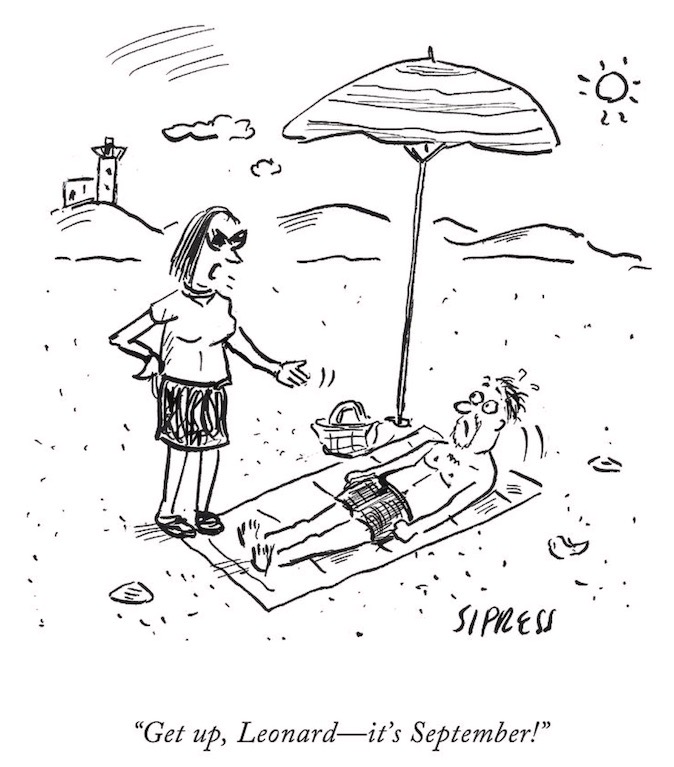
Three cartoons from the New Yorker‘s 9/1&8/25 issue. Two wonderfully goofy cartoons and then one with more of an edge to it.
from Dan Misdea, p. 21:
(#3) The central character is both a guy (identifying his assailant in a police lineup, in part (no doubt) on the basis of the mustard stain on his shirt) and also a hot dog in a bun
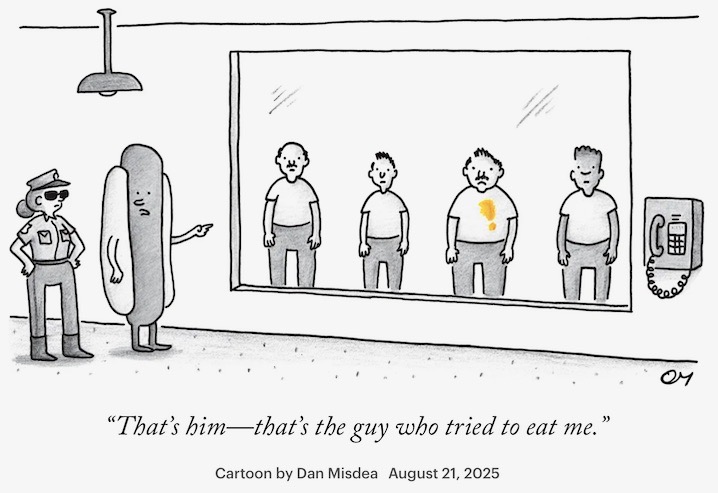
Talking hotdogs are all over popular culture, and so are wursts — sausages / wieners / hot dogs / frankfurters — as phallic symbols (there’s a Page on this blog about my wurst postings). Misdea’s cartoon manages not to stray directly into phallic / fellatial eat me territory, so it’s surprisingly sweet, but of course the raunchy allusion hovers over it.
Some cartooning just dives right in, embracing talking hotdogs that are also horny penis-men; I offer the 2016 American adult computer-animated comedy film Sausage Party, in which the main characters are hot dogs (fighting not to be eaten) that are stand-ins for penises (see my 11/8/16 posting “News for animated penises” about the film).
And see my 10/29/19 posting “Annals of burritio”, about pornographic — fellatial — burrito-eating, with excursions on analogies between eating food and fellating a penis and on the sexual verb eat.
from David Sipress on p. 47:
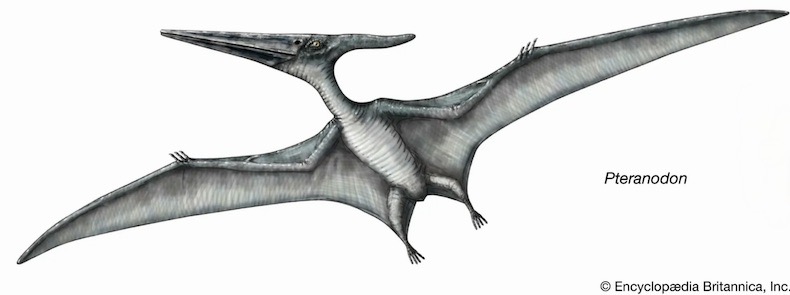
(#4) Nobody expects a gigantic pteranodon — certainly the birding apps don’t (meanwhile, I’ve had a range of experiences with plant-ID apps)

On the pteranodon, from Wikipedia:
(#5) Drawing of a pteranodon (with a wingspan of over 20 feet) — no little tree sparrow, this flying monsterPteranodon (from Ancient Greek: πτερόν, romanized: pteron ‘wing’ and ἀνόδων, anodon ‘toothless’) is a genus of [crested] pterosaur that included some of the largest known flying reptiles, with P. longiceps having a wingspan of over 6 m (20 ft). They lived during the late Cretaceous geological period of North America in present-day Kansas, Nebraska, Wyoming, South Dakota and Alabama. More fossil specimens of Pteranodon have been found than any other pterosaur, with about 1,200 specimens known to science, many of them well preserved with nearly complete skulls and articulated skeletons
And on a birding app, the Merlin Bird ID from the Cornell Lab of Ornithology:
Merlin is designed to be a birding coach for bird watchers at every level. Merlin asks you the same questions that an expert birder would ask to help solve a mystery bird sighting. Notice that date and location are Merlin’s first and most important questions. It takes years of experience in the field to know what species are expected at a given location and date. Merlin shares this knowledge with you based on more than 800 million sightings submitted to eBird from birders around the world.
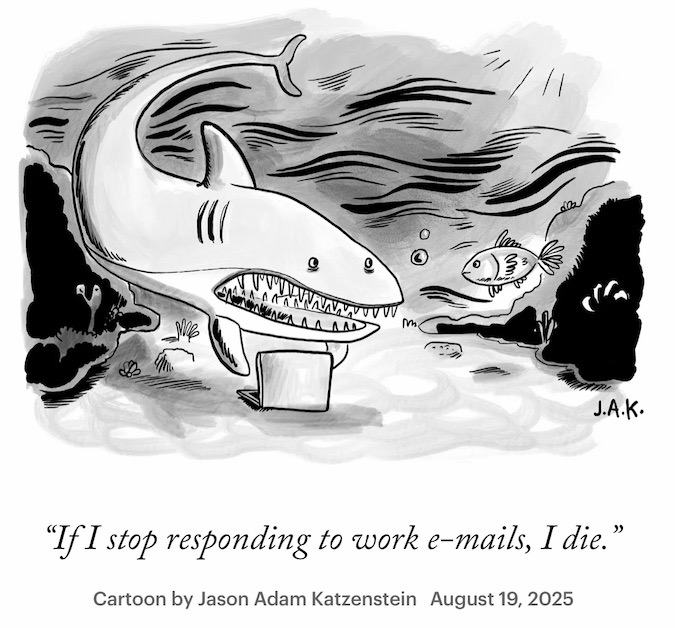
from JAK (Jason Adam Katzenstein), p. 58:
(#6) The cartoon plays on the common lore that if sharks don’t keep moving, they will die (in cartoonland, this is simply the way things are; life is different in cartoonland); JAK’s shark is also an American office worker — an American salaryman — immersed in endless waves of work e-mail, so the cartoon is a poignant jab at corporate life
As for the facts about sharks in the real world, they are — surprise! — complex. From the American Museum of Natural History site, “Myths About Sharks and Rays” from 9/25/19:
Myth #1: Sharks Must Swim Constantly, or They Die: Some sharks must swim constantly in order to keep oxygen-rich water flowing over their gills, but others are able to pass water through their respiratory system by a pumping motion of their pharynx. This allows them to rest on the sea floor and still breathe. However, sharks do have to swim to avoid sinking to the bottom of the water column. The ability to move up and down freely in the water column is, in fact, one of the extraordinary adaptations of sharks.
Meanwhile, I eye my e-mail inbox nervously.
Leave a Reply