Archive for the ‘Linguistics in the comics’ Category
February 9, 2023
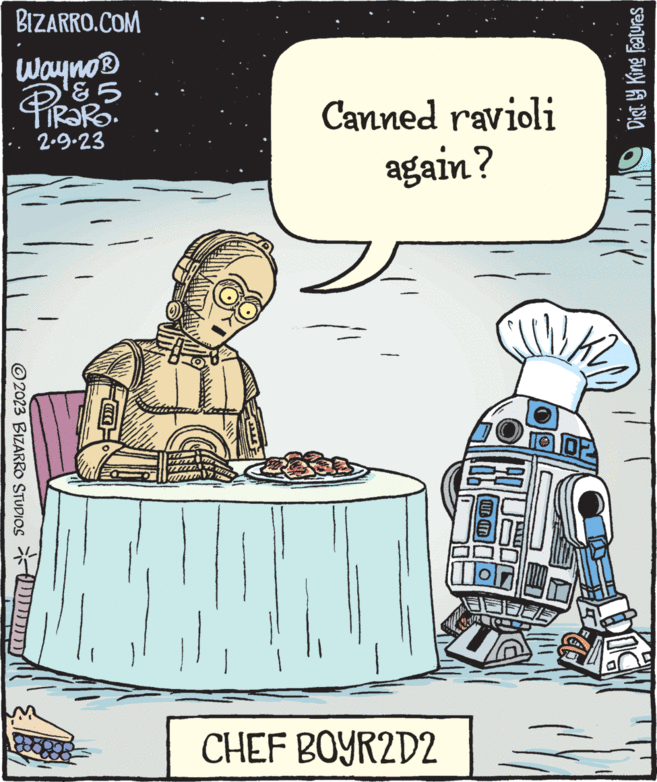
Today’s Wayno / Piraro Bizarro, in which George Lucas tangles with Hector Boiardi in an interleaved portmanteau:

(1) (If you’re puzzled by the odd symbols in the cartoon — Dan Piraro says there are 5 in this strip — see this Page.)
Orthographically, we’ve got Chef Boyardee (a brand of canned ravioli) confronting R2-D2 (a film robot), which don’t join easily to get Chef BoyR2D2. But it’s all in the pronunciation. In transcription, marked off in syllables, with the shared parts underlined:
bòj.ár.tu.dí.tu = bòj.ar.dí + ár.tu.dí.tu
(more…)
Posted in Books, Language and food, Linguistics in the comics, Movies and tv, Portmanteaus | 1 Comment »
February 8, 2023
… on the psychiatrist’s couch, in a 7/12/11 cartoon by Canadian cartoonist (illustrator, graphic novelist, and children’s book author) Dave Whamond:

(#1) A cartoon about cartoon characters (from Calvin and Hobbes by Bill Watterson), with a character reversal — the tiger Hobbes is real, and the boy Calvin is his stuffed toy, though Hobbes fantasizes that the boy is real
(more…)
Posted in Cartoonists, Comic conventions, Etymology, Linguistics in the comics | Leave a Comment »
February 4, 2023
A Mark Anderson Andertoon (brought to my attention by several Facebook posters) with an excellent portmanteau: Narcisyphus = Narcissus + Sisyphus:

(#1) Anderson’s selfie cartoon #7599 (he has a whole series of them); there’s a Page on Andertoons on this blog
Narcissus. Narcissism — usually through reflections, in water or in a mirror, but here through taking a picture of yourself. Sisyphus — a whole cartoon meme here. Not the first time Narcissus and Sisyphus have been joined in a cartoon, but not so elegantly, in a single panel.
(more…)
Posted in Comic conventions, Linguistics in the comics, Myths, Portmanteaus | Leave a Comment »
February 1, 2023
This is about comics superheroes, and the first thing you need to know is that I am not a Superhero Person. Occasionally, something from the comics, from animations, or from the movies comes by me, for one reason or another, but basically I’m an utter outsider who occasionally is moved to glance into this world. If you’re a fan, I respect your enthusiasms, but I don’t share them. Nevertheless, your worlds are a significant element in the popular culture that surrounds me, so I might want to have some awareness of them.
The second thing you need to know is that I’m looking at a report (about the mutant superhero Iceman) from the past — from nearly 7 years ago, in the New York Times on 12/24/15, when I noted it down for posting on, but then never got around to it. Now I wonder what’s happened to Iceman and his kind since then.
The third thing you need to know — which you will already know if you’re a reader of this blog — is that I’m a gay man with a lifetime of activism and of research and writing on the organization of LGBT+ life and the place of LGBT+ people in our culture. Which is why I am now curious about the fictional Iceman and his / our kind.
(more…)
Posted in Gender and sexuality, Linguistics in the comics | 1 Comment »
January 31, 2023
🐅 🐅 🐅 tiger tiger tiger for Ultimate January, as we leave the darkest period of the year in my hemisphere
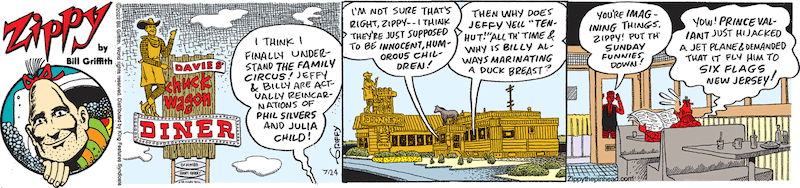
The 7/24/22 Zippy strip:
 (#1)
(#1)
Zippy theorizes that comic-strip characters and their stories are an overlay of characters, personalities, settings, and tales from elsewhere in popular culture — in particular, from television shows. (Just to get some grip on these things in the real world, rather than ZippyWorld: Billy in The Family Circus has never marinated a duck breast.)
(Note: this is a Zippy strip, always liable to veer into surrealism and the injection of Zippreoccupations into things, so that not all the details are going to hang together coherently.)
Zippy offers these theories to Griffy from inside a sort of monument to pop-cultural syncretism, Davies’ Chuck Wagon Diner in Lakewood CO: something that was created as a reproduction of East Coast diner culture, but got crossed with the symbols of mythical cowboy culture, in the shape of a gigantic neon cowboy and a life-sized fiberglass horse. Located not in the dusty high plains of cowboy country, but on a commercial strip in a thoroughly built-up suburb of Denver. (I grant that you can at least see the Front Range of the Rocky Mountains from there.)
(more…)
Posted in Diners, Language and food, Linguistics in the comics, Movies and tv, Pop culture | 1 Comment »
January 30, 2023
Today’s Wayno / Piraro Bizarro plunges us into a double play on words, plus a visual parody — offered on a platter — as well:

(#1) To understand the cartoon, you need to know about kosher delis (deli, short for delicatessen), and pastrami as a prominent offering in them; and about Salvador Dalí and his surrealist painting The Persistence of Memory (If you’re puzzled by the odd symbols in the cartoon — Dan Piraro says there are 4 in this strip — see this Page.)
The egregious pun kosher deli > kosher Dalí in combination with a play on the title of a Dalí painting Persistence of Memory > Persistence of Pastrami (with a visual parody on the painting itself, offered on a platter by the waiter; hence, Wayno’s title, “Culinary Surrealism”).
Dalí’s name is most commonly Englished as /ˈdali/, like Dolly, and that makes the deli > Dalí pun particularly close ( /ɛ/ > /a/, otherwise perfect), but sometimes maintains the Spanish / Catalan iambic accentuation as /daˈli/, in which case the imperfect pun is more distant.
(more…)
Posted in Abbreviation, Art, Language and food, Language play, Linguistics in the comics, Parodies, Puns, Understanding comics | 2 Comments »
January 29, 2023
Today’s Zits strip manages to assemble three disparate bits of assumption about cognition into a joke about maternal shrillness:

(#1) So shrill — in particular, so high-pitched — that it takes a ladder to get up there and read what’s in the speech balloon
Whoa! You might not have subscribed to any or all of these cognitive stances built into the strip:
— conceptualizing speech and thought balloons as physical objects
— perceiving women’s speech as shrill — an impression that incorporates (among other things) sociocultural associations of high pitch and loudness with various personal and interactional states, and also the association of high pitch with femininity
— (metaphorically) associating high pitch with height above the ground
(more…)
Posted in Comic conventions, Language and gender, Linguistics in the comics, Perception, Phonetics | 1 Comment »
January 28, 2023
The Zippy strip of 7/27/22:

(#1) At the Pig ‘N Whistle Diner in Brighton MA, immersed in the Team X snowclonelet
Two things here: the Team X snowclonelet; and Pig ‘N Whistle as the name of an eating establishment. Let’s dive right in with Team X, and look at Pig ‘N Whistle afterwards.
(more…)
Posted in Clothing, Gender and sexuality, Language and food, Linguistics in the comics, Metaphor, Names, Rainbow clothing, Snowclonelet composites, Trade names | 1 Comment »
January 27, 2023
Every so often the accidents of the calendar bring together remarkably contrasting occasions. This is a day of such cognitive dissonance. Weep with me. Gasp in pleasure and delight with me.
First, today is Holocaust Remembrance Day, marking the anniversary of the liberation of Auschwitz-Birkenau, the largest Nazi death camp, in 1945, an event that serves as a symbol of the Holocaust — the Shoah — that wiped out around six million Jews (and a number of others) and caused untold suffering.
But then today is also the birthday of two people whose works have brought pleasure to millions: the astonishingly prolific composer Wolfgang Amadeus Mozart (born in 1756) and the mathematician-turned-comic-writer Charles Lutwidge Dodson, who wrote the Alice books and a number of remarkable nonsense poems under the pseudonym Lewis Carroll (born in 1832).
(more…)
Posted in Books, Holidays, Language play, Linguistics in the comics, Movies and tv, Music, Nonsense, Parodies, Parody, Poetry | Leave a Comment »