Archive for the ‘Linguistics in the comics’ Category
July 17, 2023
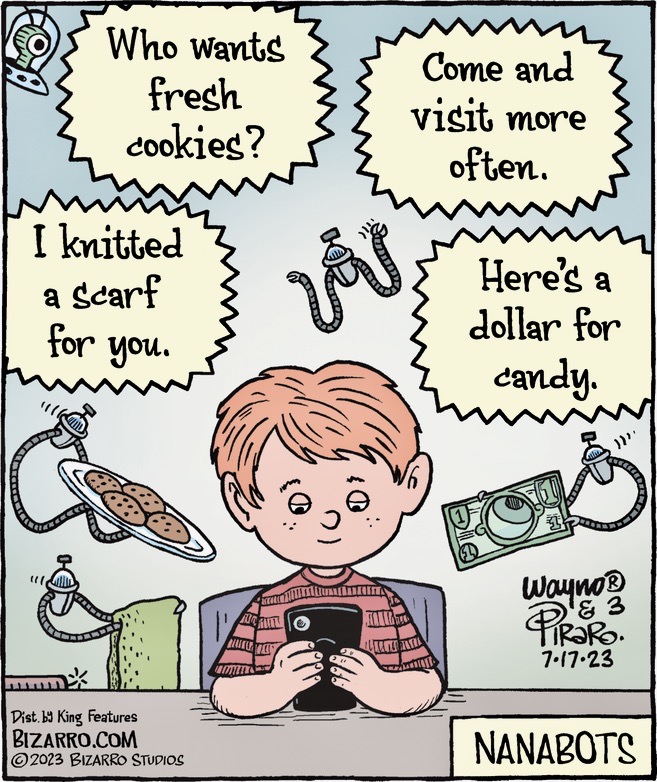
Today’s whimsical Wayno / Piraro Bizarro:

(if you’re puzzled by the odd symbols in the cartoon — Dan Piraro says there are 3 in this strip — see this Page)
A complex bit of wordplay here, which involves a chain of nouns — nanotechnology, nano, and nanobot — and then the combination of the nouns nana ‘granny’ and robot the way nano and robot are combined in nanobot. So: nanabot ‘granny robot, robot granny’. The nanabots in the cartoon are doing culturally conventional things for solicitous grandmothers: baking cookies, inviting the kid to visit, knitting a scarf, giving the kid some money for candy.
(more…)
Posted in Language play, Linguistics in the comics, Portmanteaus | Leave a Comment »
July 16, 2023
A preposterous pun — with a long history behind it — for today’s Wayno / Piraro Bizarro:

(#1) Model mummy’s curse / pun mummy’s cursor (cursor ‘a movable indicator on a computer screen identifying the point that will be affected by input from the user, for example showing where typed text will be inserted’ (NOAD)) (if you’re puzzled by the odd symbols in the cartoon — Dan Piraro says there are 12 in this strip! — see this Page)
Now the backstory:
(more…)
Posted in Linguistics in the comics, Movies, Pop culture, Puns | Leave a Comment »
July 15, 2023
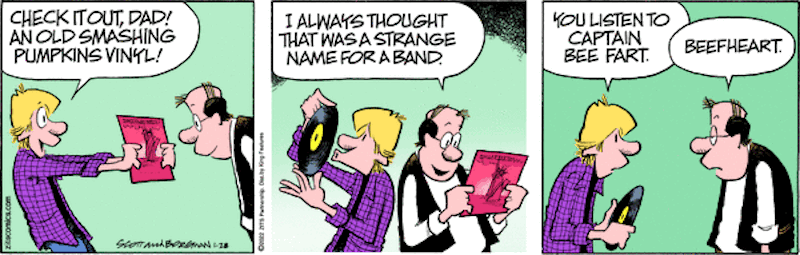
An old Zits strip — Jeremy twitting his father affectionately over Walt’s musical tastes — that’s been hanging around on my desktop for some years. This will take us far afield, thanks to the activities of the performer Don Van Vliet, best known by his stage name Captain Beefheart.

(#1) The relatively easy part of this has to do with the phonology of connected speech, which in casual speech has the compound noun beefheart / beef heart /bif.hart/ ‘the internal organ, the heart, of a bovine animal raised for its meat’ (also the name of, very roughly, a rock music performer) resyllabified and reduced to /bi.fart/ — so becoming homophonous with a novel compound bee fart / beefart; amusement ensues
The reduction without the resyllabification yields yet a third compound noun, beef art, also attested with reference to artworks featuring either bovine animals (in, say, pastoral — bucolic — scenes) or their meat (especially in still lifes, but also in performance art pieces involving raw meat).
I will now abandon this third compound in this posting. And also various imaginative uses for bee fart. I have pretty much all I can handle today with beefheart and Captain Beefheart.
(more…)
Posted in Language and food, Linguistics in the comics, Music | Leave a Comment »
July 5, 2023
A very much not-dead-yet posting to hold this space while I cope with an avalanche of posting material, plus my suddenly much improved medical condition (which is totally exhilarating). In any case, an old One Big Happy cartoon (originally from 9/4/14) in which Ruthie asks her defiantly working-class neighbor James to name something that comes in pairs, but James hears the homophone pears (both nouns pronounced /perz/ in my variety of English) and just can’t get shift his perspective:
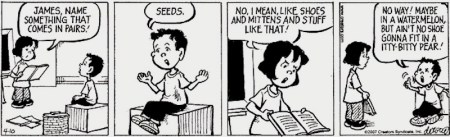
Note James’s multiply non-standard negative existential construction in his ain’t no shoes
(more…)
Posted in Ambiguity, Dialects, Language and the body, Linguistics in the comics, My life, Negation, Phallicity, Signs and symbols, Syntax | Leave a Comment »
June 29, 2023
I’m at home, recovering very erratically, with many setbacks and fresh issues. Yesterday I narrowly avoided being sent back to the emergency room at SUMC. This is all very difficult — and incredibly tiring. I don’t feel up to going over medical issues right now, but I have a big backlog of draft postings that were ready to go out on June 16th, when everything fell apart, so that I will diverge from SUMC moments to write up some of these for you.
First up, two vaguely related One Big Happy strips that appeared a while ago in my comics feeds: what I’ll call “Naked Lady” and “Define HAT”:
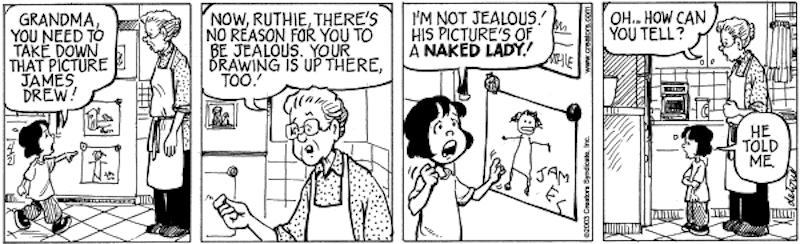
(#1) “Naked Lady”: on the artist’s intentions vs. the viewer’s perceptions of a work

(#2) “Define HAT”: on essence and appearance
(more…)
Posted in Art, Lexical semantics, Linguistics in the comics, Philosophy | Leave a Comment »
June 15, 2023
About a Jules Feiffer cartoon — still not unearthed (and it’s possible that there’s more than one) — that I recollect one way (described in yesterday’s posting “The Impostor Syndrome cartoon”) but cartoonist Dave Sim (creator of Cerebus the Aardvark) recollects a different way, in a review of Feiffer’s 1993 book The Man in The Ceiling, as quoted on the A Moment of Cerebus blog (“an unofficial cite celebrating the comics art of Dave Sim & Gerhard”) in 2015.
In today’s installment, the Sim account. And then a brisk survey of Sim, the strip Cerebus, and the character Cerebus (and yes, there will be an explanation of the name).
(more…)
Posted in Ambiguity, Cartoonists, Jokes, Language and animals, Language play, Linguistics in the comics, Puns | 1 Comment »
June 14, 2023
Whiling away yesterday morning at the CA DMV in Redwood City — being shepherded by caregiver Erick Barros through the process of renewing my senior ID from the state of California, which involved an interview and then a new photo — I entertained Erick with a retelling of the Jules Feiffer Impostor Syndrome (IS) cartoon as I recalled it, because our conversation had wandered onto the IS and because the joke that’s the hinge of the cartoon plays with ambiguity in a surprising, and especially satisfying, way.
Today I’ll just re-play the account in my 10/30/14 posting “Impostor Syndrome” and (exploiting the resources of OED3) unpack that joke into the lexical items that make it tick.
(It turns out that the cartoon has been described elsewhere (in cartoonist Dave Sim’s account of his conversation with Feiffer about an Irwin Corpulent cartoon of Feiffer’s), as having a very different resolution for the IS story. Four solid hours of searching through the materials available to me — including every damn cartoon in Feiffer’s thick volume Explainers: The Complete VILLAGE VOICE strips (1956-66) — did not, alas, produce an actual IS cartoon, neither the one I recollected nor the one Sim recollected. That search goes on.)
(more…)
Posted in Ambiguity, Argument structure, Complementation, Jokes, Lexical semantics, Linguistics in the comics, Puns, Syntax | Leave a Comment »
June 13, 2023
In a Psychiatrist cartoon by Oren Bernstein in the New Yorker of 6/12/23:
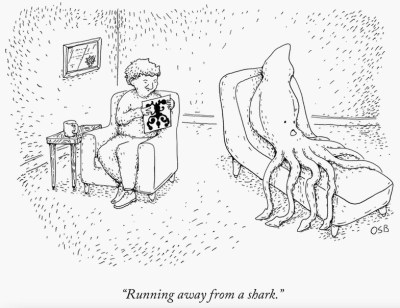
(#1) The patient flopped on the therapeutic couch is a despondent octopus [6/14: oh dear, apparently a squid rather than an octopus; later on 6/14: not exactly a squid either (see comments) — so an OSB cephalopod, of a previously unreported species]; the analyst has presented the cephalopod with a Rorschach inkblot (designed as a projective psychological test), which has aroused the patient’s deepest fears, of fleeing the pursuit of death
I know, you don’t see the savagery of an attacking shark, but then you’re not an octopus [or squid].
(more…)
Posted in Cartoonists, Comic conventions, Linguistics in the comics, Psychology | 4 Comments »
June 13, 2023
(This posting manages to (barely) skirt male genitals and man-on-man sex, without (almost any) street speech or explicit images, but the topic is daddy fantasies in gay porn, so it will not be to everyone’s taste)
For Memorial Day (and other American patriotic holidays), ads for gay porn play to fantasies of military men, while for Fathers Day, coming up rapidly (this Sunday, 6/18), they play to daddy fantasies (see the Page on this blog about my postings on Daddy-Boy encounters and DILFs, on the sexualization and various ritualizations of the father-son roles). With luck, pretty much the same material can serve for both holidays, as in the case of Papi Kocic (with his heavily loaded porn name) in MEN.com’s Norse Fuckers, who did ad duty on Memorial Day (in an ad for a porn emporium’s Memorial Day sale; see my 5/29/23 posting “Hordes of Norsemen insert themselves into a national holiday”) playing a military leader; and now appears in a porn-sale ad for Fathers Day in his guise as a hot daddy:

(#1) The ad, with genitals concealed (for WordPress modesty) and ad copy suppressed (so we can focus on the image and the porn-purveyors’ sentiment “We ❤️ Hot Dads!”)
(more…)
Posted in Gay porn, Holidays, Homosexuality, Language and the body, Language in advertising, Language of sex, Linguistics in the comics, Masculinity, Movies and tv, Poetry | Leave a Comment »
June 10, 2023
Yesterday’s Wayno / Piraro Bizarro has Frankenman Victorsson — a man-monster created by cobbling together an ragbag of human bodyparts — somehow fulfilling his destiny by stitching pieces of fabric together to make bed covers:

(If you’re puzzled by the odd symbols in the cartoon — Dan Piraro says there are 5 in this strip — see this Page)
There’s some variety of imitative fallacy here, as if the fact that I was conceived in Niagara Falls should mean I was fated to become a plumber. Or perhaps a garden fountain. Oh wait! I have become the Whizzman of Ramona St.; maybe there’s something to this idea.
(more…)
Posted in Linguistics in the comics, Names, Naming | Leave a Comment »