Archive for the ‘Linguistics in the comics’ Category
November 27, 2023
A One Big Happy strip, recently in my comics feed:

(#1) James (mis-)takes Ruthie’s meta-commentary — her talk about what’s going on in her interaction with James — to be part of that interaction, to be her next move in the routine of the knock-knock joke, and shows that he understands that routine, by producing the appropriate next move in the routine
James might be a dirty-faced urchin, but he knows his joke routines. And, in the last panel, is probably wondering how on earth Ruthie’s going to make a pun out of jeezy-peezy-I-forgot-the-joke.
So: mastering the routine of the knock-knock-joke is one thing, but then the routine incorporates another type of joke, the pun joke, which has its own requirements. In addition, the knock-knock joke requires not just any pun, but a (phonologically) imperfect pun, the more distant the better, so that its punch line will have genuine surprise value.
(more…)
Posted in Ambiguity, Formulaic language, Jokes, Language acquisition, Language play, Linguistics in the comics, Puns, Routines and rituals, Variation | 3 Comments »
November 25, 2023
The title of a Sara Lautman cartoon in the New Yorker issue of 10/27/23:

(#1) The instrument emerges from the primordial ooze, climbs onto land, and ascends, eventually to stand upright at the pinnacle of evolution
Two things here: the musical instrument; and the cartoonist.
(more…)
Posted in Cartoonists, Evolution, Linguistics in the comics, Music | 3 Comments »
November 25, 2023
An old One Big Happy strip, one in a long series in which Ruthie or her brother Joe is confronted with some type of test question (rather than an information-seeking question):

Ruthie is laboring at a workbook — a culture object that subjects a student to test questions, in this case a question requiring the student to demonstrate their understanding of the culturally appropriate grounds for publicly assessing the characteristics of other people: industriousness is an appropriate ground for assessing a farmer (because it’s relevant to his doing his job), while a conventionally attractive appearance is not
Even though she’s filling in questions in a workbook, Ruthie falls back on treating busy-or-pretty? as a question about her opinions, rather than her knowledge of cultural appropriateness. In fact, for all we can tell from the workbook picture, Farmer Brown might not be at all busy; he might be sitting upright in a stationary tractor, daydreaming about what’s for supper. But he could perfectly well be busy, while even if was drawn to look like a handsome film star, his looks would be culturally irrelevant to his job. (Subtle point: they would, however, be culturally relevant in general, since men judged to be conventionally good-looking have a social edge over other men in various contexts.)
Here, Ruthie personalizes her response by giving her opinions. In other OBH test-question strips she looks situations from her point of view or takes her own experiences as background for answering questions. But test questions demand a depersonalized stance — and then regularly plumb very fine points of sociocultural awareness. Fine points that for the most part aren’t treated in the workbooks, aren’t explicitly taught in schools. I’ll give one further example from an earlier posting of mine below.
(more…)
Posted in Childhood, Culture, Linguistics in the comics, Questions, Speech acts, Teaching | 2 Comments »
November 22, 2023
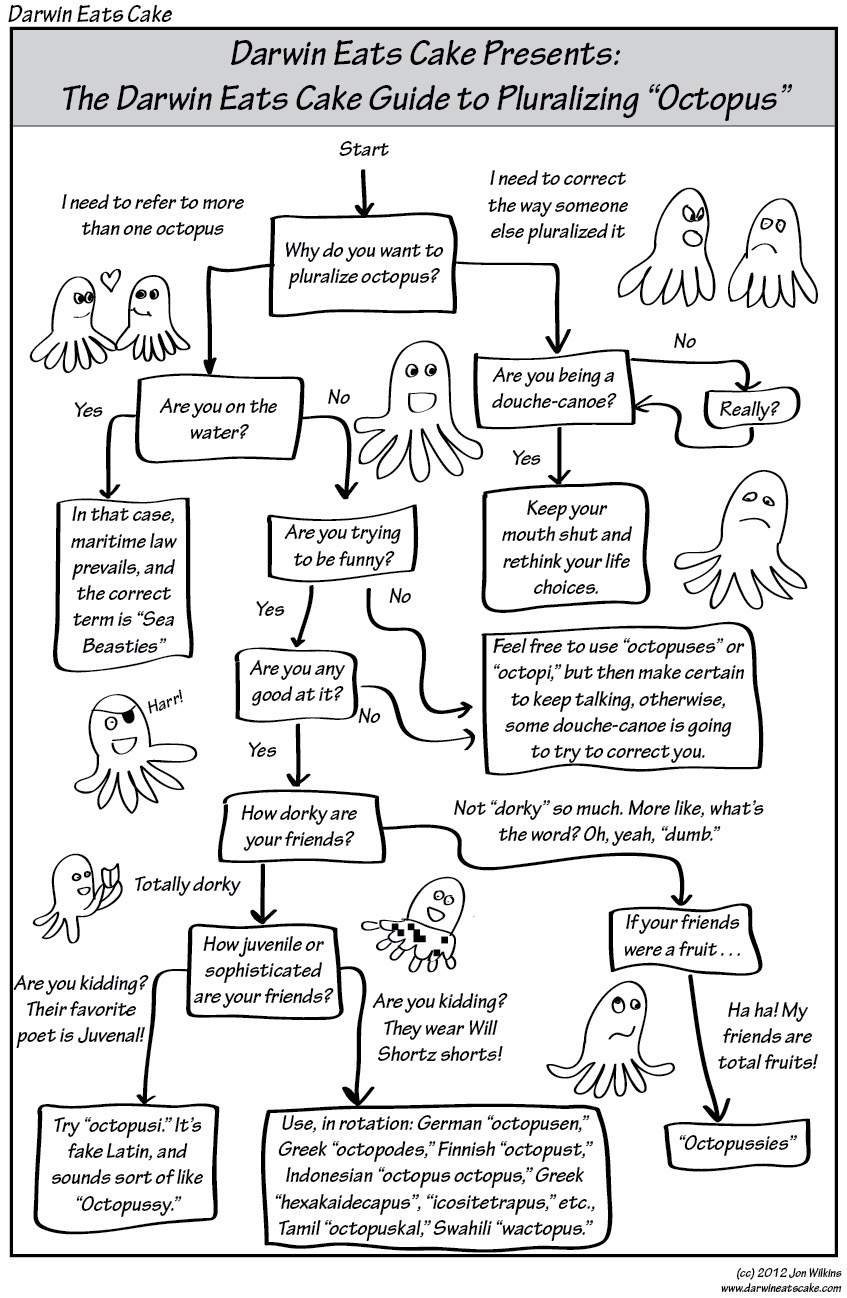
The pursuit of plurals for the English noun octopus — most recently, in yesterday’s posting “Obscure plurals of octopus (and rhinoceros)” — has now lurched into the zone of the dorky, the raunchy, and the portmanteaued with Kyle Wohlmut’s posting today on Facebook of Jon Wilkins’s webcomic Darwin Eats Cake‘s smartass Guide to Pluralizing “Octopus”:
 (#1)
(#1)
The cartoon seems determined to take us to the raunchy portmanteau octopussy (= octopus + pussy) and to Octopussy, the 1983 James Bond spy film, titled from its principal female character, the wicked seductress Octopussy. I’ll be following it there.
(more…)
Posted in Gender and sexuality, Language and the body, Language of sex, Linguistics in the comics, Metaphor, Movies and tv, Portmanteaus, Slang, Taboo language and slurs | Leave a Comment »
November 20, 2023
Briefly noted, this Leigh Rubin cartoon passed on to me by Susan Fischer on Facebook today:

To understand this, you need to recognize a bull and a young goat
Two stock expressions, both of them similes, lie behind the two images of creatures entering retail establishments: like a bull in a china shop, like a kid in a candy store. The two ideas can appear as an explicit comparison, in a simile with like; or in a metaphor, with the comparison implicit: you are a (veritable) bull in a china shop; they were (proverbial) kids in a candy store.
(more…)
Posted in Ambiguity, Figurative language, Formulaic language, Linguistics in the comics, Metaphor, Puns, Semantics, Simile, Stock expressions | 3 Comments »
November 18, 2023
… visiopun being my coinage referring to a punning word presented visually — not actually said or printed, but alluded to by some striking image, usually with some lead-on hinting at the pun. An extremely simple, utterly flat-footed example of my own devising:
What do you call a US infantryman from World War I?
 (#1)
(#1)
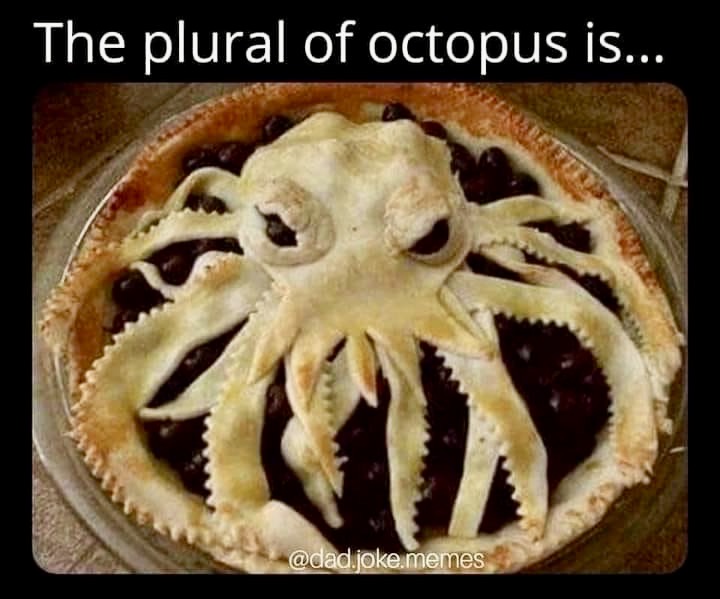
The image is of a small male figure made of dough, so the punning word is doughboy. (Yes, the Pillsbury Doughboy. I simplified things by using an existing image.)
Now to a complex visiopun passed on to me on Facebook today by Emily Menon Bender (the source is cited in the image):
 (#2)
(#2)
The image is of a pie in the shape of an octopus, so the punning word is octopie (/áktǝpàj/ in my AmE variety), a play on octopi, one of the plural forms of octopus. Cute.
(more…)
Posted in Etymology, Inflection, Lexicography, Linguistics in the comics, Puns, Usage advice, Usage attitudes | 1 Comment »
November 17, 2023
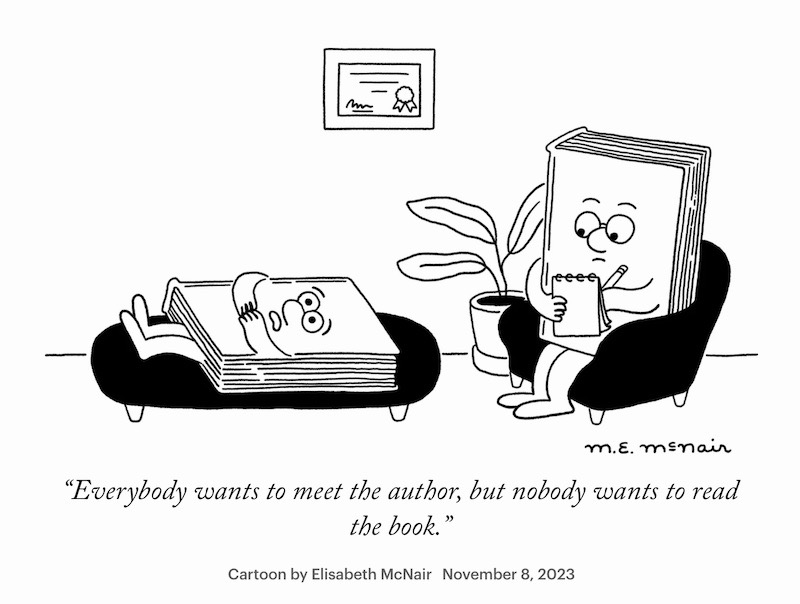
The new issue of the New Yorker (dated 11/20/23) brings us a Psychiatrist cartoon by Elisabeth McNair, one of a special subtype I’ll call In-Group Psychiatrist (in which a patient from some extraordinary group — a dog, a robot, a squid, what have you, in #1 a book — is being treated by a therapist from that very group):

(#1) You wonder whether the notebook the therapist is writing on is itself preparing to publish its thoughts, and then it’s books all the way down
McNair is new to this blog. So a few words — her own — about her, and then some more cartoons she’s done for the New Yorker, starting with, yes, another In-Group Psychiatrist.
(more…)
Posted in Art, Comic conventions, Language and food, Linguistics in the comics, Paradoxes, Snowclones, Words and things | Leave a Comment »
November 15, 2023
Today’s Wayno / Piraro Bizarro hinges on a bit of language play that cuts across two categories of play: it’s a pun based on a portmanteau, a punmanteau:

(#1) A cummerbund in the shape of a Bundt cake (Bundt punning on bund), with a name that’s a portmanteau of the names for those two things: cummerbund + Bundt (cake) = cummerbundt (if you’re puzzled by the odd symbols in the cartoon — Dan Piraro says there are only 2 in this strip — see this Page)
(Note: The Cumberbatch is something else entirely.)
(Further note: Wayno’s title for this one is “Frosted Formalism”, alluding to the icing (aka frosting) on the cummerbundt in the cartoon — though Bundt cakes are not necessarily frosted.)
(more…)
Posted in Categorization and Labeling, Clothing, Language and culture, Language and food, Language play, Linguistics in the comics, Portmanteaus, Puns | 2 Comments »
November 9, 2023
From cartoonist Charlie Hankin in the 11/13/23 New Yorker (which has not yet arrived in my mailbox), a big black bird, a writer at his desk, and a penguin. And then today’s Wayno / Piraro Bizarro, with a geneticist reluctant to order fusilli at a restaurant, asking for linguine instead. The first one is pretty easy, so long as you recognize an American poet and his most famous subject. The second is more challenging, requiring that you know about both pasta and genetics, plus a concept that unites fusilli and DNA.
This is another Small Posting Through Pain (see my previous posting, on boletes), which will probably take me several hours to get through, because my poor fingers hurt like hell.
(more…)
Posted in Biology, Furnishings and tools, Language and food, Linguistics in the comics, Penguins, Understanding comics | 6 Comments »
October 31, 2023
Three that have come to me today: in today’s comics feed, a Wayno / Piraro Bizarro showing a young René Magritte trick-or-treating; on Facebook, passed on by Robert Poletto for Halloween, an Edward Gorey 1973 skull-tossing watercolor with the sly title A Dull Afternoon; and also on FB, reposted by Jeff Bowles for Halloween, an old Charles Schulz Peanuts cartoon in which Linus enthusiastically reconceptualizes the eve of the Day of the Dead as a version of Christmas Eve.
(more…)
Posted in Art, Holidays, Linguistics in the comics, Semantics | 3 Comments »