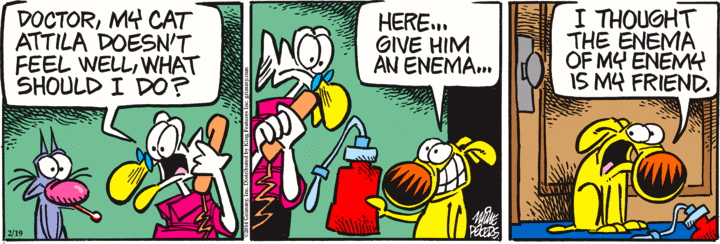
Yesterday’s Mother Goose and Grimm with an outrageous pun:
Posted in Linguistics in the comics, Proverbs, Puns, Quotations | 3 Comments »
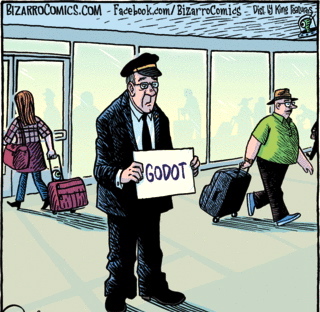
Today’s Bizarro, first in a captionless version:
 (#1)
(#1)
This is funny as it stands, though it requires considerable sociocultural knowledge to understand (I very much get doubt that my soon-to-be ten-year-old grand-daughter would get it).
Posted in Captioning, Linguistics in the comics | 4 Comments »
An AP story from the 16th: “Pa. exhibit traces history of female comic artists” by Kevin Begos:
It took a war to let the country’s female comic book artists break character.
A new exhibit at Pittsburgh’s Toonseum is celebrating the history of female comic artists, including those who began laying the groundwork 100 years ago and the female artists of the 1940s, when World War II sent many male artists overseas.
Posted in Language and gender, Linguistics in the comics | Leave a Comment »
Today’s Bizarro:
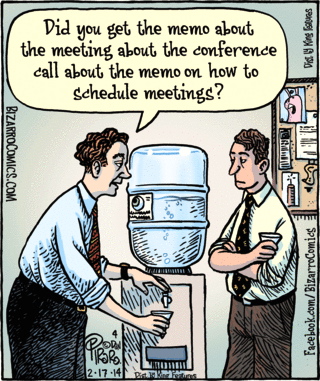
PPs within PPs. All are postnominal modifying PPs that are (roughly) equivalent to postnominal relative clauses:
the memo which was about the meeting which was about the conference call which was about the memo which was on how to schedule meetings
So these postnominal PPs have been referred to as “reduced relative clauses”.
Posted in Linguistics in the comics, Syntax | 2 Comments »
Today’s Pearls Before Swine, with yet another word avalanche:

A chain of rhymes or near-rhymes. With Rat, as so often, upbraiding the cartoonist. I’m irrationally fond of these.
Posted in Language play, Linguistics in the comics | Leave a Comment »
Two cartoons for today: a Pearls Before Swine on some visual conventions in the comics, and a Dilbert on telling stories, through images and words.
Posted in Linguistics in the comics, Words | Leave a Comment »
A recent Zits:
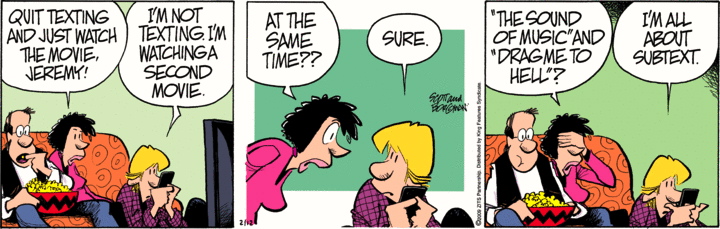
Subtext has come up in the Stanford Language of Comics seminar I’m involved with, in discussions of indirection — primarily, Gricean implicature, in which expressions have a straightforward interpretations but are used to convey different ones. Subtext is subtler, since two messages are sent at the same time.
In the Zits case above, the subtext (Drag Me to Hell) is made explicit, as commentary on the surtext (The Sound of Music).
Posted in Linguistics in the comics, Pragmatics | 1 Comment »
Today seems to be pun day. Passed on by Barbara Need on Facebook, this Bizarro from 2009:

Groan: phero- vs. pharaoh. These are homonyms for some speakers, near-homonyms for others (who have have [æ] in pharaoh and a higher vowel, [ɛ] or [e], in phero-).
Posted in Linguistics in the comics, Phonology, Puns | 1 Comment »
Today’s Mother Goose and Grimm:
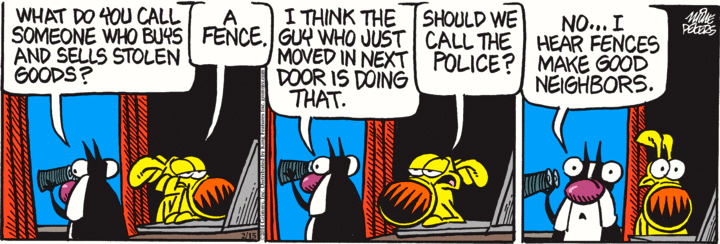
For a change, I won’t leave this as an exercise for the reader. Two crucial pieces: a pun on fence — a barrier or someone who sells stolen goods — and an allusion to Robert Frost’s “Mending Wall”, which ends with the quotation “Good fences make good neighbors”.
Posted in Linguistics in the comics, Puns, Quotations | 4 Comments »
Today’s Scenes From a Multiverse, on today’s holiday:
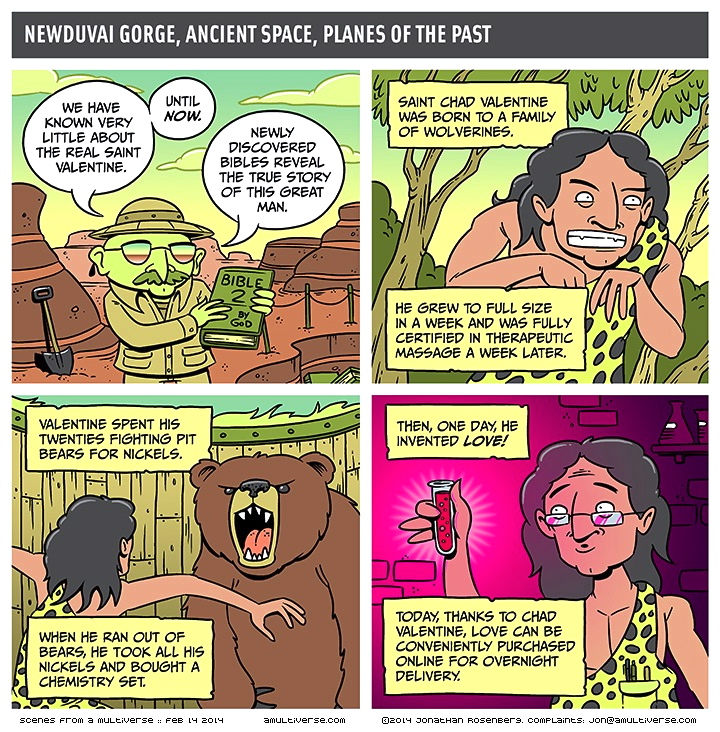
Given that we know almost nothing about St. Valentine, Jon Rosnberg is free to invent whatever he wants.
Posted in Holidays, Language and religion, Linguistics in the comics | Leave a Comment »
You are currently browsing the archives for the Linguistics in the comics category.
