Archive for the ‘Linguistics in the comics’ Category
May 7, 2024
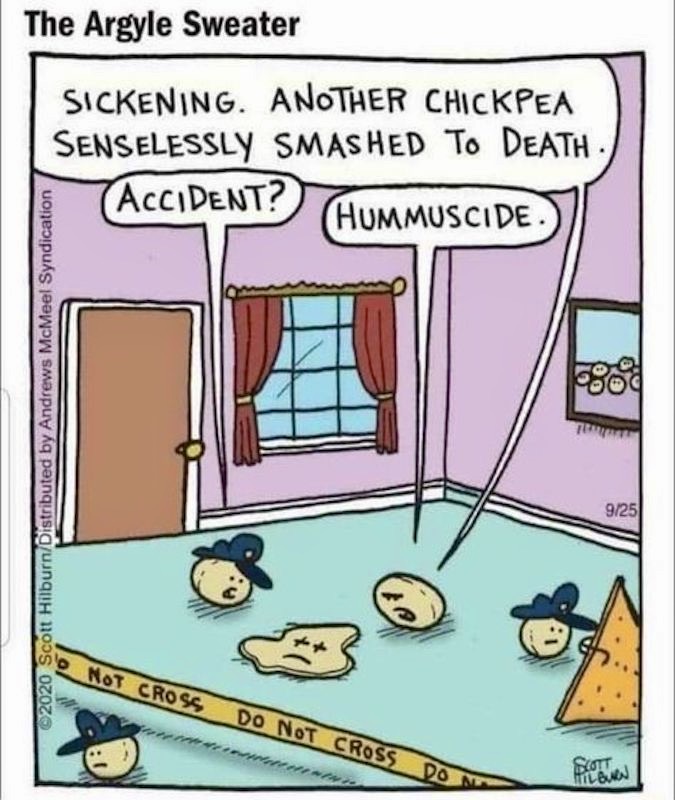
In Pinterest this morning, Scott Hilburn’s Argyle Sweater comic strip of 9/25/20:

(#1) This from the creator of the Puns of Steel collections
#1 is a still from a sad tale of chickpeas smashed to death in a cheap Baltimore apartment, an episode of the tv drama Hummuscide: Life on the Street; meanwhile, death strikes down a rich legume in the novel The Great Garbanzo, in which the title character is murdered by a distraught husband. The grand fictions of Cicer arietinum.
(more…)
Posted in Cartoonists, Language and food, Language and plants, Linguistics in the comics, Puns | 2 Comments »
May 6, 2024
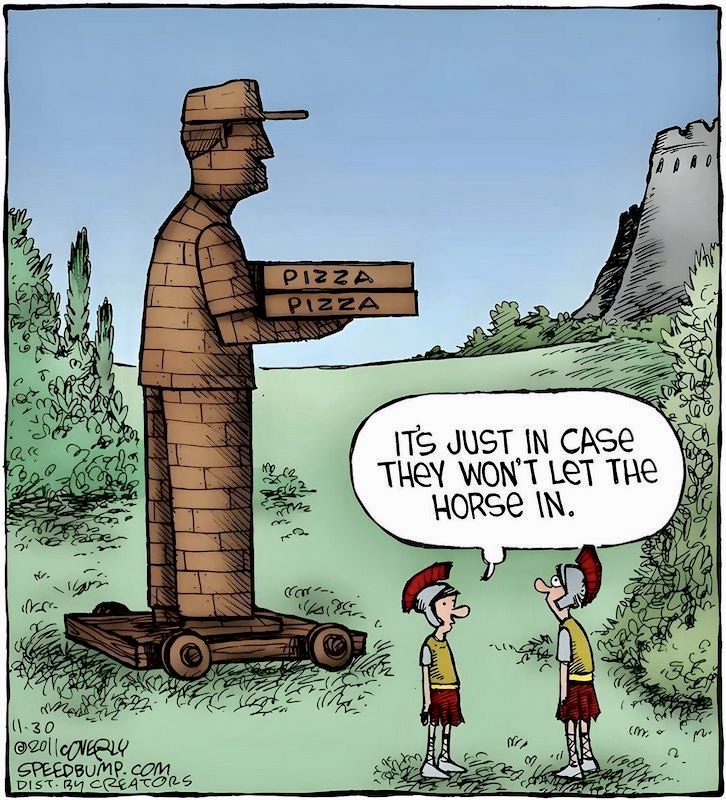
From Susan Fischer on Facebook today, a link to a very old (11/30/11) Dave Coverly Speed Bump cartoon depicting the Trojan Pizza Boy:

(#1) Pizza Boy wears a cap, and he comes bearing two pizza cartons (plus, we assume, a lot of concealed Trojan warriors)
(more…)
Posted in Gay porn, Gender and sexuality, Homosexuality, Language and food, Language and sexuality, Language and society, Linguistics in the comics, Male art, Masculinity, Myths | 2 Comments »
May 5, 2024
… Wayno’s title for yesterday’s Wayno / Piraro Bizarro, with its excellent POP (phrasal overlap portmanteau) laissez-fairy godmother:

(#1) laissez-faire + fairy godmother yields a hands-off mentor and guide, of not much use to the disgruntled Cinderella, who will now have to do her own prince-finding (if you’re puzzled by the odd symbols in the cartoon — Dan Piraro says there are only 2 in this strip — see this Page)
(more…)
Posted in Dance, Folklore, French, Lexical semantics, Linguistics in the comics, Music, Phrasal overlap portmanteaus, Puns | Leave a Comment »
May 4, 2024
(or maybe his gay cartoon world. either way, this posting gets right into men’s bodies and sex between men, in plain talk, so it’s totally not for kids or the sexually modest)
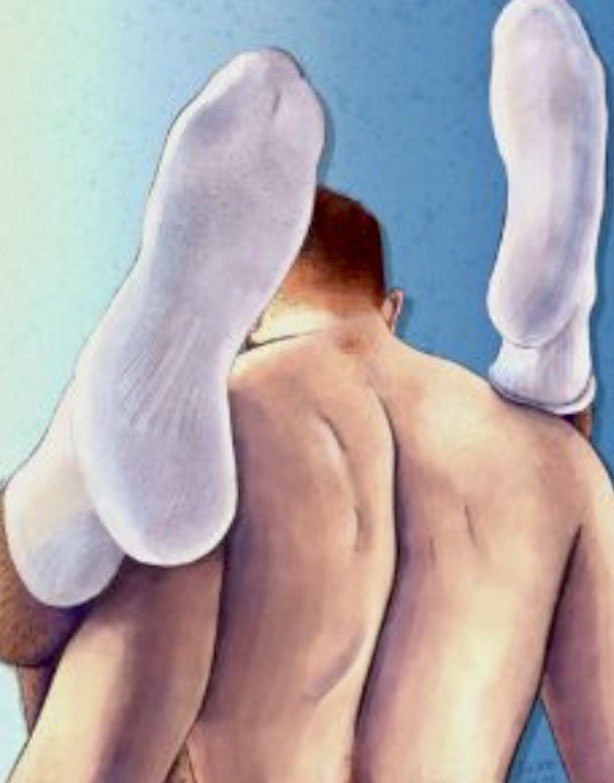
Encountered on Pinterest some time ago, an item from the Jason Lloyd Art website, with a work much like this one, two men in the act (but without a visible penis, so I can show it to you here):

(#1) “Just Relax” — I think Frankie Goes to Hollywood’s 1983 hit song is an inevitable association here — is about taking pleasure in getting fucked, and it’s in JL’s least cartoonish and most realistic (but soft-focus) style, which can be either simply erotic (and touching) or actually pornographic (and arousing), depending on how you approach it
All of JL’s work is at least somewhat simplified in its lines, and most of it is straightforwardly cartooning, all of it skilled, some of it notable.
(more…)
Posted in Captions, Cartoonists, Gender and sexuality, Homosexuality, Language and the body, Language of sex, Linguistics in the comics, Male art | 2 Comments »
April 27, 2024
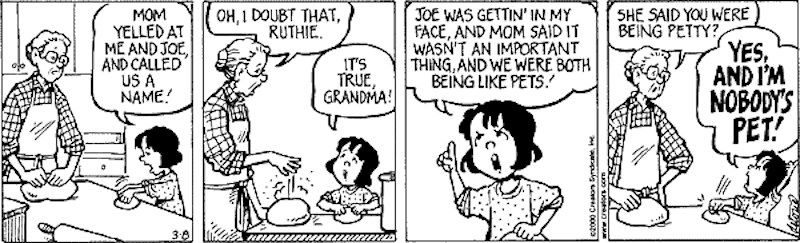
So cries Ruthie (in an old One Big Happy strip that came up in my comics feed this morning), objecting to what she saw as her mother’s accusation that she and her brother Joe were being like pets:

Here Ruthie shows an admirable appreciation of the English derivational suffix –y ‘relating to, like, resembling’, while betraying her ignorance of the adjective petty ‘of little importance’ (which is not pet + –y).
(more…)
Posted in Derivation, Lexical semantics, Linguistics in the comics, Morphology | Leave a Comment »
April 23, 2024
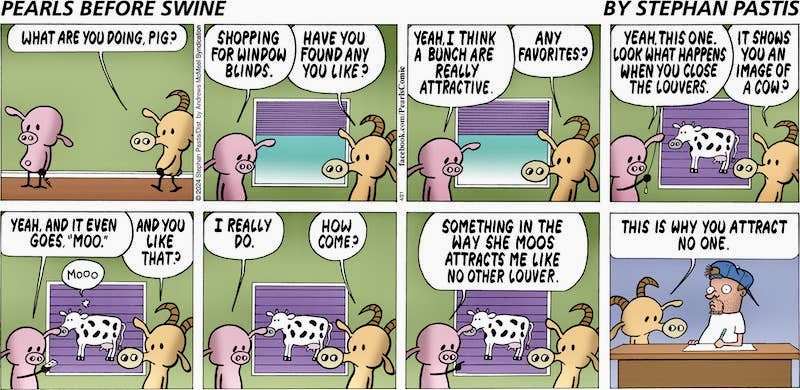
The Pearls Before Swine strip of 4/21 has cartoonist Stephan Pastis committing a formula pun joke, a genre of humor at which he’s a master:

(#1) Pig assembles, for Goat as his straight man, the parts of an outrageous pun on the first two lines of the Beatles’ song “Something”: Something in the way she moves / Attracts me like no other lover (and then in the last, frame-breaking, panel, Goat upbraids Pastis for exploiting him for the sake of a joke)
So, two things: formula pun jokes; and the song “Something”.
(more…)
Posted in Comic conventions, Jokes, Linguistics in the comics, Music, Puns | Leave a Comment »
April 22, 2024
… many people’s reaction to the cartoon psychiatrist (in my 4/20 posting “Charlie on the couch”) admitting to her patient Charlie the StarKist tunafish:
you’re my first patient with a fear of not being eaten
Well, not an everyday word, but a specialized medical term, a bit of arcana from abnormal psychology.

There are, remarkably, two terms (one using the Latin ‘devour’ stem, one the corresponding Greek ‘eat’ stem) for ‘fear of being eaten’, so from these we can compose terms for ‘fear of not being eaten’.
Here you will object that this is a profoundly silly exercise; surely, such a term would have no utility in the real world. But no, there turns out to be a documented paraphilia centered on a erotic desire to be eaten (in the imagination), and in the world of this kink — very far from a top paraphilia, but a real thing — fear of not being eaten, of not having this desire satisfied, would also be a real thing.
(more…)
Posted in Derivation, Language of sex, Linguistics in the comics, Morphology | Leave a Comment »
April 20, 2024
Today’s Wayno / Piraro Bizarro is a Psychiatrist cartoon with a stylized tunafish on the couch:

(#1) To understand this cartoon, you need to recognize that the patient’s not any old tuna, but Charlie, the celebrity mascot for the StarKist brand, whose widely advertised decades-long goal in life is to taste good (while — sorry, Charlie — his pursuit of good taste constantly frustrates this ambition, an experience that seems have led him to seek therapy) (if you’re puzzled by the odd symbols in the cartoon — Dan Piraro says there are 6 in this strip — see this Page)
There’s a surprisingly rich history here (but one that might be specifically North American, so that the cartoon might be baffling to many of my readers). Summarized in this entry on the tv tropes site:
(more…)
Posted in Catchphrases, Language and animals, Language and food, Language in advertising, Linguistics in the comics, Mascots, Signs and symbols, Understanding comics | 2 Comments »
April 19, 2024
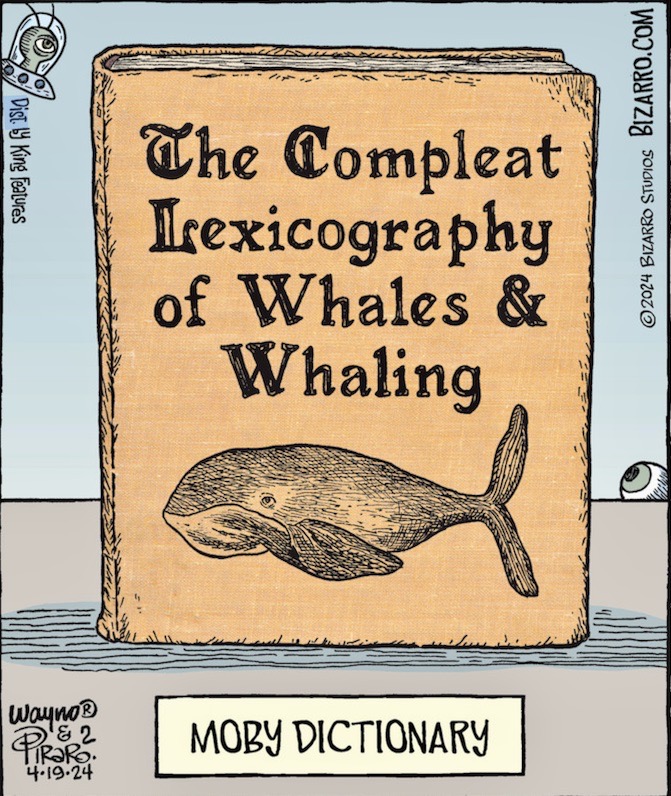
… Wayno’s title for today’s Wayno / Piraro Bizarro, which I think of “MobyDicPOP”, to recognize the phrasal overlap portmanteau Moby Dictionary in it:

Moby Dick + dictionary (if you’re puzzled by the odd symbols in the cartoon — Dan Piraro says there are only 2 in this strip — see this Page)
Easy to imagine other DicPOPs: Tricky Dictionary, for Richard Nixon’s pungent vocabulary of contempt and abuse; Private Dictionary, for the lexicon of private eyes; Pencil Dictionary, for a list of famous men with thin penises; and so on.
I suppose it’s merely caviling to note that a Moby Dictionary should be huge, and white.
Posted in Books, Language and animals, Linguistics in the comics, Names, Phrasal overlap portmanteaus | 3 Comments »
April 16, 2024
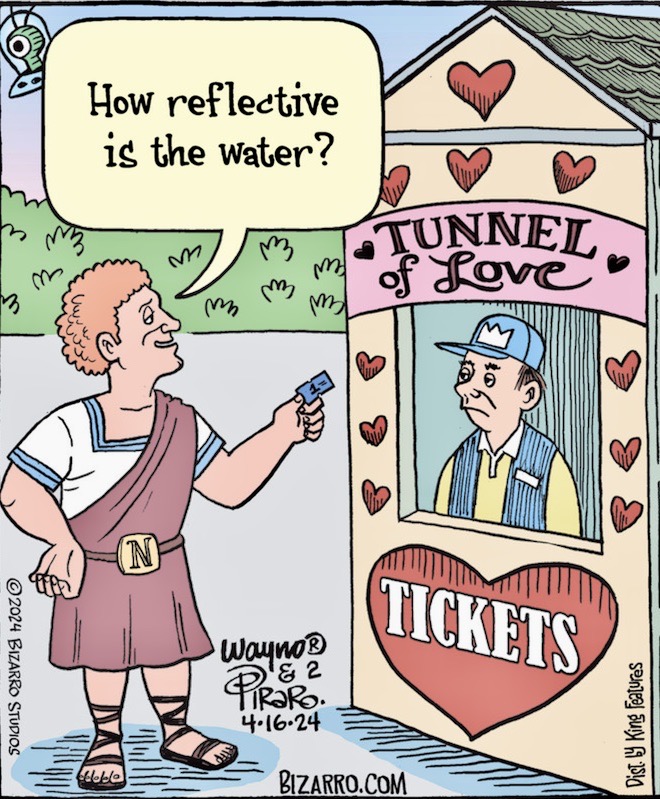
From the annals of cartoon understanding: about today’s Wayno / Piraro Bizarro, in which an unaccompanied young man in classical Greek attire inquires about the reflectivity of the water in a Tunnel of Love:

(#1) In case you didn’t recognize (a pop-cultural version of) the figure of Narcissus from Greek mythology, the young man sports a buckle with a big N on it; meanwhile, you need to recognize another piece of pop culture, the amusement park ride the Tunnel of Love (which largely disappeared about 80 years ago as an actual amusement park phenomenon, but lives on as a trope in songs, movies, and tv shows) (if you’re puzzled by the odd symbols in the cartoon — Dan Piraro says there are only 2 in this strip — see this Page)
So, yes, you need to bring cultural knowledge to bear on understanding the cartoon — to seeing that it’s hilarious that a Narcissus figure would buy a single ticket for a ride through a Tunnel of Love (designed to provide about 6 minutes alone in the dark for couples to get steamy with one another) and want to know how reflective the water in it is: can I see myself in it?, he needs to know; can I become one with that beautiful man in this dark monument to love?. But all this cultural knowledge is second-hand, coming to us through the distorting, simplifying lens of pop culture: not the myth of Echo and Narcissus, but just a guy foolishly falling in love with himself; not actual amusement park rides, but their pop-cultural echoes in cartoons and the like.
(more…)
Posted in Art, Language of sex, Linguistics in the comics, Metaphor, Movies and tv, Myths, Understanding comics | Leave a Comment »