Archive for the ‘Linguistics in the comics’ Category

On the surreal train

July 1, 2016

Following on my earlier posting on ceiling fans and, yes, the surrealism of René Magritte, today’s Zippy:
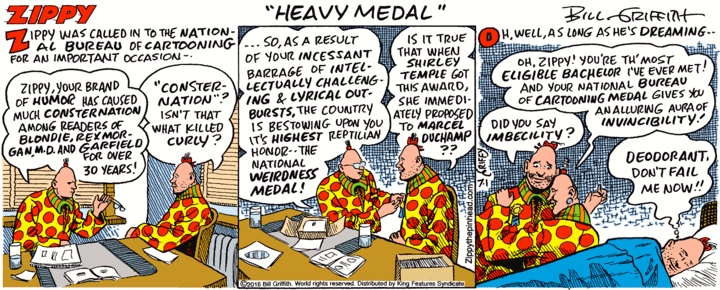
Every once in a while, the strip’s self-referentiality extends to recognition of its surrealist inclinations and the hostility this arouses in some people.

I’m enjoying the idea of Shrley Temple proposing to Marcel Duchamp.
Michael DiMotta

June 28, 2016

(Graphics on gay male subjects, probaby not for kids or the sexually modest, and with little linguistic interest.)

A follow-up to my “Kinsey strip-tease” posting yesterday. I was unable to identify the artist for the graphic there, but (once again) Chuk Craig has done the detective work: illustrator Michael J. DiMotta, who free-lances lots of stuff, but has a special attachment to hunky, barely clad men and other gay male subjects.

(more…)

The Kinsey strip-tease

June 27, 2016

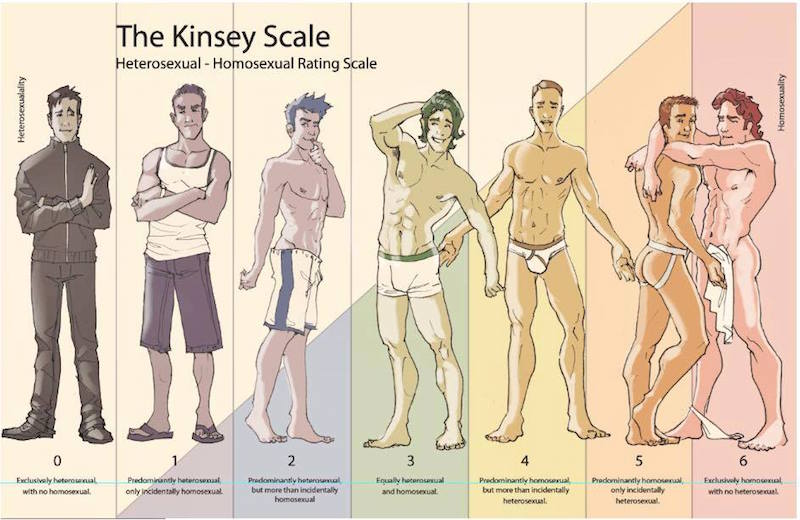
Passed on by Daniel MacKay on Facebook, this graphic interpretation of the Kinsey Scale of male sexuality:

Daniel: “What could the artist have been thinking by relating the amount of clothing to the gay-ness of the subject?” What indeed? Kinsey 6 as the state of nature? The ultimate in depravity? Or what?

The graphic has been picked up by many dozens of posters, but not (that I have found) with an attribution to a source.

Levels of taboo language

June 26, 2016

Today’s Mother Goose and Grimm, on a linguistic theme:

Aside from the meta character of the strip — the dogs know they are characters in a cartoon — there’s their avoidance of the word bitch, as unsuitable for the strip, because the strip is carried by “family newspapers”, where women and children (notoriously delicate and easily damaged by words) might come across bitch (even used to refer to a female dog, not to mention in the idiom son of a bitch).

(more…)

Bob Eckstein

June 24, 2016

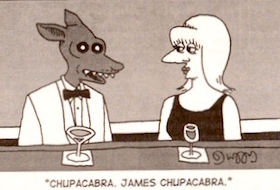
On the occasion of my posting a Bob Eckstein (“bob”) cartoon (#1 in 6/22/16, “Two tests in cartoon understanding”), the cartoonist has friended me on Facebook (earlier Eckstein from 5/30/15, “Earworms, snowmen, and parodies”). So now a few more of his cartoons, of several different types.

(more…)

Word times: two Ruthies, three Psychs

June 24, 2016

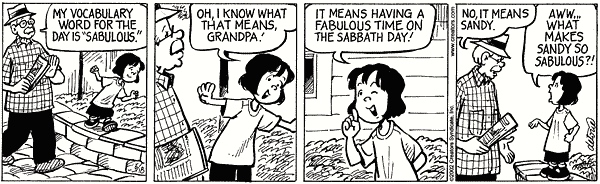
Annals of lexical confusions and innovations. Two word problems from Ruthie in the cartoon One Big Happy (two recent strips), a word confusion and two innovations from the tv show Psych.

(more…)

Two tests in cartoon understanding

June 22, 2016

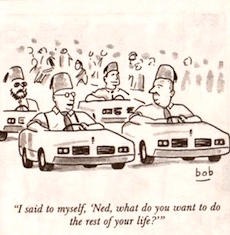
From the July 2016 issue of Funny Times, two cartoons that are real tests of understanding, the second more so than the first. From Bob Eckstein, a cartoon that is funny on the grounds of sheer silliness:

(#1)

And from J.C. Duffy, a cartoon that is just incomprehensible unless you have two pieces of (pop-)cultural information:

(#2)

(more…)

Frenemones

June 21, 2016

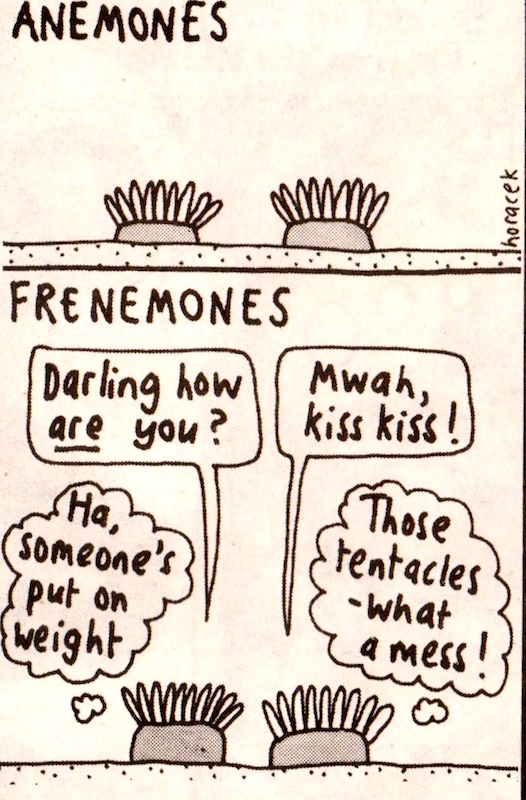
In the July 2016 Funny Times, this punning cartoon by Australian cartoonist Judy Horacek:

Layered portmanteaus: frenemy (friend + enemy) + anemone. Frenemy from NOAD2: ‘a person with whom one is friendly despite a fundamental dislike or rivalry’.

(more…)

Anatol Kovarsky

June 17, 2016

In the New York Times on the 14th, an obituary by William Grimes, “Anatol Kovarsky, New Yorker Cartoonist for Decades, Dies at 97”:

Anatol Kovarsky, an artist and illustrator whose sense of whimsy and the absurd made him a fixture at The New Yorker from the late 1940s through the 1960s as both a cartoonist and a cover artist, died on June 1 at his home in Manhattan. He was 97.

Mr. Kovarsky, a master of the wordless visual gag, produced nearly 300 cartoons for The New Yorker. His first, published on March 1, 1947, showed two museum visitors peering at each other in surprise as they looked through the hole in a large Henry Moore-like nude.

(more…)

Two Thursday cartoons

June 16, 2016

Words words words. Ruthie in One Big Happy is confounded by sandy, and Mother Goose and Grimm gives us a howling pun on Transcendental Meditation:

(#1)

(#2)

(more…)