Archive for the ‘Lexicography’ Category

lx and g&s

August 6, 2025

(Not lox and Gilbert & Sullivan, though that’s a charming idea for a matinee; I’d prefer to think of lx (linguistics) and g&s (gender and sexuality studies) as two gay linguists, Lex and Gus, who go together like, oh, politics and poker (from Act I of the 1959 Broadway musical Fiorello!) — or, more relevantly, like mind and body)

A non-academic friend, new to my net presence, wondered what the things I said my blog is mostly about — lx and g&s — have to do with one another. My immediate, overly glib, reply:

Nothing intrinsic, but they happen to come together in me, along with gardening, Sacred Harp singing, an interest in food and cooking, Mozart and Haydn, and more. Various accidents of history and outgrowths of different parts of my make-up.

Strictly true, but in fact my postings about lx tend to have a lot of g&s content, and my postings about g&s very often end up illustrating points of lx. And sometimes they meld together — as in my recent (from 7/26/25) posting “F-lexicography”, on the semantics of the sexual verb fuck.

So now a quick visit to Lex and Gus’s world, just picking out things from here and there in work by me and my colleagues. Not a systematic survey, just the odd snapshots.

(more…)

F-lexicography: the guest posting

August 2, 2025

What follows is a response to my 7/26 posting “F-lexicography, in which I wrote, combatively (and, as it turns out, not entirely accurately):

I argue that the OED treatment of the semantics of the sexual verb fuck is unsatisfactory, not compatible with the actual usage of English speakers for a long time now — apparently because earlier lexicographers, embracing normative views of sexual behavior, posited a single sense of sexual fuck, centrally denoting an agentive act of penis-in-vagina intercourse but with a large penumbra of vagueness, embracing many other sorts of sexual encounters. Then this inadequate treatment was adopted without comment or critique in Jesse Sheidlower’s The F Word. So that essentially all the authoritative literature on sexual fuck gets things wrong.

What follows is not the scorched-earth savagery that I would have expected from some of my colleagues, but a calm, thoughtful, and clarifying response from JS, which I reproduce here almost untouched, as a guest posting from him. I have some brief reflective words of my own afterwards.

(To properly appreciate much of what follows, you would really need to look at the (often technical) material reproduced in my 7/26 posting — admittedly, enlivened by a fair number of raunchy real-life citations, but still essays on technical syntax, semantics, and pragmatics. Not, I think, impenetrable, but also not especially reader-friendly.)

I had intended to go on to celebrate JS’s character — in particular, as shown in his response, but also more generally — and to situate him in a larger academic and personal context. But recent days have been medically perilous for me, so I’m settling for the bare bones right now, with a promissory note to get on with the rest of the picture later, painting in the humanity.

JS’s response, in between the lines:

(more…)

F-lexicography

July 26, 2025

(all about the F-word and its uses, so obviously not for kids or the sexually modest)

Another posting that’s been hanging around for months. I argue that the OED treatment of the semantics of the sexual verb fuck is unsatisfactory, not compatible with the actual usage of English speakers for a long time now — apparently because earlier lexicographers, embracing normative views of sexual behavior, posited a single sense of sexual fuck, centrally denoting an agentive act of penis-in-vagina intercourse but with a large penumbra of vagueness, embracing many other sorts of sexual encounters. Then this inadequate treatment was adopted without comment or critique in Jesse Sheidlower’s The F Word. So that essentially all the authoritative literature on sexual fuck gets things wrong. I will explain; there will be no pictures.

(more…)

Stoop labor

July 6, 2025

Earlier on this blog I’ve had occasion to celebrate the humane gravity of MSNBC commentator Jonathan Capehart, who happens to be both Black and gay. Now in JC talking about his 2025 book Yet Here I Am: Lessons From a Black Man’s Search for Home, an observation about the stoop labor historically done by Black folk in the American deep south (harvesting cotton, tobacco, and sugarcane):

“My cousin Rita and I are the first generation in our family to not have to pick cotton, and for people of a certain age, they will understand what that means,” Capehart said. “… It wasn’t until I was writing this book that I understood, when our parents were our age, they were working. They were working in the fields, picking cotton, picking tobacco. We did not have to do that.

So JC and his cousin Rita represent a shift in the fortunes of Black folk. Here’s JC informing us, explaining things, interviewing political and cultural figures, a figure of importance on national television — and a moving reporter on his own life history in that book. In what I see as the release of great abilities, drive, and insights that follow on opening up opportunity to everyone: excellent qualities that are in fact distributed widely across the population will flourish in new places (and since those who succeed first will have had to run through a lot of tough hoops, they will be seen to be especially talented).

(more…)

rollsuck, verb and noun

June 4, 2025

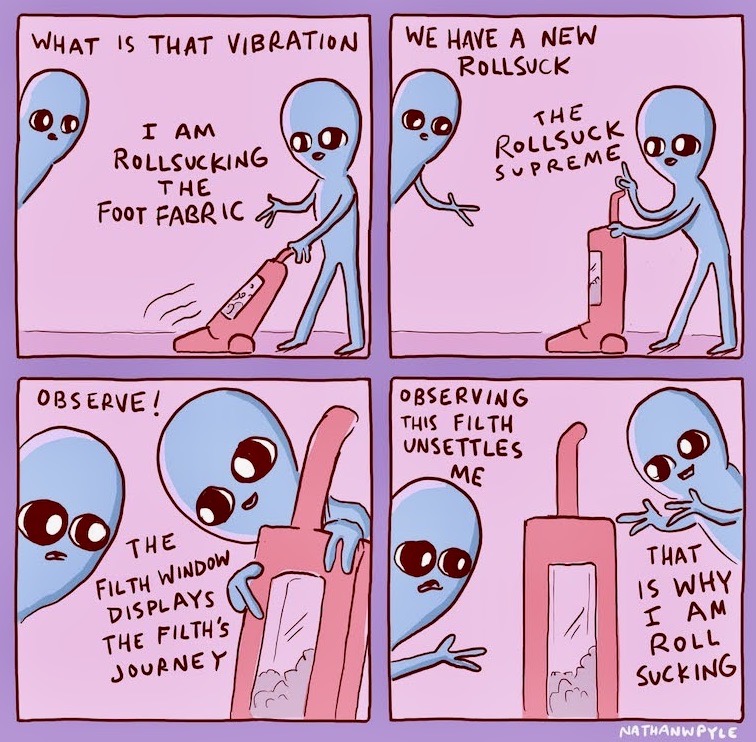
Yesterday’s Strange Planet comic strip by Nathan W. Pyle introduces the delightful verb / noun rollsuck ‘to vacuum’ / ‘vacuum cleaner’ (on Pyle’s strange planet, which has our customs but not our vocabulary):


The verb / noun as in: I am rollsucking the foot fabric ‘I am vacuuming the rug’

(more…)

Rabbit stew 2: vanella

December 1, 2024

Another Rabbit Day item in the stew (see my earlier posting today “Rabbit stew 1: Asian soup spoons”), taking off from this Facebook posting by Greg Morrow yesterday (with some editing by me):

In sort of an opposite of the penpin merger [AZ: in which syllable-offset /ɛn/, as in pen, and /ɪn/, as in pin, are both realized as [ɪn]], local dialect (including mine) has [vǝnɛlǝ] vanella as the pronunciation of vanilla [vǝnɪlǝ].

(Heard it today in the grocery, and I was like, yes that’s right, wait a second…)

A further comment went on with the idea that this ɪ > ɛ (before l) that gives widespread US vanella was in some way the opposite of the ɛ > ɪ (before n) shift that gives us US midlands inkpin [ɪŋkpɪn] ‘(ink)pen’.

(more…)

Perfecto Fancy-Boy

June 24, 2024

Perfecto Fancy-Boy, the Dingburg psychoanalyst, analyzes the appeal of Helmet Grabpussy in today’s Zippy the Pinhead strip:


(#1) Grabpussy’s real name is suppressed above, as too indecent to mention, even on this blog; but what grabbed me first in this strip was the name Perfecto Fancy-Boy for the psychoanalyst — a name that is most unlikely to have ever been given to any actual person, but is instead a pure creation of Zippy‘s cartoonist Bill Griffith

Zippy is a savorer of words and phrases. (He is also the playful lord of nonsensicality, call him Absurdo.) He has favorite names — Ashtabula, Estonia, Valvoline, Ding-Dongs, taco sauce, and more, treasured just for the way they sound, not for what they refer to; the Talking Heads album Stop Making Sense could have been named in his honor.

And he’s forever latching onto random expressions whose sound enchants him, so that he repeats them for pleasure, like mantras — what Griffy, the cartoon avatar of Bill Griffith, calls onomatomania. (There’s a Page on this blog about my postings on chants, cheers, mantras, and onomatomania.)

Then there’s Griffith’s choice of names for his characters — like Perfecto Fancy-Boy. No doubt intentionally crafted to some degree, but also to some degree pulled out of thin air, from Griffith’s subconscious, picked because they “sounded good”. I’m in no position to say which part is which, so here I’ll just unearth some possible ingredients in the name Perfecto Fancy-Boy, specifically in this name referring to a psychoanalyst.

(more…)

Extremely famous in a very small world

May 27, 2024

In my Friday (5/24) appointment with my rheumatologist, David Fischer, the doctor reported that he had found me cited as a distinguished linguist, in writing by a lexicographer whose name he couldn’t quite recall, except that it had a K in it. (It’s always a good thing when your doctors treat you as a knowledgeable person of consequence.) I allowed that I hung out with lexicographers and that I was in fact extremely famous in a very small world. We then had to press on to my arthritic gout and its treatment, in the brief time for the appointment, but afterwards I e-mailed him with two suggestions about the identity of the lexicographer:

most likely: Kory Stamper, author of Word by Word: The Secret Life of Dictionaries (2017), though I didn’t recall her having cited me

also possible: Arika Okrent, author of In the Land of Invented Languages: Esperanto Rock Stars, Klingon Poets, Loglan Lovers and the Mad Dreamers Who Tried to Build a Perfect Language (2009), who certainly did cite me

The answer is: KS, in Word by Word. On page 196:

(more…)

The Bizarro dog park

March 3, 2024

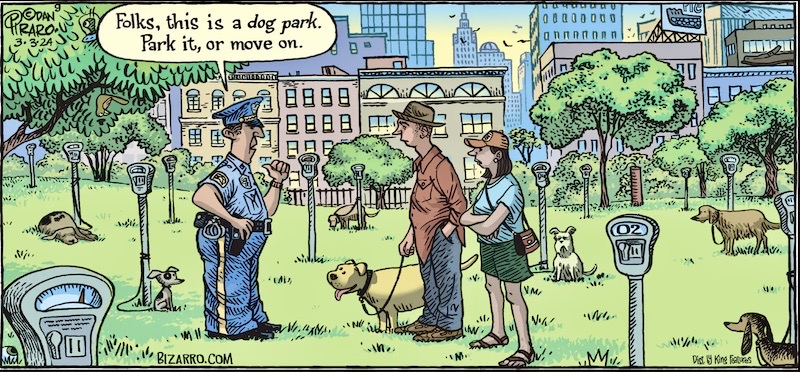
In today’s Bizarro, a dog park, with parking meters, where you can park your pooch by the hour:

Surprise! The strip exploits a possible sense of the N+N compound dog park — roughly, ‘an area or building where dogs may be left temporarily, for a fee’, the canine analogue of (largely British) car park ‘an area or building where cars or other vehicles may be left temporarily; a parking lot or parking garage’ (NOAD) — that you probably had never imagined.

Instead, you expected the everyday sense of dog park, ‘a park for dogs to exercise and play off-leash in a controlled environment under the supervision of their owners’ (Wikipedia) — a Use compound with the general meaning ‘park for dogs (to use)’, but coming with a sociocultural context that in practice conveys something considerably more specific.

Now, more details on everyday dog parks, and Bizarro dog parks too.

(more…)

UNVOICING

February 26, 2024

From Chris Waigl on Facebook yesterday, coping with the day’s Spelling Bee game on the web, in which she was told that her candidate UNVOICING was not a word — well, not a word acceptable in the game. Her hedged response:

UNVOICING is a word. (Well, maybe.)

(CW is, among other things, a linguist, and linguists often have complaints about what Spelling Bee is willing to accept as a word of English.)

I’ll expand on CW’s comment, and that will take us to a surprising place (AI chatbots and their discontents). But first, some background on the NYT Spelling Bee.

(more…)