Archive for the ‘Latin’ Category
February 22, 2025
A second follow-up on back-accented nadir in (American) English, now about the history of the word, whose antecedents in English include both front-accented pronunciations (as is — on the testament of dictionaries for British, American, and Australian English — standard throughout modern English) and back-accented ones (as I reported on in previous postings, with some surprise).
The questions are how English settled on front accent and where the exceptional back accent comes from, and I lack the resources to answer those questions, since the sources I have available to me provide spellings, not pronunciations, and accentuation isn’t marked in English spelling (so we have the homographic front-accented noun PRESENT and back-accented verb PRESENT). What I need is help from people who are familiar with the evidence on the accentuation of Middle French and Middle English (material that’s entirely unavailable to me; I don’t have access to a scholarly library).
(more…)
Posted in Accent, French, Language change, Latin, Pronunciation, Spelling, Variation | 2 Comments »
January 31, 2025
(dirty verse — a raunchy burlesque of some scurrilous doggerel — so not for kids or the sexually modest)
This is what I wrote to cease my weeping at a moment this morning when a number of MSNBC commenters, who were variously black, Jewish, female, and queer, struggled not to break down in hurt, anger, and despair in reporting on Anaranjado Grabpussy’s apparently declaring a ban on federal celebrations of DEI occasions (Black History Month, Pride, etc.). Further inspired by someone ranting, I don’t know why, on Facebook about Dildo as if it were the name of a person, a character in some social drama.
(more…)
Posted in Latin, My life, Parody, Poetic form, Quotations, Taboo language and slurs | 4 Comments »
November 15, 2024
Very briefly noted.
Passed on back on 11/9 by Michael Palmer on Facebook, this fine reworking of the map of Austria as an ostrich:

MP came across it on the Language Nerds Facebook site, but I don’t know who created the image in the first place
In English, Austria (a Latinization of the German name Österreich ‘eastern realm’) and ostrich (from a compound of the Latin avi- stem meaning ‘bird’ and the Greek struth– stem meaning ‘ostrich, big sparrow’) have only medial /str/ as clearly shared material, so are very distant puns, if they count as puns at all. Much the same is true of Spanish Austria and avestruz. Things are even more distant in Italian (Austria and struzzo) and of course German (Österreich and Strauß).
But in French, as I pointed out on Facebook, by the accidents of phonological change, Latinized Austria > Autriche and the avi– + struth– compound > autruche, yielding a truly fine pun: Autriche is an autruche!
So Austria not only looks like an ostrich, in French it sounds like one too. This makes me happy.
Posted in Art, Compounds, French, German, Greek, Language and animals, Language change, Latin, Placenames, Puns, Spanish | 3 Comments »
August 28, 2024
Well, actually, concept time. First come the useful concepts, then come the terms for them. My comments are prompted by Martin Haspelmath on Facebook today, on the useful terms (due to Alexandre François) colexification and dislexification for the expression, in some language, of distinct concepts in a single lexical form or distinct lexical forms, respectively; with MH citing this 2024 article from the journal Asia Pacific Translation and Intercultural Studies: “Colexification of “thunder” and “dragon” in Sino-Tibetan languages” by Hongdi Ding and Sicong Ding. From the abstract:
[372] languages were classified into colexifying and dislexifying languages, depending on whether the two concepts are associated with shared lexical forms. The findings reveal that 47 languages in the sample exhibit thunder-dragon colexification; most of them are Bodic and Na-Qiangic languages, with a few Sinitic, Mongolic, and Turkic languages. This areal pattern results from both inheritance and language contact.
So, patterns of colexification spread areally, through both inheritance and language contact, just like other linguistic features.
Note that colexification must have arisen in at least one language at some time, but this article isn’t about the mechanisms that might have given rise to colexification of ‘thunder’ and ‘dragon’ or to simple examples of colexification in English: ‘grain stalks’ (in the mass N straw) and ‘drinking tube’ (in the count N straw); ‘riverside land’ (in the count N bank, as in both banks of the Seine) and ‘financial institution’ (in the count N bank, as in savings banks).
But now the terminology.
(more…)
Posted in Categorization and Labeling, Derivation, Greek, Latin, Negation, Opposition, Semantics, Terminology | Leave a Comment »
December 26, 2023
(The randy elves of 12/22/23 are engaged in 3-way man-on-man sex, described here by its makers in street language, so this part of the program is unsuitable for kids and the sexually modest (IF THAT’S YOU: DO NOT READ); the rest of it is about a variety of seasonal customs, some of them off-beat but none requiring policing (PLEASE READ AND ENJOY))
In my title: highlights of the first day of the three-day run-up to Christmas 2023.
Each day provides two occasions to celebrate:
— 12/22/23: CAYF (the gay porn movie Cum All Ye Faithful) climax day, with that Christmas-elf 3-way sex as the centerpiece of the final scene in the movie and the title of the movie distantly connected to the Christmas carol in Latin, Adeste Fideles; and Festoonus (celebrated at my house with that Korean feast)
— 12/23/23: Last day of Saturnalia; and Festivus
— 12/24/23: Fourth Sunday of Advent; and Christmas Eve (finally, two well-known holidays — though how Christmas Eve is celebrated varies enormously)
Notes on the first two days, on which fall four occasions of minor rank (at least in the modern world).
(more…)
Posted in Clothing, Costumes, Gay porn, Hats, Holidays, Italian, Korean, Language and food, Latin, Lexical semantics, Music, Myths, Puns, Underwear | Leave a Comment »
June 27, 2023
On the nurses’ board, under “diet”, it said NPO; and if you asked if you could have some juice or whatever, nurses would tell you no, you were NPO — and then maybe they’d explain that meant ‘nothing by mouth’.
Why should NPO be an abbreviation of Nothing By Mouth? If they’d once learned why, they’d forgotten, and now it was just medical jargon with this meaning, and many of them no longer realized that ordinary people might be baffled by the claim that NPO was an abbreviation for Nothing By Mouth (for which the alphabetic abbreviation would be NBM).
But it is an abbreviation. Of Latin Nil Per Os — more exactly, Nil / Nihil Per Ōs, where nil is a contraction of nihil ‘nothing’ (as in English nihilism) and ōs (the object of the preposition per) is the acc sg of the 3rd-declension ‘mouth’ noun with nom sg ōs and gen sg ōris (as in English oral).
But in any case, users of jargon — expressions associated with particular occupations or activities — are very often not aware of its in-group status and aren’t prepared to explain it to outsiders; it’s just the way you talk in this context.
Posted in Abbreviation, Formulaic language, Initialisms, Jargon, Language and medicine, Latin | 2 Comments »
November 1, 2022
🐇 🐇 🐇 (NOVEM! NOVEM! N-O-V spells VON! Von who? No, No, that’s Doctor Von Who! Doctor Von Who’s on first? Doctor Von Who’s on first of November, oh god this is where we came in)
Bob Eckstein’s charming cartoon-trope cartoon (a new cartoon for Halloween this year @AltaJournal, also posted yesterday on Facebook along with a trick-or-treating story; and note that National Pumpkin Day went by on 10/26):

(#1) Three cartoon memes (I will no longer attempt to distinguish memes from tropes, given the extraordinary variation in the usage of the two terms): Sisyphus, Desert Island, Seeker and Seer
(more…)
Posted in Comic conventions, Language and religion, Latin, Linguistics in the comics, Music, Parody | 1 Comment »
August 30, 2020
Today’s morning name. So obviously Latin, a 2nd-declension neuter noun. But apparently not; instead it’s a mystery.
OED2 on tantrum:
Etymology: Origin unascertained.
colloquial.
An outburst or display of petulance or ill-temper; a fit of passion. Frequently in plural. Now often spec. a fit of bad temper in a young child.
[1st cite: 1714 E. Verney Let. 30 Oct. in M. M. Verney Verney Lett. (1930) II. xxi. 18 Our lady has had some of her tanterums as Vapors comeing out etc. Then: 1754 S. Foote Knights ii. 41 None of your Fleers!..Your Tantrums! You are grown too head-strong and robust for me.]
fleers? From NOAD:
verb fleer: [no object] literary laugh impudently or jeeringly: he fleered at us. noun archaic an impudent or jeering look or speech. ORIGIN late Middle English: probably of Scandinavian origin and related to Norwegian and Swedish dialect flira ‘to grin’
Etymology occasionally throws up mysteries like this one. If someone now wants to search collections of texts from the period, they might find some clues as to its source. It’s even possible that the noun doesn’t have an ordinary etymology, but was a mock-Latin invention. Whatever; ya gotta know the territory.
(more…)
Posted in Etymology, Latin, Morning names, Music | Leave a Comment »
June 20, 2020
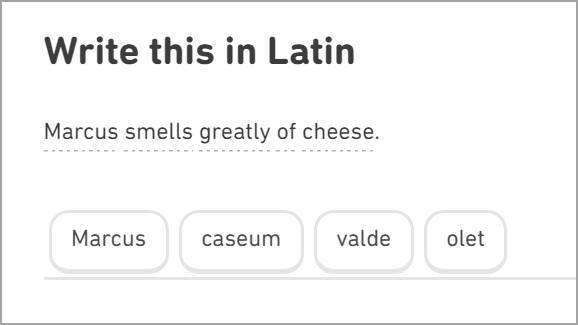
From Mike Pope on Facebook yesterday, this Duolingo exercise:

(#1) Mike’s note: “Duolingo is really great for learning those phrases you need every day”; word by word: ‘Marcus cheese greatly smells’ (with verb-final syntax)
A little hymn to Marcus as a cheesy comestible:
Marcus smells greatly of cheese
ripe, redolent of cheddar, his
pubic bacteria broadcasting his
manscent to any intimate nose, a
deeply tasty hunk, serve him up
with a young cabernet
Well then: some Latin, and some reflections on cheese and male sweat.
(more…)
Posted in Argument structure, Captions, Language and food, Language and the body, Latin, Switzerland and Swiss things, Syntactic functions | Leave a Comment »