Archive for the ‘French’ Category
September 20, 2022
(Warning: a vulgar term for the primary female sexual anatomy will end up playing a big role in this posting.)
Where this is going: to an alternative name for an American President (#45, aka TFG); and to an alternative name for a classic American novel (by J.D. Salinger) — both names being exocentric V + N compound nouns, the first in English, the second in French. (I’ll call them exoVerNs for short.)
(more…)
Posted in Architecture, Art, Books, Compounds, Derivation, French, Language and gender, Language and plants, Language and the body, Language in politics, My life, Synthetic compounds, Taboo language and slurs, Writers, Writing | 1 Comment »
September 9, 2021
(Astonishingly, this silly posting will devolve into references to male pubes (NOAD entertains both /pjúbìz/ and /pjubz/ as pronunciations, by the way, so do as thou wilt) and photos of hunky young men stripped down to them, so it’s not to everyone’s taste.)
It is once again Negation Day, a festival for semanticists, also customarily the day for the annual convention of No Joke, aka the Society for Language Play.
This year, the semanticists will gather en masse at the Square of Opposition, where a statue of Larry Horn, caught in mid-smile, will be unveiled; and in collaboration with the No Joke meeting, there will be staged performances of Monty Python’s “Argument Clinic” sketch. Then, as usual: a clinic for those suffering from overnegation and undernegation; and a bazaar where shoppers can rummage for negative polarity items and reinforcements for their everyday negatives. (Just Don’t Do It: because of ugly incidents in the past, metalinguistic negatives have been banned from the festival site.)
(more…)
Posted in Art, French, Idioms, Italian, Metonymy, Music, Puns | 3 Comments »
August 19, 2021
(Well, yes, jockstraps, depicted and described, with attention to their contents, so not to everyone’s taste.)
In a comment on my 8/15 posting “Jock Robin” (a posting about jockstraps in beautiful colors, masculinity, and sexuality), Mike McManus noted the relevant novelty song “Harry’s Jockstrap” (a jock that’s pale blue, suggesting that Harry is a fairy), a burlesque on the French nursery rhyme (and round) “Frère Jacques”. I had somehow missed “Harry’s Jockstrap”, but here it is, in all of its pale blue fairy glory:
Harry’s jockstrap, Harry’s jockstrap
It’s pale blue, it’s pale blue
They say that he’s a fairy. But Harry is so hairy
So are you, so are you
(Call this verse HJ.) The burlesque goes on and on through many more verses; I’ll give you a transcription and a recording of the whole thing — but first, some background. (more…)
Posted in Color, Dialects, French, Gender and sexuality, Language and the body, Masculinity, Music, Parody, Phonology, Poetic form, Poetry, Underwear, Variation | 3 Comments »
March 28, 2021
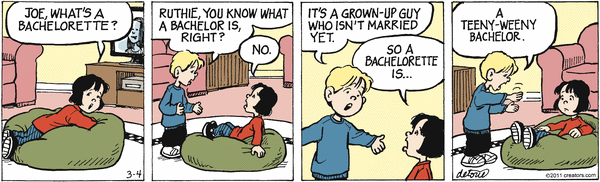
Diminutive, feminine (in some sense), both. In the One Big Happy strip of 3/4, in my comics feed on 3/36:
 (#1)
(#1)
In modern English — that’s important — the suffix -ette has two relatively productive — that’s also important — functions: as a literal diminutive, referring to a small version of the referent of the base to which –ette is attached (“diminutive” suffixes can have a variety of other functions, notably as expressing affection towards this referent); and as a literal feminine, referring to a female version of the referent of the base to which –ette is attached (“feminine” suffixes can have a variety of other functions, notably as markers of grammatical gender (ggender), as opposed to natural, or sex, gender (ngender); English doesn’t have ggender).
The big generalization about modern English is that –ette attached to bases with inanimate reference (like disk) tends to have the literally diminutive function (diskette), while attached to bases with human (or, more generally, higher-animate) reference (like usher), –ette tends to have the literally feminine function (usherette). Novel formations follow the generalization: a spoonette would be a small spoon, not a spoon in female shape, or a spoon intended for use by girls and women; while a guardette would be a female guard (perhaps viewed dismissively or derogatorily), not a miniature guard.
Ruthie’s brother Joe apparently fails to appreciate the big –ette generalization, and takes a bachelorette to be a miniature bachelor, rather than the female counterpart of a bachelor (in Joe’s terms, a grown-up girl — a woman — who isn’t married yet).
(more…)
Posted in Derivation, Diminutive, Etymology, French, Gender, Grammatical categories, Inflection, Linguistics in the comics, Morphology, Movies and tv | Leave a Comment »
September 5, 2020
Elizabeth Daingerfield Zwicky arrived this morning with a collection of astonishing bird-related birthday presents for me: a ground-hugging bird bath, a Water Wiggler for the bird bath, and a hanging metal mesh bird feeder in the shape of a penguin. (There’s always something penguin-related.)
None of these is a standard item for the yard or patio, but Elizabeth has been cultivating birds in her own backyard and now knows a lot about bird gear. (Oddly, though she lives only about six blocks from me, she has bird visitors I do not: hummingbirds, chickadees, and parakeets, in particular).
(more…)
Posted in Etymology, French, Language and animals, My life | 1 Comment »
January 21, 2020
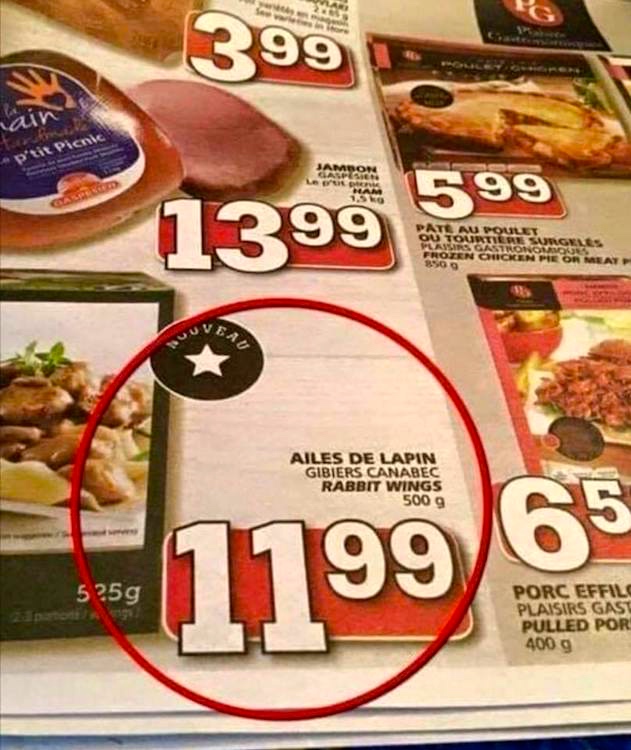
On Facebook recently, this supermarket snap, presumably from a store in Quebec, with a notable offering highlighted:

(#1) Five parts to the labeling: the name of the product in French (ailes de lapin); the name of the company (Canabec, a Quebec distributor of game — gibiers — and exotic meats; cf. elsewhere Plaisirs Gastronomiques, a Quebec company offering gourmet food, and Gaspésien, another Quebec fine food company); the name of the product in English (rabbit wings); the weight (in grams); and the price (in C$ / CA$ / CAD)
Much FB merriment over ailes de lapin ‘rabbit wings’, to which I responded:
Um, these are rabbit legs, right? Metaphorical? They resemble chicken wings and can be cooked in all the same ways. (Chinese rabbit wings are yummy.) M. Lapin: “Oh, that I had wings like a dove! for then I would fly away, and be at rest.” (Psalm 55) — later adding: “Oh, that I had wings like a rabbit! for then I would bound away, and be at rest.”
It’s a metaphor, son! A metaphor! Apparently one that is dead in Quebec, and so unremarkable in Quebecois — cf. Fr chauve-souris ‘bat’ (lit. ‘bald mouse’), Engl head of lettuce (where are its eyes and mouth?), and other dead metaphors that become entertaining when you attempt to breathe life back into them.
(more…)
Posted in Catchphrases, French, Language and food, Mascots, Metaphor, Movies and tv, Silliness | 3 Comments »
December 8, 2019
Recently posted on Facebook, this melding of the traditions of Judaism with the traditions of Jedi-ism for the holiday season, in French:

(#1) ‘May the light be with you’: the Jedi Master Yoda wields a lightsword menorah for Hanukkah (Fr. Hanoucca) — Happy Hanukkah! (Joyeuse fête de Hanoucca!)
(more…)
Posted in Arabic, French, Greetings, Hebrew, Holidays, Language and religion, Movies and tv, Pop culture, Rainbow | 3 Comments »
March 17, 2019
(Men’s bodies and tons of mansex — anal, anal, anal — in street language. No actual penises on display, but nevertheless absolutely not for kids or the sexually modest.)
Padraig porn for the day:

(#1) The TitanMen gay porn sale for this weekend: Kiss me, I’m Irish
(more…)
Posted in Argument structure, Art, Catchphrases, Dance, Facial expressions, Formulaic language, French, Gay porn, Gaze, Gender and sexuality, Holidays, Language of sex, Language play, Music, Puns, Snowclones | 1 Comment »
March 16, 2019
A dire nautical theme in today’s morning names: le naufrage ‘shipwreck, sinking’ and le naufragé ‘shipwreck victim, castaway’, powerful elements of popular culture and frequent subjects of news stories, books, and films.
I was first taken to le naufrage de l’Andrea Doria, an event that vividly evoked the summer before my junior year in high school; then (among the innumerable fictional representations of shipwrecks and castaways, going back to the Odyssey and before) to Tom Hanks in the appalling Cast Away; and, then, through the whimsicalities of googling, to Le naufragé (English title Stranded), a 2009 short comedy-drama film — about which I can find virtually nothing of substance.
(more…)
Posted in French, Morning names, Movies, Pop culture, Snowclones | 3 Comments »
March 3, 2019
From various friends on Facebook who know that I’m interested in meta-comics, this 4/21/17 Imbattable strip by Pascal Jousselin, in an English translation:

(#1) Imbattable (‘Unbeatable’) is a bandit superhero in a yellow and black costume
Among Imbattable’s superpowers is his ability to break the walls of the cartoon’s panels and freely move between them. With the result that temporarily, in the fourth panel, the cat is in two places at once — a phenomenon that unsettles both the cat and the old lady.
(more…)
Posted in Comic conventions, Formulaic language, French, Idioms, Linguistics in the comics, Truncation | 1 Comment »