Archive for the ‘Language play’ Category
December 13, 2023
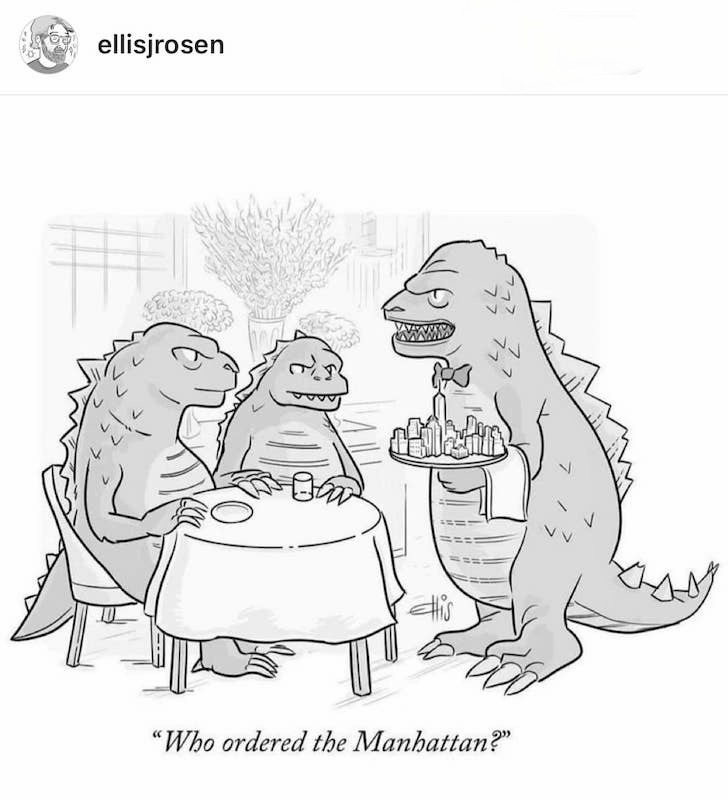
An Ellis Rosen pun cartoon (which came by me on Facebook this morning) in which ER manages to treat Manhattan, the name of the island that’s one of the boroughs of New York City, as a pun on Manhattan, the name of the cocktail (made with whiskey, sweet vermouth, and bitters). This is a signal achievement in joke puns, managed by exploiting Godzilla / Gojira, from the Japanese movies, a radioactive prehistoric reptilian monster with a ravenous appetite for urban infrastructure, especially city buildings and large vehicles:

The cartoon, situated in a world of reptilian monsters (a world that’s a translation from our everyday world of restaurant dining); as a bonus, in an inset, the cartoonist’s thumbnail sketch of himself
On his Instagram page, ER says he’s re-posted this old cartoon of his because of the new Godzilla movie.
(more…)
Posted in Ambiguity, Comic conventions, Jokes, Linguistics in the comics, Movies and tv, Puns, Understanding comics | Leave a Comment »
December 11, 2023
Country names, take me home
To the place at the table where I belong
(with apologies to John Denver and his collaborators)
This posting is, first of all, about bare-bones pun jokes, typically a one-line set-up followed by the pun in a pay-off line.
In this case, on a theme (food and eating), with the puns all from a domain (of country names); the classic pun name on this theme from this domain is Hungary (punning on hungry). I will illustrate with three Hungary-based bare-bones jokes.
Then, name-domain + theme puns (in this case, country + food puns) can be arranged in a cascade, which can be performed by a single joke-teller or framed as repartee between two performers. The classic country + food cascade is triggered by Hungary (Greece, Turkey, and Chile are other possible triggers); I’ll call it the Hungary For Food Riff, HFR for short. HFR comes in many variants; here I give two repartee versions: one relayed to me by Probal Dasgupta on Facebook on 12/9, the other I found in net collections of puns on Hungary later that day.
(more…)
Posted in Ambiguity, Formulaic language, Jokes, Linguistics in the comics, Music, Names, Puns, Routines and rituals | 1 Comment »
December 8, 2023
Now for a joke type that isn’t pun-based. Instead, like snowclones, these jokes are based on formulaic expressions, and involve replacing items in the formulas by (semantically) analogous items; they are analogical extensions of the formulas. One popped up in today’s Wayno / Piraro Bizarro:

(#1) To understand this cartoon, you have to retrieve the conventionalized N + N compound dog whistle, the basis for dog tuba (if you’re puzzled by the odd symbols in the cartoon — Dan Piraro says there are 3 in this strip — see this Page)
From NOAD:
(compound) noun dog whistle: [a] a high-pitched whistle used to train dogs, typically having a sound inaudible to humans. [b] [usually as modifier] a subtly aimed political message which is intended for, and can only be understood by, a particular group: dog-whistle issues such as immigration and crime.
It’s sense a that’s relevant to #1, which shows a guy playing a tuba at a high pitch humans can’t hear (note that the other guy is struggling to hear anything at all) but dogs can (note the dog stopping up its ears in pain). So: the dog is experiencing not a dog whistle, but (preposterously) a dog tuba.
(more…)
Posted in Formulaic language, Jokes, Language play, Linguistics in the comics, Snowclones, Understanding comics | 1 Comment »
December 8, 2023
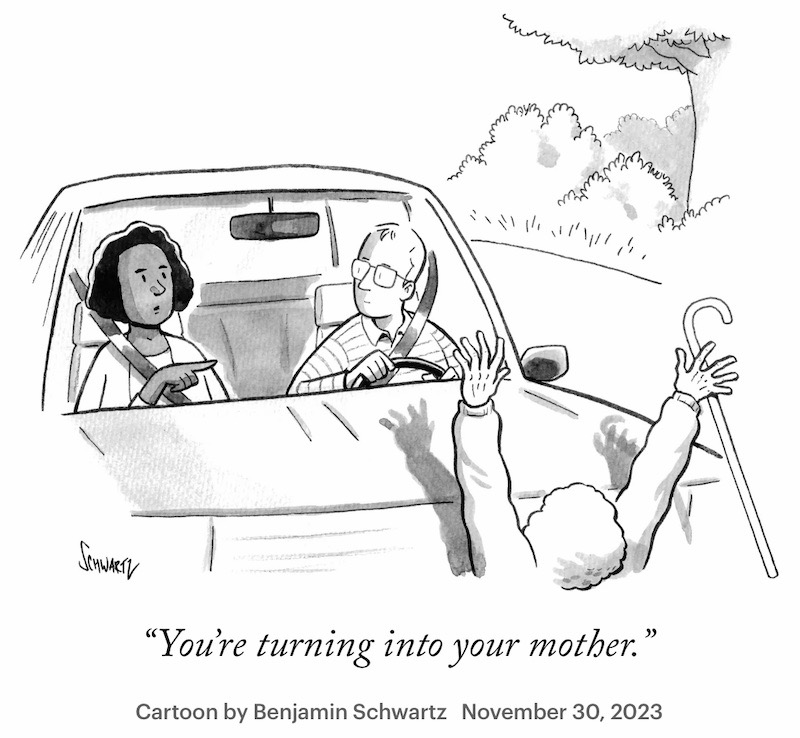
By Benjamin Schwartz in the 12/11/23 print issue of the New Yorker:
On first looking at the cartoon, we go to the faces, because faces are so socially important to human beings. There are two: a woman, speaking; and her male companion, the driver of the car they are in, his face turned to listen to her. She is voicing an observation (usually a complaint) that is conventionally and stereotypically taken be to common in intimate couples in our society, that the addressee is turning into — becoming, in significant ways — one of their own parents.
In any case, what we perceive at first is the passenger telling the driver: You’re turning into your mother, with inchoative turn into ‘become’.
But then we take in the rest of the drawing, where we see — surprise! — an old woman, up against the hood of the car, her hands up in the air, her cane flying into the air; the car has run into her. The passenger is in fact observing to the driver that he’s driving into the old woman, using one of the senses of motional turn into, with a complement referring to the end-point of the turn.
(more…)
Posted in Ambiguity, Argument structure, Jokes, Lexical semantics, Linguistics in the comics, Puns | 1 Comment »
December 5, 2023
It’s a foggy day in Palo Alto town, on the anniversary of my return home from a Palo Alto rehab center on 12/5/20, after having given up drinking several weeks before, a decision that impelled me into Stanford hospital with alcohol withdrawal syndrome on 11/11; I was moved to the rehab center on 11/17, and then discharged into the world on 12/5, as a recovering alcoholic beginning a new life. So 12/5 is a kind of rebirth day for me.
12/5 comes in between the death days of two remarkable musicians: Frank Zappa on 12/4 and Wolfgang Amadeus Mozart on 12/6. This year Zappa’s death day was anticipated by Kyle Wohlmut’s posting, on Facebook on 12/3, this inspired digital creation honoring FZ:

(#1) Seeing nothing like this on the (delicatessen food company) Dietz & Watson site, I assume that the Zappa Franks billboard is the work of ingenious bots.
It occurred to me that FZ might have composed the thing himself, that would have been so FZ, but I can find no evidence that he did. So this will be our “Eat Me” homage to him now.
(more…)
Posted in Art, Death notices, Holidays, Language and food, Language and medicine, Music, My life, Phallicity, Puns | Leave a Comment »
December 4, 2023
(Rampant nakedness, juicy description of man-on-man sex, definitely not for kids or the sexually modest)
A piece of sheer raunchy frivolity. Two naked lads, a hunky bottom and a twink top, both wearing Santa caps, meet in a 12/1 mailer ad for a scene from Falcon’s gay porn flick Cum All Ye Faithful. Bottom Beau Butler has a package, a box, to offer top Trevor Brooks, who has pulled his briefs down to show what he’s got available to put into Butler’s package:
(more…)
Posted in Clothing, Costumes, Euphemism, Gay porn, Hats, Holidays, Homosexuality, Language and the body, Language in advertising, Language of sex, Male art, Metaphor, Puns, Slang, Taboo language and slurs | Leave a Comment »
December 2, 2023
A common joke form exploits an ambiguous expression E. Prior likelihood or the preceding context in the joke favors one understanding for E, but then fresh context (in the joke) brings out another, more surprising one. The effect is that the sense of E has shifted as the joke proceeds. It’s a pun, son. Used in a sense-shifting pun joke. (Puns get used in all sorts of jokes: knock-knock jokes, one type of riddle joke, and more.)
I now offer two examples that especially tickled me, to show how such ((phonologically) perfect) puns work. Then some comments on a different joke form, formula pun jokes, which can turn on imperfect puns and involve a different kind of set-up / pay-off from sense-shifting pun jokes.
(more…)
Posted in Ambiguity, Comic conventions, Illusions, Jokes, Language and race, Language and the body, Linguistics in the comics, Perception, Performance, Puns, Quotations, Snowclones, Taboo language and slurs, Understanding comics | Leave a Comment »
December 1, 2023
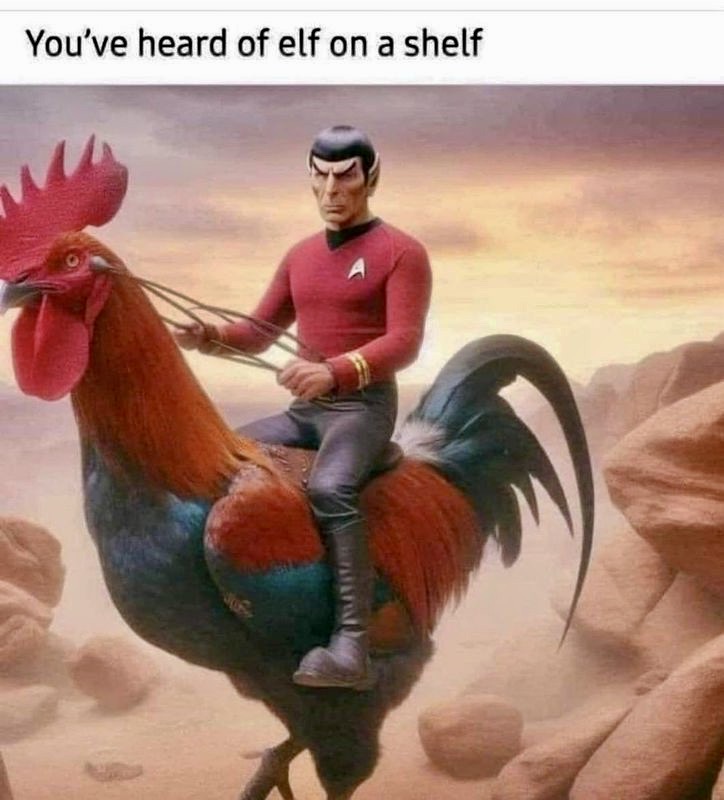
It’s December, and as the Christmas elves appear, there comes a startling elfshelfism joke (in abbreviated form), on Facebook today. I got it from Ryan Tamares, who got it from Britannic Xen Osiris Zane, who got it from someone else, and who knows where such memic material originated.

(#1) Yes, Spock on a cock: the science officer of the starship USS Enterprise, riding a monstrously large rooster (across a bleak alien landscape)
To get to the punchline Spock on a cock, you have to recognize the figure of Spock (from popular-culture tv and movie fiction) and also recall that cock — most commonly used for raunchy reference to the penis — is also a somewhat antique or specialist word for a rooster. (As a result, #1 is not only a joke, but also a slightly dirty joke.)
As described in my 12/22/22 posting “Elfshelfisms”, the elfshelfism is a riddle form presented visually, and depends on rhyme (perfect rhyme or half-rhyme), with example punchlines: lemur on a femur, Dolly [Parton] on a tamale, and sonorants on cormorants.
(more…)
Posted in Formulaic language, Jokes, Language and animals, Language and the body, Linguistics in the comics, Movies and tv, Rhyme, Riddles, Taboo language and slurs, Understanding comics | 1 Comment »
December 1, 2023
(Hey, it’s Tom of Finland, what do you expect? — it’s dripping with raunchy suggestiveness; not to everyone’s taste)
🐇 🐇 🐇 rabbit rabbit rabbit to inaugurate December, and time for some seasonal sexy silliness. Meanwhile, it’s World AIDS Day, a moment of retrospective grieving and prospective hope.
For the month of December in my 2023 Tom of Finland calendar, this b&w vintage Santa (from 1982):

(#1) A pleasant smile, admirable pecs and abs, and a gigantic ToF erection
And now, three more ToF Santas, in vivid color.
(more…)
Posted in Art, Gender and sexuality, Holidays, Male art, Puns | Leave a Comment »
November 27, 2023
A One Big Happy strip, recently in my comics feed:

(#1) James (mis-)takes Ruthie’s meta-commentary — her talk about what’s going on in her interaction with James — to be part of that interaction, to be her next move in the routine of the knock-knock joke, and shows that he understands that routine, by producing the appropriate next move in the routine
James might be a dirty-faced urchin, but he knows his joke routines. And, in the last panel, is probably wondering how on earth Ruthie’s going to make a pun out of jeezy-peezy-I-forgot-the-joke.
So: mastering the routine of the knock-knock-joke is one thing, but then the routine incorporates another type of joke, the pun joke, which has its own requirements. In addition, the knock-knock joke requires not just any pun, but a (phonologically) imperfect pun, the more distant the better, so that its punch line will have genuine surprise value.
(more…)
Posted in Ambiguity, Formulaic language, Jokes, Language acquisition, Language play, Linguistics in the comics, Puns, Routines and rituals, Variation | 3 Comments »