Archive for the ‘Language of teenagers’ Category

DWM

August 7, 2010

A Zits for the weekend, on adolescent males and the language used to talk about them:

The initialism DWM traces back to DWI, for the legal term Driving While Intoxicated (compare DUI for Driving Under the Influence), surely mediated by DWB (Driving While Black-or-Brown), which is a (somewhat bitter) play on DWI.

Zippy taken over by Valley Girl

August 6, 2010

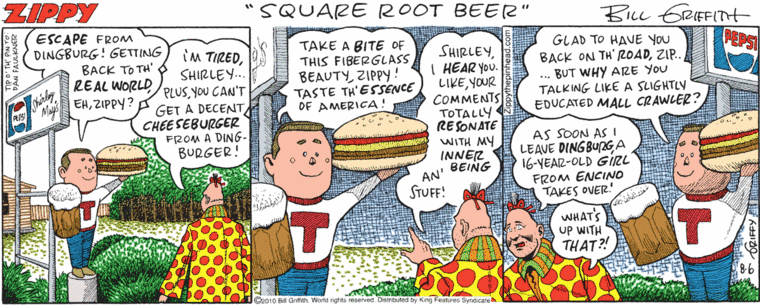
Gender, generation, class, and region stereotypes come together in the Valley Girl figure — SoCal upper-middle-class teenage girl — that we’ve written about several times on Language Log and this blog. Now she’s gotten to Zippy:

As usual, the locale of a Zippy is taken from real life: Shirley May’s Restaurant-Big Boy in Albany (or, if you want to get really local, Crabtree) OR (photo here). Shirley’s breakfasts get good reviews.

I like the conceit of having Zippy address Big Boy as Shirley.

And then there’s the strip’s title, “Square Root Beer”, a phrasal overlap portmanteau.

Guytalk

August 2, 2010

Teenspeak and genderspeak are perennial topics here and on Language Log, especially as they are represented in cartoons — see, for example, “Dudetalk in the Arctic” (here) and “Teenspeak, genderspeak” (here). But mostly we talk about the linguistic features of generationlects and genderlects. Of course, the content, or subject matter, of speech is equally of interest, and there are genuine differences between groups in what they tend to talk about — what interests and concerns them — as well as heavy stereotypes about such things.

Which brings us to today’s Zits, where the teentalk and guytalk stereotypes about content come together in another one of those little mother-son chats:

On exhibit is the stereotypical adolescent (and adult) male interest in the extreme, especially in activities that are disgusting, humiliating, or dangerous (but challenging). And the stereotypical adolescent (and adult) female interest in relationships and clothing. There’s some basis for the stereotypes in reality, of course.

Cartoons for the weekend

June 25, 2010

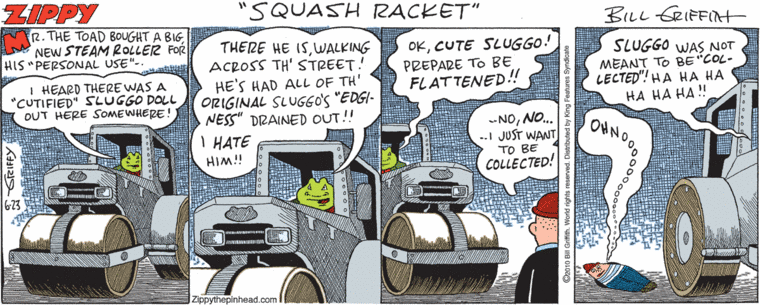
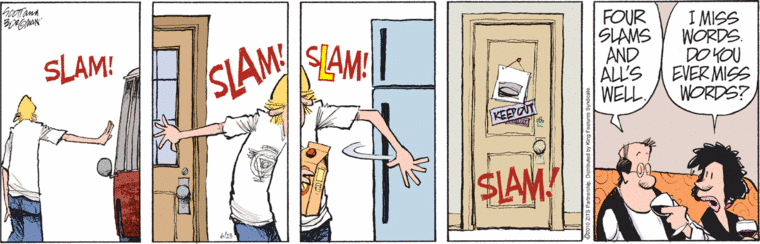
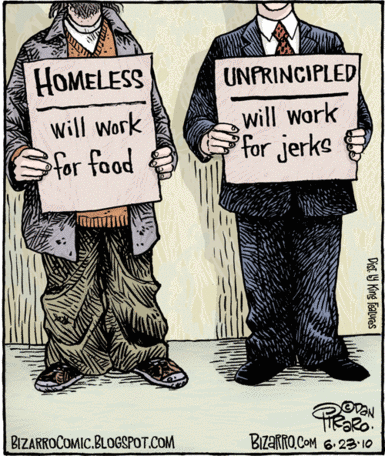
Three language-related cartoons: in order, a Zippy, a Zits, and a Bizarro.
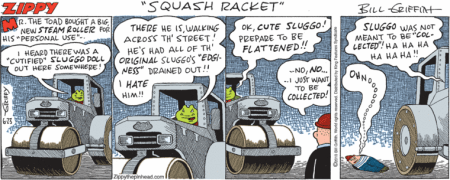
Mr. Toad’s cutified (in quotation marks, note, to signal its ostentatiously innovative character)  — adjective cute + causative/inchoative derivational suffix -ify — exemplifies Zippyworld playfulness with derivational morphology (on which, see, most recently in this precinct, my “creepitude” posting here). Here’s the relevant part of the entry on -fy in Michael Quinion’s affix list, where it’s glossed ‘make or produce; transform into; become’:

Many verbs in this ending exist, formed either from nouns or adjectives. Some examples are amplifycertifydignifyexemplifyhorrifyidentifyliquefy, magnifypacifyratifysatisfystupefytestify, and verify. [AMZ: Note that many of the examples in this list, though historically related to noun or adjective stems (example – exemplify, dignity – dignify, liquid – liquefy, peaceful – pacify) are now not productively related to these sources. The way is then open to “liberate” the derivational suffix and apply it afresh to noun and adjective words (not just stems).]

The ending is in active use, forming verbs both from nouns and adjectives. Because many existing examples contain the linking vowel -i-, its form is usually taken to be -ify rather than -fy.

Verbs are sometimes created with humorous intent, as in trendify, to make trendy or fashionable, and yuppify, to make an area attractive to yuppies; others of similar kind are cutify [right there in Quinion’s list, Mr. Toad]uglify, and youthify.

If the examples I’ve collected (as contributions to Beth Levin’s more extensive lists on verbings with zero, -ize, and -ify) are any indication, the playful innovations appear most commonly in PSP forms (cutefied) and in nominalized versions with -ification (cutification). (My lists include the variant cutesify, which is even cutesier than cutify.]

Now the Zits, in which Jeremy does the stereotypical sullen-teenager wordless thing:

Finally, another Bizarro disquisition on (potential) ambiguity, presented here not in an actual pun, but in the juxtaposition of two different senses of an expression (work for, ‘work to obtain something’ or ‘work in the employ of someone’):


These distinct senses won’t conjoin, except in deliberately joking zeugma: “I’ll work for food but not Daddy Warbucks.”

Remember: Ambiguity Is Everywhere.

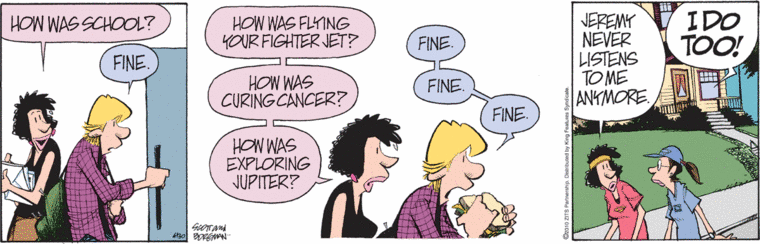
You’re not listening to me!

April 30, 2010

Another cartoon for the weekend: a Zits on communication hang ups:

Here, the person doing the talking is female and the person (apparently) not listening is male, and this configuration is conventionally associated with communication hangups, especially (but not only) in mixed-gender couples; “he just doesn’t listen to me”, the women complain. (In real life, you can sometimes find male couples where one man — or each man — complains about the other.)

But in the cartoon the person doing the talking is also a parent and the person (apparently) not listening a teenage child, and this configuration too is conventionally associated with communication hangups.

Put the two conventional associations together, and you get an especially potent combination of beliefs, that teenage boys just pay no attention to what their mothers are saying.

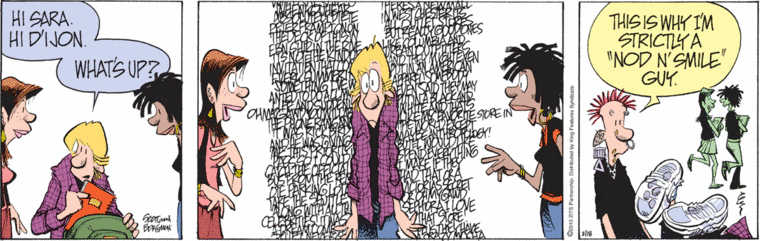
Chatty Cathies

February 18, 2010

(or Cathys — see this posting on, among other things, the plural of rubber ducky.) Yet another Zits on gender stereotypes of adolescents:

800 words

January 11, 2010

I’m sure this has come by me before, but I can’t unearth it. In any case, here’s the beginning of a piece (“On the 800-word myth”) by David Crystal on his blog, January 10:

Sunday Times correspondent rang up last week to ask what I thought about the claim made by Jean Gross (described as the new UK ‘communications czar’) that ‘the average teenager uses just 800 words in daily communication’. It was one of those waste-of-time interviews, where I spoke to the reporter for about 20 minutes, explaining how simplistic statements of that kind are rubbish, and what the linguistic realities are, and got one sentence in the report for my pains. Plus an ignoring of all the issues. The report was headed ‘Youngsters are using just 800 words in everyday speech’, as if this was a fact. I’m already receiving emails asking whether this is true, and I expect more as the week proceeds.

Crystal goes on to look at estimations of vocabulary size and vocabulary use — an evergreen topic on Language Log and other linguablogs. Of course, 800 is an absurdly small number.

Teenagers are often the butts of such reports. After all, everyone knows how linguistically deficient kids are.

Low marks to Gross for the preposterous claim and to the Sunday Times for passing it on (disregarding David Crystal’s information in favor of reproducing stereotypes). The press these days!

(A possible lead to the source of the 800 words figure: educational consultant Ruby Payne, who maintains that casual conversation between friends is usually limited to a vocabulary of 400 to 800 words and also that children of poverty are limited in the registers available to them. Where she gets the 400-800 word estimate, I have no idea.)