Via Dennis Lewis on Facebook, a link to a Huffington Post piece “Social Conservatives Will Defeat The Gay Agenda By Inventing New Words” (by Jason Linkins, April 11). What’s being proposed is not lexical innovation but a shift in the terms to be used in the domain of homosexuality, substituting other existing terms for those used by gay people (especially the term gay itself) — a shift referred to as rebranding by some social conservatives.
Archive for the ‘Language and sexuality’ Category
Rebranding
April 14, 2011Naming your porn company
March 26, 2011Suppose you’re going into the business of providing scenes from gay porn movies on-line. You’ve written the copy that says
Your home for the best adult male movies & scenes. Stream, download & own thousands of XXX scenes from your favorite movies.
Now what do you name the company?
Falsely masculine names
January 5, 2011More from David Rakoff’s Half Empty:
At eight years old, in the Canadian Rockies and faced with the prospect of an enclosed gondola that traveled up to the summit of a mountain, I wept in fear, as I was often wont to do, even as I understood myself to be in surroundings of unconscionable majesty and loveliness; magnificent peaks rising through the pine-scented air, with adorable, nut brown chipmunks scampering about. After what must have been a trying interval of patient parental psyching up, I finally marshaled myself and got on. In the snack bar at the top, tears all dried, my father made me a medal in one of those machines that presses letters into a metal disk–part sheriff’s star, part one of those plastic cogs one used to put over the central post in a turntable to play a 45. DAVE THE BRAVE it read. Everything about it was counterfeit, from the rhyming slogan’s required shortening of my name into the falsely masculine Dave, to the lightness of the cheap, soft aluminum, too easily impressed–more thumbprint cookie than Vulcan-struck ingot.
My focus is on Rakoff’s judgment that the nickname Dave is falsely masculine.
Word associations as synonymy
December 31, 2010From “Disappearing ink: Afghanistan’s sham democracy” by Matthieu Aikins, Harper’s Magazine for January 2011, p. 40:
The Anglicism “democracy,” for many Afghans, has become synonymous with unprecedented corruption, moral decay, and hypocrisy; it is another one of the plagues that the West has brought to this country.
So, for these Afghans, the word democracy has picked up (specific) negative connotations in certain sociocultural contexts. This is bad word association — [bad] [word association] , not [bad word] [association] — in fact, bad word association described by synonymous with in an extended sense.
Pansies
August 28, 2010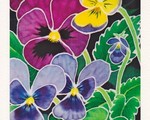
A few words from Sir Ian
July 25, 2010Passed on to me by Mary Ballard: Sir Ian McKellen proclaiming a gay pride slogan (not one I have — yet — on a t-shirt):
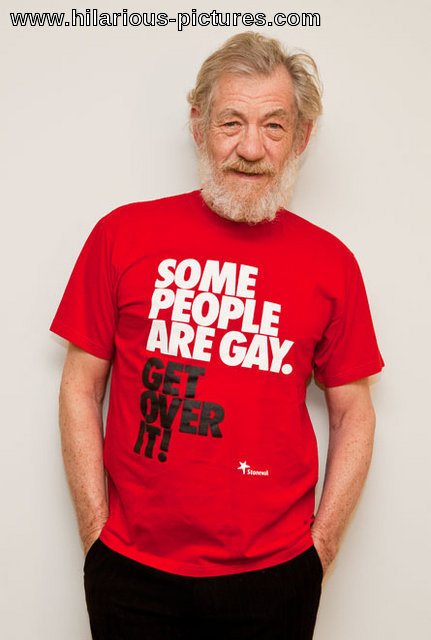
Observation: the slogan comes in two parts, together replacing the gay pride slogan of my youth (a few years ago):
We’re here / We’re queer / Get used to it
The in-your-face first part of the older slogan has been replaced by a simple statement of fact (and modest, too, making an existential claim well short of the universal We Are Everywhere), the second part by a more currently fashionable exhortation. (At least, many people seem to feel there’s a fashion for “get over it”. I haven’t tried to collect data on this version as opposed to “get used to it”.)
Observation: I don’t know whether something is intended by the bold color choice (flaming red and black), and if so, what, but it’s an interesting alternative to more traditional pink or lavender.
Observation: yes, that’s a Stonewall shirt, here.
Observation: somebody seems to feel that the shirt is hilarious, a suitable target for mockery. But then the range of images on hilarious.com is pretty wide.
Observation: a number of commenters on hilarious.com identify Ian McKellen as Gandalf, period, as if that’s what he had been knighted for.
Observation: yes, Sir Ian is very old, by which I mean that he’s at least a year older than I am. Ok, not by much, but still more than a year. (Nancy Pelosi is younger than he is, but only by about ten months, which means that by my metric she’s old but not very old.)
Color coding
May 6, 2010From Bizarro, a new color-coded threat level for U.S. Homeland Security:
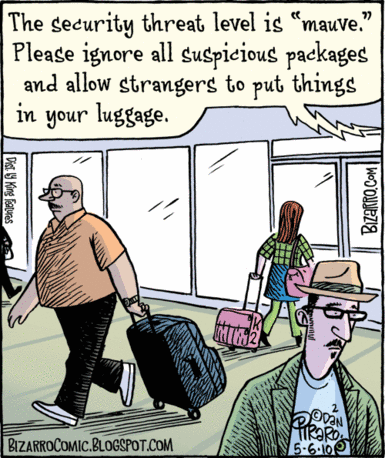
The lavender-lilac, or pinky-purple, color mauve (named for the flowers of the mallows, of the genus Malva) — Whistler, contemptuously, “Mauve is just pink trying to be purple” — became culturally, socially, and economically significant following on William Henry Perkin’s 1856 discovery of the synthetic dye mauveine (the first of the many aniline dyes). (See Simon Garfield’s Mauve: How One Man Invented a Color That Changed the World.) It eventually became associated with femininity (due to its use in women’s clothing, most notably by Queen Victoria and Empress Eugénie), homosexuality (one gay man to another, contemplating a sunset, in Angels in America: “Purple? What kind of homosexual are you, anyway? That’s not purple, Mary, that color out there is mauve.”), and decadence (as in Thomas Beer’s book about the 1890s The Mauve Decade: American Life at the End of the Nineteenth Century — compare Oscar Wilde, Aubrey Beardsley, and all that).
The feminine/gay associations continue to be strong, as in the stereotype that (only) women and gay men know and use color terms like mauve and taupe; see Mark Liberman’s discussion, here, of xkcd’s recent explorations into color vocabulary as used by women and men.