Archive for the ‘Language and gender’ Category

Can I help?

October 1, 2025

🐇 🐇 🐇 rabbit rabbit rabbit for the new month, which is coming in locally with October showers (a tiny amount of rain, but always an excitement in what is still the dry season in this part of the world)

And now I turn to a William Haefeli cartoon from the New Yorker issue of 9/22/25 (this is only a bit behind the times; I have promised follow-up postings to first installments going all the way back to January, and my life is now spectacularly more difficult than it was before, so I’m just taking random shots). This cartoon:


(#1) All about the complexities in offers of help — from anyone, from someone who shares your household, from your spouse (or equivalent partner), or specifically from your same-sex partner, or (since this is Haefeli) even more specifically from your gay male partner; and also about the division of labor in households of all sorts
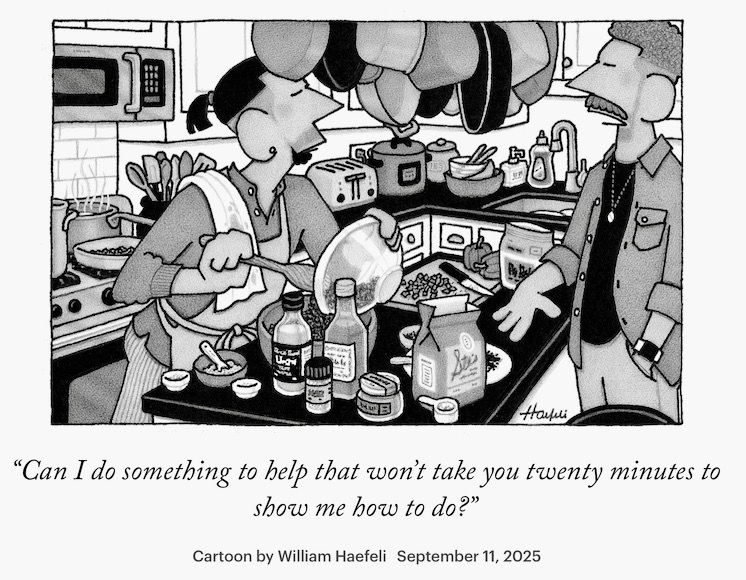
The cartoon is in face exceedingly rich, readable at several different levels. It is, in fact, funny even if you eliminate all the rich social specificity Haefeli has built into it.

A thought experiment: replace the highly socially located characters in #1 by cute indistinguishable cartoon creatures not identifiable by species or sex. One is engaged in some neutral task, like sorting unidentifiable objects; the other, standing by and observing, asks (in a way that presupposes that the observer doesn’t already know how to do the task):

Can I do something to help that won’t take you twenty minutes to show me how to do?

(This is an offer to help, couched indirectly, as a question, and also hedged, with a precondition on the offer.)

It’s still funny — because all tasks require skills, which must be learned (by observation or instruction, and then by practice), but there’s a wide range of complexity and difficulty for these skills, and at the upper end of the range, it could take a significant amount of time for a new helper to pick up the skill, so the observer conveys that their offer is conditional on the learning time being short; 20 minutes would be too great an investment for them. We then have some wry mockery of the observer’s attitudes — that they’ll do it, but only if it’s not too much trouble. They want the credit for offering, but don’t want to commit much to the task.

In real life, I have often had the experience, in difficult times, of having someone turn up offering to give me whatever help is needed, but then when asked to do some specific task, demurring on the grounds that “Oh, I couldn’t do that!” I have an especially unpleasant memory of my stepmother-in-law arriving in Cambridge MA (in the middle of a bitter winter, from Florida), after our daughter Elizabeth was born, to help out with the baby. Almost anything that would have helped us — doing some cooking, getting groceries, taking clothes to the laundromat, whatever — was greeted with “Oh, I couldn’t do that!”. After a few days she went back to Florida and out of our lives for a while, to our great relief.

But now in the social context. As soon as you add some social context, the cartoon becomes much richer.

First, the task is cooking, which is famously complex and time-consuming. And look at that kitchen! Crowded with pots and pans and, everywhere, ingredients. Conveying that helping out is likely to be no small undertaking.

Second, the the cartoon is about a cook and their housemate, so the division of household labor now comes to the fore: how does it come about that one person does all the cooking while the other merely observes, sometimes extending a conditional offer of help?

Third, domestic cooking in our sociocultural context is “women’s work”, so we would guess that the cook is female and the observer male, that these roles are assigned by gender-normative conventions, with the result that the observer is being cast as normatively masculine: pointedly not doing women’s work, because that would be feminine. But he might, um, lend a hand to the little lady. As a favor. If it wasn’t too much trouble. Then the cartoon is a poke at the pretensions of the observer.

But, wait! Fourth, the couple in the actual cartoon are both men. Whatever their relationship, if they are at least housemates, tasks have to get done, and somebody’s got to take the cook role. The roles have to be negotiated. And the cartoon is, again, a poke at the pretensions of the observer.

And then, in fact, the cartoon comes from Haefeli-land, a place of urban (very likely, NYC) upper middle class couples, many of them gay men. So fifth, the men in the cartoon are in fact a gay couple — and they are differentiated as two different types of gay men: the observer presenting himself as normatively masculine in appearance, the cook as deviating from these norms (earring, fashionable haircut, ponytail). Which, by playing on the norms (real men don’t cook), makes the cartoon an actual swipe at the pretensions of the observer.

The cartoon might have been titled “Sympathy for the Cook”. See, in this light, an earlier Haefeli cartoon:


(#2) Again, the cook
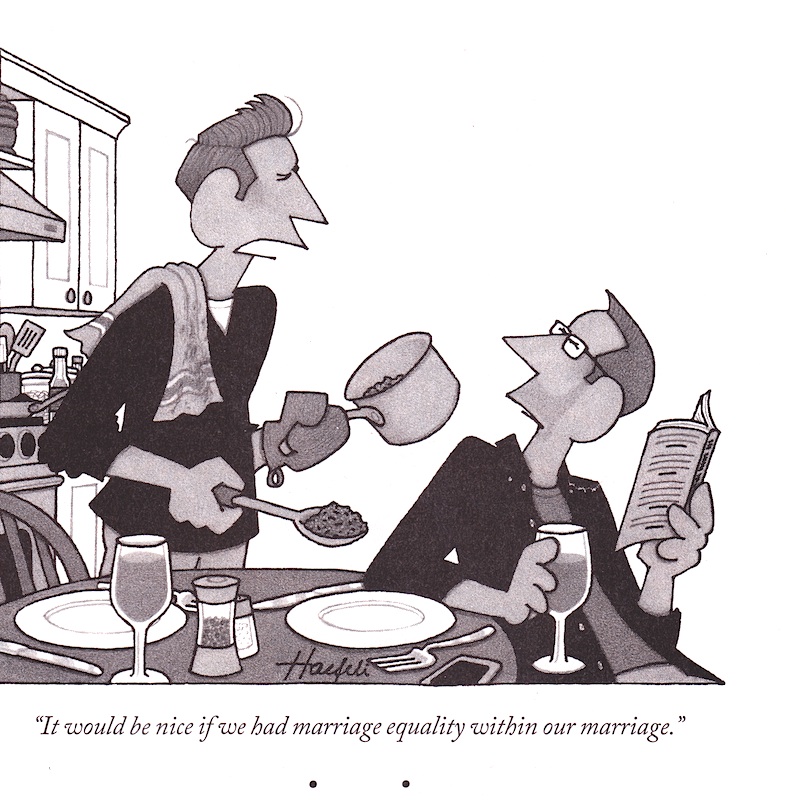
Real life is, of course, immensely complicated, and roles and presentations are distributed in all sorts of ways, at different times, in different contexts, for different purposes. This is literally the cartoon version.
 

Sonja Lanehart

April 14, 2025

[4/25 disclaimer. In the constant upheavals of my life and the world around me, I’m now just picking random stuff to post about, from the 60 or 70 items in my ever-expanding queue — whatever catches my fancy at the moment. Don’t try to make sense of it as a whole.]

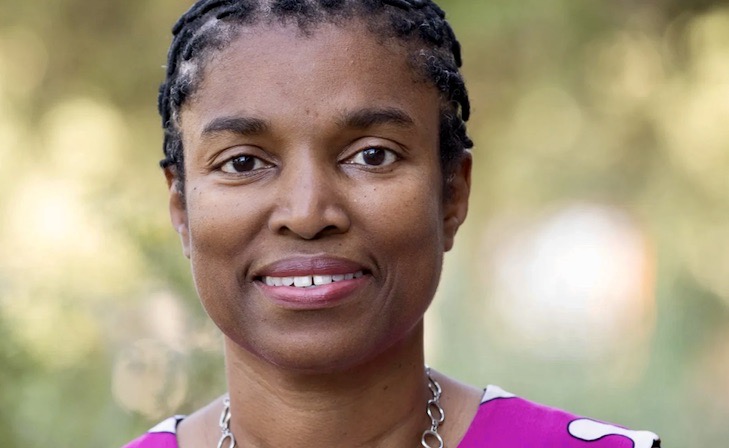
A little tribute to the linguist Sonja Lanehart, because I admire her work, but also — current relevance in my country — because she’s a vivid embodiment of the principles of diversity, equity, and inclusion in research, teaching, and writing. She’s a distinguished authority, so she’s the editor of the 2021 Oxford Handbook of African American Language and similar authoritative works. She’s also the author of the 2002 Sista, Speak! Black Women Kinfolk Talk about Language and Literacy — a remarkable piece of narrative anthropology from personal experience (a variety of participant-observer sociology / anthropology that I have ventured into myself, but in the gay male world rather than the Black female world).


(#1) SL in a recent photo (from the Univ. of Arizona)

(more…)

Dream blending

August 24, 2024

It appeared on Pinterest this morning, with no information beyond the artist’s name, Anthony Cudahy: a dreamlike sexual encounter like this one:


(#1) Like this one, but with a significant dream penis and testicle, which hog our attention; eventually, I’ll show you Full Frontal Man, but here, we’re drawn to the relationship between the somewhat anxious yellow-hued guy and the purple guy looming over him — note the subtle hand on yellow guys’s head, and then the head of another purple figure behind him, a remembered character, no doubt from another artwork, Cudahy’s or someone else’s

(I’d tell you more about this painting, but this is all I’ve got. So far the only copy of the image on the net seems to be this one on Pinterest.)

My first experience of Cudahy’s world. A quick intro from Wikipedia:

Anthony Cudahy (born [in] Florida, 1989) is an American painter. Cudahy’s approach is both figurative and abstract and takes inspiration from a breadth of source material ranging from personal photographs, movie stills, queer archival images and ephemera, and art history. Cudahy lives and works in Brooklyn, New York.

… Cudahy’s paintings are often a hybrid of visual histories blending various figures from art history and queer photography into contemporary scenes such as portraiture, domestic spaces, or social sites.

Now for more detail.

(more…)

Today’s dissertation defense

June 12, 2024

… in Stanford linguistics — the announcement:

The Department of Linguistics is pleased to announce a dissertation oral presentation on 6/12/24:

Indexing Respectability by Zion Mengesha

Committee: Penny Eckert (co-chair), Rob Podesva (co-chair), Jonathan Rosa, John Rickford, Paula Moya (university chair)

(more…)

Green grow the pickles, O

October 13, 2023

This remarkable photo left me dumbstruck yesterday when Monica Macaulay passed it along on Facebook, having gotten it from the Art Deco FB group on 10/10:


The Pickle Sisters, a vaudeville group from the 1920s (photo: eBay.com)

[Here I repeat a note from the last posting I was able to manage, the 10/7 posting “THE shirts”, six days ago:

Note: this is massively a Mary, Queen of Scots, Not Dead Yet posting, indeed something of a celebration of my being able to post anything at all, not to mention through enormous pain in my swollen fingers. But no details about any of that here; at the moment, I truly am pleased to be still alive and want to show that I can manage a posting.

This caution applies fully to this Pickle Sisters posting.]

(more…)

VIO

September 26, 2023

Received in e-mail this morning, from Dave Sayers on the Variationist mailing list:

We are delighted to announce the next in the 2023-24 series of online guest seminars here in the English section at the University of Jyväskylä, Finland — open to all!

On Tues 10 Oct at 11:00 East European Summer Time Mie Hiramoto (National University of Singapore) and Wes Robertson (Macquarie University, Australia) will give a talk titled ‘Framing masculinity and cultural norms: A case study of male VIO hair removal in Japan’.

That’s it. I was baffled by VIO hair removal; it has two possible parsings, and some large number of possible interpretations. And I was baffled by what looked like an unfamiliar initialism, VIO. Masculinity and cultural norms being one of my areas of interest within the G&S (gender and sexuality) field, I wasn’t willing to let these puzzles just slide.

Two parsings (and many interpretations).

 [ VIO [ hair removal ] ‘hair removal related to VIO’, where VIO is one of: a social group, the removers of hair (cf. born-again hair removal, transsexual hair removal, Ainu hair removal, Japanese hair removal ‘hair removal by Japanese (people)’), a method of hair removal (cf. laser hair removal), a philosophy of hair removal (cf. Buddhist hair removal), a place where hair removal is practiced (cf. Japanese hair removal ‘hair removal in Japan’), or any number of other interpretations

[ [ VIO hair ] removal] ‘removal of VIO hair’, where VIO hair is hair related to VIO, VIO admitting of a wide variety of interpretations: an area of the body (cf. armpit hair, pubic hair), a racioethnic group (cf. Black hair, Jewish hair), an evaluative characterization (cf. ugly hair, unwanted hair), a physical characterization (cf. kinky hair), a color (cf. gray hair), and much more

The (apparent) initialism VIO. Acronym dictionaries list a great many unpackings for VIO, but none even remotely hair-relevant. Searching on “VIO hair removal”, I eventually discovered that VIO is Japanese terminology for the bikini zone, with the initials standing for

V line (the pubes and genitals), I line (the perineum), O line (the anus)

So: the three Latin letters are to be understood as iconic signs, as (highly abstract) pictures of the three bodyparts, not as an acronym, not as the initials in an abbreviation. I don’t think that such an interpretation would ever have occurred to me.

No doubt it never occurred to Hiramoto and Robertson, steeped as they are in Japanese sexual culture, that the letter-sequence VIO would be utterly opaque to outsiders, but it is; I had no clue as to what their paper is about, except that hair removal and males are involved, and that the removal takes place in Japan.

Missing lexical items. A recurrent theme on this blog is that languages regularly lack ordinary-language, widely used lexical items for referential categories of things that are in fact relevant in the sociocultural context the language is embedded in.

So it is for English and the body region that extends from the waistline under the crotch to the anus: the pubes, genitals, perineum, and anus, taken together. This is a region of modesty, and it’s socioculturally highly salient in English-speaking communities generally, but English has no lexical item covering just that territory.

The composite phrase private parts would have been a good choice, but it’s already taken, as a euphemism for the central portion of the region of modesty, the genitals. In this case, it’s hard to see how we could get by with a narrow sense of the phrase (the current usage) alongside a broad sense (for the region of modesty). So we’ll bump along with things as they are, as we do in lots of other cases; people cope. Maybe someone can start a fashion for VIO in English.

Cover your VIO, dude! Were you born in a barn? (And while you’re at it, close the front door!)

Barthropods seeking silverfish

August 8, 2023

Today’s Wayno / Piraro Bizarro, a complex composition in which two centipedes look for bar snacks:


(#1) First bit of language play: the portmanteau barthropod = bar + arthropod, centipedes being arthropods, creatures in the gigantic phylum Arthropoda — also encompassing insects (including silverfish and springtails as well as flies, butterflies and moths, beetles, and more), spiders. crustaceans (among them, shrimp, crabs, lobsters, and barnacles), and millipedes (if you’re puzzled by the odd symbols in the cartoon — Dan Piraro says there are 3 in this strip — see this Page)

Then there’s a more subtle bit of language play in silverfish serving as bar snacks in a world in which centipedes drink in bars — given that Goldfish crackers (gold fish, silver fish, bring out the bronze) are often served as bar snacks in the real world.

(more…)

Maternal shrillness on Zits

January 29, 2023

Today’s Zits strip manages to assemble three disparate bits of assumption about cognition into a joke about maternal shrillness:


(#1) So shrill — in particular, so high-pitched — that it takes a ladder to get up there and read what’s in the speech balloon

Whoa! You might not have subscribed to any or all of these cognitive stances built into the strip:

— conceptualizing speech and thought balloons as physical objects

— perceiving women’s speech as shrill — an impression that incorporates (among other things) sociocultural associations of high pitch and loudness with various personal and interactional states, and also the association of high pitch with femininity

— (metaphorically) associating high pitch with height above the ground

(more…)

Briefly: exocentric V + N

September 20, 2022

(Warning: a vulgar term for the primary female sexual anatomy will end up playing a big role in this posting.)

Where this is going: to an alternative name for an American President (#45, aka TFG); and to an alternative name for a classic American novel (by J.D. Salinger) — both names being exocentric V + N compound nouns, the first in English, the second in French. (I’ll call them exoVerNs for short.)

(more…)

Extended cisgender

June 19, 2022

A physician writes to the NYT Magazine‘s ethicist about a patient who used a racist slur (the N-word) to his Black nursing staff and a homophobic slur (probably the queer F-word, but maybe the queer D-word) to his receptionist, and contemplated ways to support these staff members as an outsider, explaining in the letter that he’s “a Hispanic, cisgender male”.

The first identifier, Hispanic, is a racial / ethnic identifier, counterposed to Black, White, API, Indigenous, etc. The second identifier, cisgender, is clearly intended to be counterposed to homosexual / gay / queer, terms that refer to same-sex (rather than other-sex) sexual orientation; but that looks like some kind of category mistake, since the standard usage of cisgender (with the prefix cis– ‘on this side of’, opposed to trans– ‘on the other side of’) is for a sexual identity that aligns with birth sex (and so is opposed to transgender) — a matter that’s orthogonal to sexuality / sexual orientation. Indeed, most same-sex-oriented people are cisgender; I myself am a cisgender queer, one of millions, though we’re hugely outnumbered by the cisgender straights, who are all over the place. And while some transgender people are sexually oriented towards their own sex, some are oriented towards the other sex. (more…)