Archive for the ‘Language acquisition’ Category

Alpacas on the march

December 4, 2012

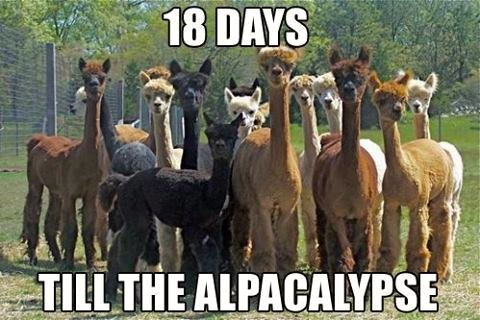
It begins with this slogan/image, passed on to me on Facebook by Ruth Lawrence:

Though the reference of the term Alpacalypse isn’t clear here (in 18 days?), the term is very satisfying phonologically, whether seen as a portmanteau of alpaca and Apocalypse or as the suffixing of the libfix -alypse ‘(terminal) disaster’ (historically from Apocalypse) to alpaca ‘species of camelid’; Apocalypse and alpacalypse are very close indeed.

(more…)

Foreign language learning software

July 12, 2012

A friend wrote me a few days ago about Paul Pimsleur’s language-learning schemes, which were on sale; he said that this guy sold language-learning tapes. I pointed out that Pimsleur died in 1979, and that Simon and Schuster now ran the franchise. (This is no reflection on the software, which I haven’t checked out.)

Then there’s a Berlitz program, started by Maximilian B., who died in 1921, and continued in the family (eventually on-line) through his grandson Charles, who died in 2003.

And then there’s Rosetta Stone, an indomitable lady, who lives quietly in Arlington VA, close to the cosmopolitan and multilingual precincts of D.C. She teaches many languages, all over the world. And advertises relentlessly.

Family Circus

June 24, 2012

A comment from Tané Tachyon on my last Zippy posting, in which Family Circus figured prominently:

A couple years back I had The Best American Comics 2008 out from the library, and just loved Lynda Barry’s intro comic about what the Family Circus had meant to her when she was growing up.

So: some words about Lynda Barry and Family Circus, and about language in Bil Keane’s strip.

(more…)

Eggcorn to portmanteau

June 5, 2012

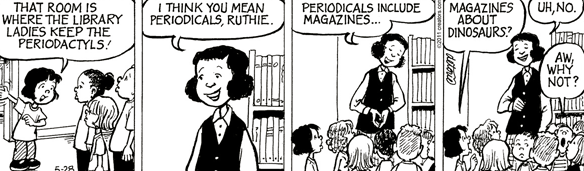
From Benita Bendon Campbell, a link to a recent One Big Happy strip, in which a child’s eggcorn becomes a portmanteau:

Ruthie has eggcornishly reanalyzed periodical on the basis of her knowing the word pterodactyl. Corrected, she then hopes to treat her word periodactyl as a portmanteau of periodical and pterodactyl.

(more…)

Me no likie?

April 23, 2012

Ann Burlingham wrote me on March 28th about an on-line argument about the expression me no likie, which she saw as racist (based on a stereotype of Asian English), but which others defended as childish language (as the sort of thing their 3-year-old niece says, and the like), some citing Urban Dictionary, which attributes the expression to the animated tv comedy The Family Guy. Other discussions cited Gullah [Sea Island Creole] and Jamaican Creole, and some writers saw me no likey X as an annoying webism:

Which demon-spawn, script-kiddie coined this baby-talk phrase, which I see plastered all over UBB systems every week? Who is he and what’s his address, because I’m going to beat him to death with a Nerf Bat. (link)

which brings us back to baby-talk.

This is a case in which everyone might be right, to some extent. We’re dealing with what we might think of as “imperfect English”, which can arise in several different contexts — child language acquisition, adult language learning, language contact — but can also deployed in intentional mockery of the English used in those contexts, either playfully or disparagingly.

(more…)

Learning to talk (in)appropriately

November 2, 2011

Story from Elizabeth Daingerfield Zwicky about her 7-year-old daughter Opal (reported here with Opal’s permission):

She had carefully divided her library books into “read” and “unread”. I brought the book bag, which contained the unread book, in from the car. She woke up in the morning and demanded to know where her library books were, so I told her. She threw herself to the floor, sobbing, and said “But I had my heart set on reading my library books! I wanted Garfield as soon as I woke up!” I said, reasonably, “Then why don’t you get them out of the car?” She got up, bravely dried her tears, took a deep breath, looked me in the eye, and said “Then why don’t you give me the fuckin’ car keys?”

(more…)

More Sundance

April 4, 2011

One more Sundance and Butch episode, about names and about language learning, on my X blog, here. Warning: high carnality fiction.


Child spelling

January 16, 2011

… and the mechanical conventions of writing.

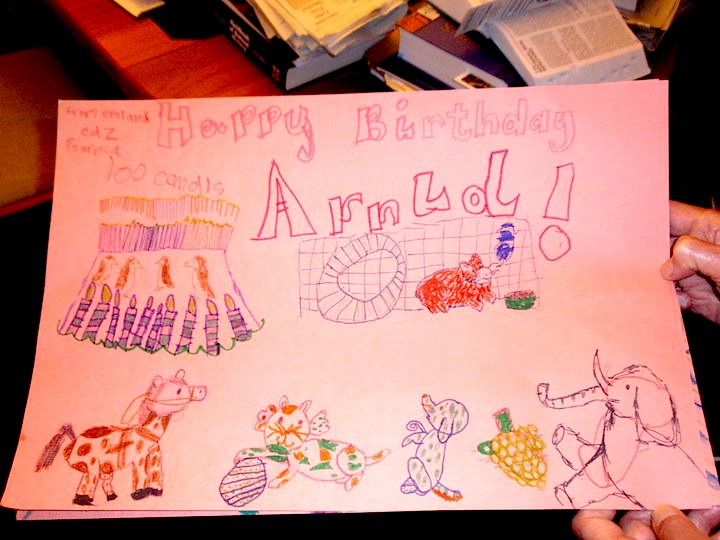
Exhibit A, a drawing that my grand-daughter Opal made for me on the occasion of my 70th birthday, back in September:

(Those are 100 candles, because Opal didn’t think 70 were enough.)

The point is the carefully outlined spelling of my name: ARNLD.

(more…)

Famous first words

May 17, 2010

A Zippy on Little Zippy’s cognitive development, including his first words:

Stories of “baby’s first words” abound, many of them obviously tall tales, in which a baby speaks not at all for several years, then comes out with some complex, and perfectly well-formed, utterance, explaining that they hadn’t said anything before because they didn’t have anything important to say, or because they wanted to wait until they could get it right. Nice stories, but utterly implausible, since perfecting a linguistic system requires not only practice (which they might have managed in secret), but in fact practice with other people.

I think I’ve said this several times in various places on the net, but there is such a tale in my first family-in-law, which I heard from Keene Daingerfield, my first father-in-law. It’s about his daughter, Ann Daingerfield Zwicky (who died, alas, 25 years ago in January; she surely would have told it better than I’m about to). The story bears every mark of sheer invention on Keene’s part; the Daingerfields were given to embroidering on family stories to make them better in the telling, and were not above just making things up.

Ann’s “first words” (at roughly age 2) were reported to be:

I hear a train but I do not see it. Pa tells me it is far, far away.

Students of language acquisition, feel free to discuss.

[People are going to ask me about the name Keene Daingerfield, so here goes…

Keene’s paternal grandfather Foxhall Daingerfield (ok, both Foxhall and Daingerfield are originally Anglicized Norman French names — Vauxhall and D’Angerville) trained race horses for James R. Keene (this is a story from the Virginia/Kentucky horse country), and the two became best friends, to the point of each naming his first son for the other. So in time Foxhall Daingerfield Keene and James Keene Daingerfield came into the world. Ann’s father was James Keene Daingerfield, Jr., and went by J. Keene Daingerfield, Keene for short, so as to distinguish himself from his father.]
Teaching what?

October 7, 2009

Among the letters (October 6) to the NYT Science Times spurred by Jane Brody’s “From Birth, Engage Your Child With Talk” (September 29), in which she wrote that speaking and reading to young children will help develop their communication skills, is this odd item from Susan Poser of Lincoln, Nebraska:

I could not agree more with Ms. Brody’s exhortation to talk and read to young children all the time. It reminded me of the game that my husband, a chemistry professor, and I would play with our daughter when she was 2.

We would each hold one of her hands, and on every step we would lift her up and say one of the elements of the periodic table. By the time she was 4, she could recite the first 45 elements of the periodic table (up to Rhodium), on demand.

It seems that with persistence and ingenuity, you can teach a young child almost anything. But I don’t see how reciting the periodic table could contribute to developing communication skills (whatever you think “communication skills” are).