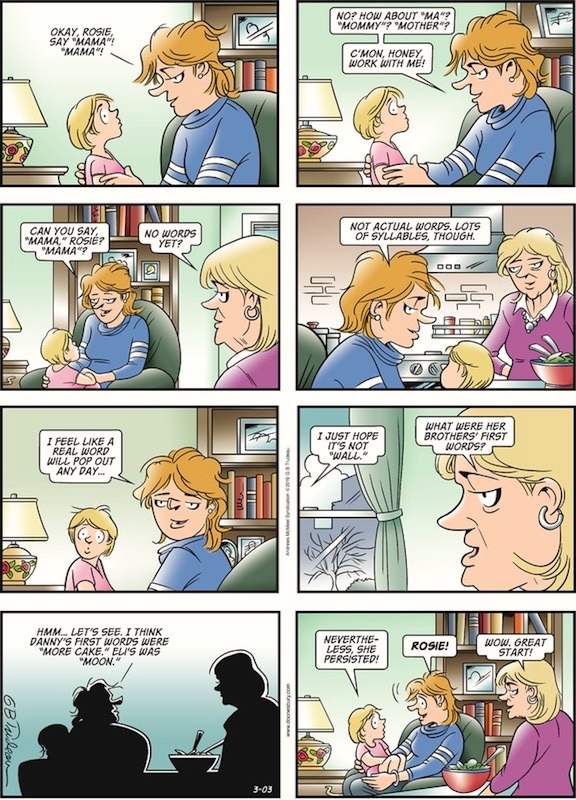
From the Doonesbury cartoon of 3/3/19 on baby’s first words:
(#1) Alex Doonesbury, watched by her mother, coaches her infant daughter Rosie to say mama — and is rewarded with Nevertheless, she persisted!
From the Doonesbury cartoon of 3/3/19 on baby’s first words:
(#1) Alex Doonesbury, watched by her mother, coaches her infant daughter Rosie to say mama — and is rewarded with Nevertheless, she persisted!
🐅 🐅 🐅 tiger tiger tiger for ultimate April; this is Lepus Eve, that fearful moment before the rabbit hordes of May descend, in a cloud of fragrant muguets, to ravish and despoil the golden youths of spring, the band of bros, of buddies, bonding to spread their seed and alliterate aimlessly: Bunnies Bash Buds
Two images for the day: a cinematic account — Night of the Lepus — of the threatening rabbit hordes; and just one of those adorable buds at risk in this moment of peril: Dean Young. serving as the embodiment of the vulnerable golden youths of spring.
A One Big Happy strip, recently in my comics feed:
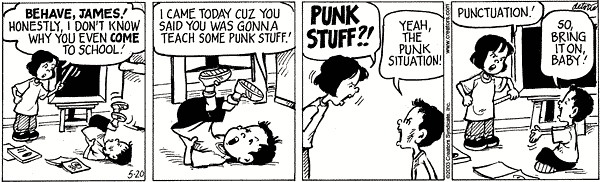
(#1) James (mis-)takes Ruthie’s meta-commentary — her talk about what’s going on in her interaction with James — to be part of that interaction, to be her next move in the routine of the knock-knock joke, and shows that he understands that routine, by producing the appropriate next move in the routine
James might be a dirty-faced urchin, but he knows his joke routines. And, in the last panel, is probably wondering how on earth Ruthie’s going to make a pun out of jeezy-peezy-I-forgot-the-joke.
So: mastering the routine of the knock-knock-joke is one thing, but then the routine incorporates another type of joke, the pun joke, which has its own requirements. In addition, the knock-knock joke requires not just any pun, but a (phonologically) imperfect pun, the more distant the better, so that its punch line will have genuine surprise value.
This morning, Stephanie Ruhle, reporting a Michigan school shooting on MSNBC, and confronting the word tragedy (with /ǰ … d/ ), replaced it by tradegy (with /d … ǰ/), transposing the two consonants; she noticed the error, and “corrected” it by, alas, a repetition of tradegy, which she didn’t notice, so she just went on. Then in a later report on the shooting, she again referred to it as a tradegy, this time without noticing.
As an error in spelling — TRADEGY for TRAGEDY — this transposition of consonants is common enough to have been listed in Paul Brians’s Common Errors in English Usage, p. 207 (and on the website), where Brians remarks:
Not only do people often misspell “tragedy” as “tradegy,” they mispronounce it that way too.
Here I think that Brians’s focus on errors in written English has led him astray, led him to treat what is at root an error in pronunciation — with the erroneous pronunciation then carried over to spelling — as an error in spelling that then is then carried over into pronunciation. Admittedly, the latter transfer is part of the story for some speakers, but the problems begin with inadvertent speech errors like Stephanie Ruhle’s. An inadvertent speech error that seems to be part of a larger phenomenon.
All this, and more, in two recent One Big Happy cartoons, from 7/2 (I broke a finger — the determiner cartoon) and 7/4 (Where was the Declaration of Independence signed? — the locative cartoon). Both featuring Ruthie’s brother Joe. I’ll start with the locatives.
On March 6th, the Linguistic Society of America announced the creation of the C.L. Baker Award (named in memory of Carl Leroy Baker, known as Lee), and on July 12th put out the call for nominations.
Lee, who died in 1997, was my first Ph.D., the first person to finish a Ph.D. under my direction, with the excellent 1968 dissertation Indirect Questions in English (at the Univ. of Illinois, Urbana-Champaign). Also a friend and a fine person (modest, gently humorous, earnestly principled, and humane).
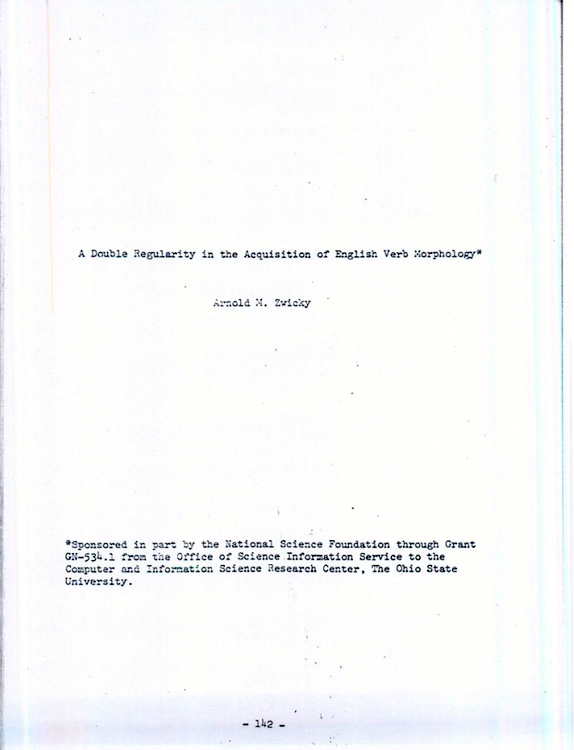
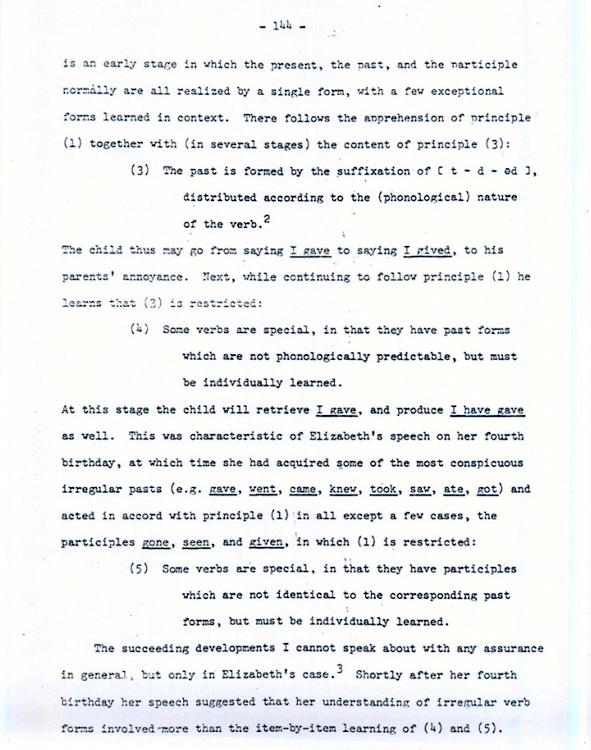
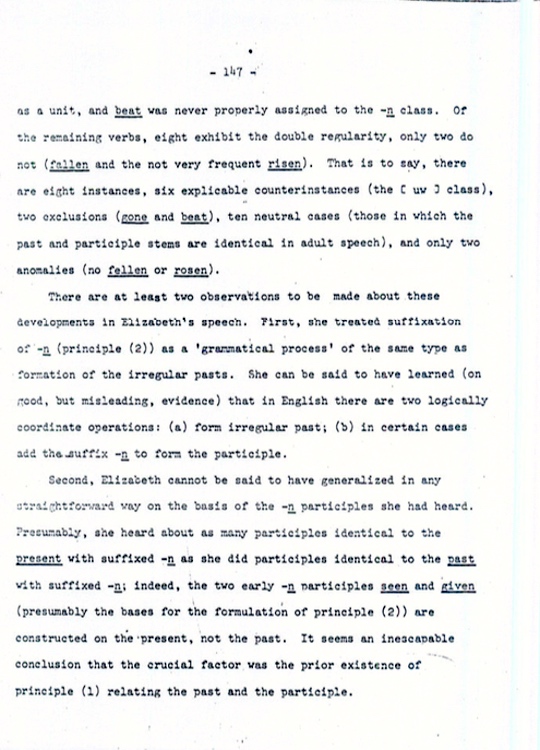
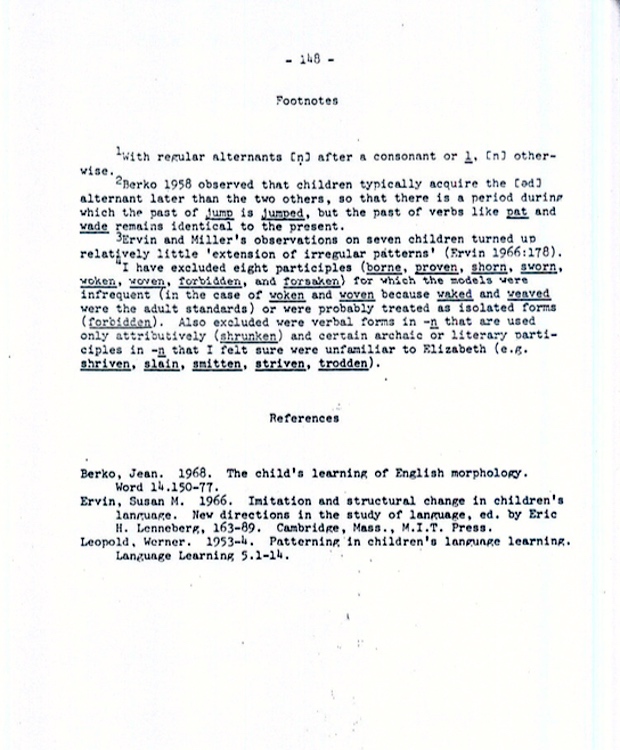
Arnold M. Zwicky, A double regularity in the acquisition of English verb morphology. Papers in Linguistics 3.3.411-8 (1970). Also in OSU WPL 4.142-8 (1970).
From OSU Working Papers in Linguistics No. 4: Papers by Gaberell Drachman, Mary Louise Edwards, Charles J. Fillmore, Gregory Lee, Patricia Lee, Ilse Lehiste, and Arnold M. Zwicky



… two recent cartoons, one a Rhymes With Orange with a notable verbing of a noun, the other a One Big Happy with a child coping with an unfamiliar word:
 (#1)
(#1)
 (#2)
(#2)
These on the occasion of Eve’s retirement from Stanford, celebrated at a department party yesterday afternoon.
(This takes a turn to sexual politics that some — though not, I think, Bill Griffith — might find surprising.)
Today’s Zippy offers us some office soap opera between boss (Don) and employee (Ms. Carlisle), from the point of view of Ms. Carlisle:
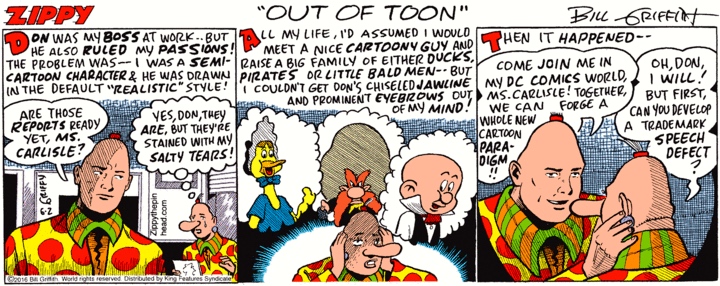 (#1)
(#1)
The topic is a familiar one in Zippyland: cartoonishness or cartooniness, indicated by various physical characteristics — noses, eyes, eyebrows, ears, jawlines, and mouths. In Zippyland, of course, everyone’s a cartoon character and they’re all dressed like one, but some of them are “realistic”, normal, regular folks,, while others are flagrantly cartoony.
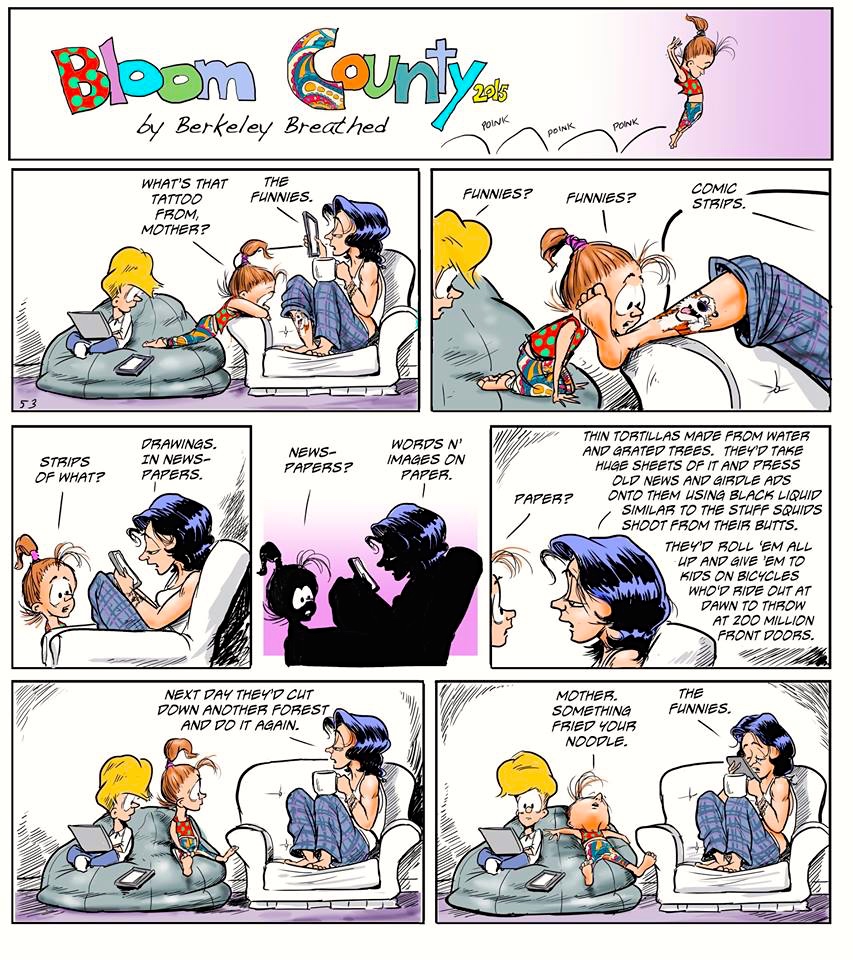
Passed on by John McIntyre, a Bloom County from some time ago about little kids and what they have to learn. And their mother and how she copes with their persistent inquiries: