Archive for the ‘Innovations’ Category

Ad-talk: your morning groom

December 19, 2025

Caught on tv this morning, one version of a Titanium Edge tv spot ad “Any Hair Anywhere”, released 7/31/25 (details on the iSpot site here); from this ad:


Titanium Edge, the “2-in-one nose and ear groomer that goes wherever razors can’t … to finish my groom” — with a noun groom, a nouning of the verb groom, to denote a regular routine of grooming, here specifically for men and in fact specifically for shaving; this nouning would appear to be a commercial invention by Titanium Edge’s ad agency

(more…)

rollsuck, verb and noun

June 4, 2025

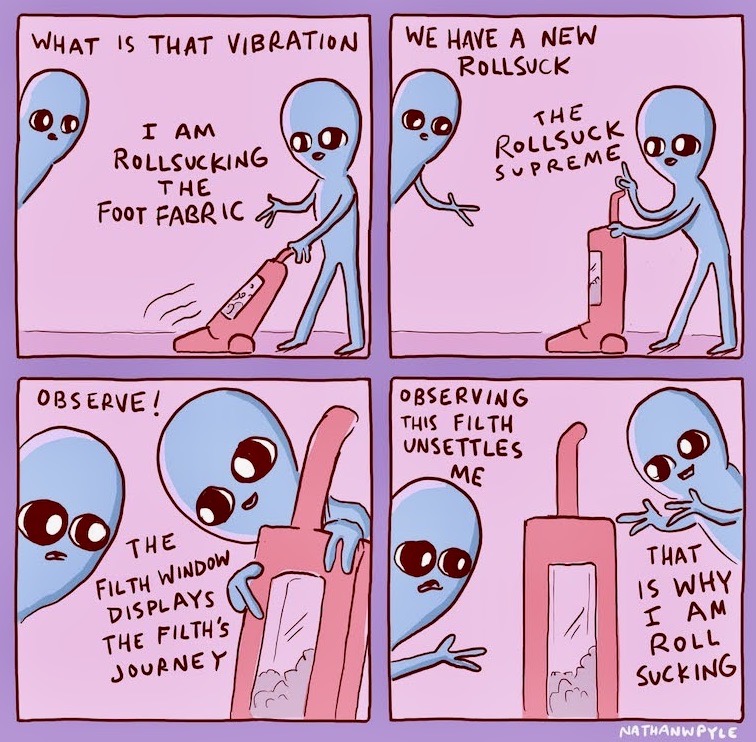
Yesterday’s Strange Planet comic strip by Nathan W. Pyle introduces the delightful verb / noun rollsuck ‘to vacuum’ / ‘vacuum cleaner’ (on Pyle’s strange planet, which has our customs but not our vocabulary):


The verb / noun as in: I am rollsucking the foot fabric ‘I am vacuuming the rug’

(more…)

Where to door knock and cold call

October 19, 2022

… and, eventually, how to abracadabra things out of sight. Yes, it’s Verbing Day on AZ Blog!

Politics and real estate: to door knock. It started on the Rachel Maddow Show on MSNBC on 10/11, with the cite presented here in its larger context:


(#1) to door knock / door-knock ‘knock on doors’ (in political canvassing): a N + V verb, whose origin lies in a back-formation from the synthetic compound door knocking / door-knocking

The semantics / pragmatics of the synthetic compound is specialized — not merely knocking on doors, but doing so in specific sociocultural settings (political canvassing and door-to-door solicitations by real estate agents, in particular) — and this specialization is shared by the 2pbfV (two-part back-formed V)

(more…)

A masculinity meze: face men

April 27, 2022

(This has turned out to be quite a large meze, but it’s only about one idiomatic slang expression. Well, men and masculinity come into the thing, and you know what can happen then.)

Reflecting a couple days ago on my Princeton days (1958-62) and the tangle of the attitudes of the (all-male) students at the time towards (among things) masculinity, male affiliation (as systematized in a pervasive system of male bands, the eating clubs of the time), women, homosexuals, race, and social class. The topic is vast, also deeply distressing to me personally, and I suspect that I’ll never manage to write about the bad parts of it in any detail — note: there were some stunningly good parts — but in all of that I retrieved one lexical item of some sociolinguistic interest (and entertainment value), one slang nugget: the idiomatic N1 + N2 compound noun face man / faceman / face-man.

A common noun frequently used among my friends, which was then also deployed as a proper noun nicknaming one of our classmates, a young man notable for his facial male beauty: everybody had to have a nickname (mine was Zot, for the Z of my name and the cartoon anteater), so we called him Face Man because he was a face man.

(more…)

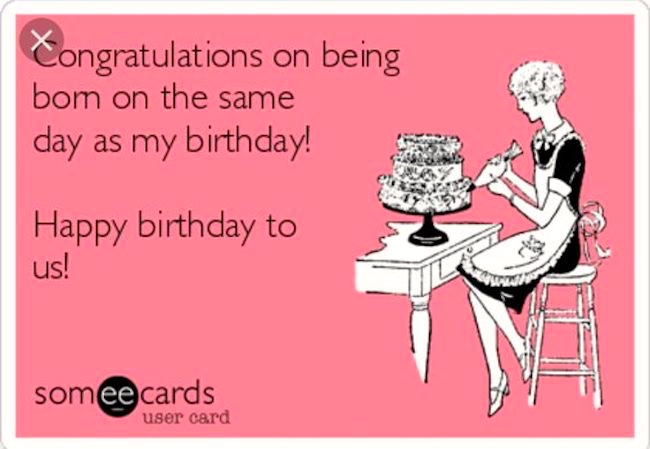
Born on the same day

September 18, 2020

Today is the birthday of my second mother-in-law, Monique Serpette Transue (born 1912). And also of Samuel “Dictionary” Johnson (born 1709). A coincidence of dates that entertains me. When I noted this on Facebook yesterday, Ned Deily wrote:

The interwebz assert that no single word exists, in English at least, to describe people who share the same birthday anniversary. Time to invent one? A lexicographer’s work is never finished.

After a digression on what lexicographers do and another on Samuel Johnson and a note about Gilbert du Motier, the Marquis de Lafayette, I’ll make a stab at coining.

(more…)

IN in the news

February 21, 2017

The lesson for the day begins with a news story. From yesterday in the Guardian:

British Muslim teacher denied entry to US on school trip: Juhel Miah from south Wales was removed from plane in Reykjavik despite suspension of president’s travel ban … A council spokesman said Miah was left feeling belittled at what it described as “an unjustified act of discrimination”. The council said the teacher is a British citizen and does not have dual nationality.

Then from Nadim Zaidi on Facebook, commenting on this:

These stories are becoming so commonplace that I don’t even bat an eye at them anymore. And that is how it starts, through normalization. More specifically, banality, the banality of evil, as Hannah Arendt wrote.

That’s normalization, the nominalization of innovative normalize (IN) — ‘render normal [‘acceptable’] that which was previously deemed beyond acceptable bounds’  used in a political context. From Emily Dreyfus in Wired 11/23/16:

Long before [[REDACTED]] became the president-elect, his detractors warned against “normalizing” his myriad violations of campaign decorum: the bigotry and misogyny, the Putin-philia and cavalier talk about nuclear weapons. Since [his] election …, “don’t normalize this” has become a liberal mantra, a reminder to stay vigilant in the face of aberrant presidential behavior that Americans may feel tempted — or emotionally bludgeoned — into excusing as just the way the country works now.

(more…)

The agony of homophobia

November 15, 2016

A Harry Bliss cartoon from the November 14th New Yorker:

(#1)

Four things, related in complex ways. One, the (very common) deflection of physical symptoms to psychological states (“You have knots in your lower back” > “You have lots of anxiety in your lower back”), here carried to an absurd degree of specificity, with knots or musculuar tension being attributed to homophobia.

Two, the physical intimacy of massage, here between two men.

Three, the formal composition of the drawing, with the masseur at right angles to his client and all those vertcal lines, broken by the angled branch on the scroll, which connects the bodies of the two men.

Four, the word homophobia, to which some have objected, on the grounds that it’s contrary to etymology: –phobia from the Greek ‘fear’ root, but homophobes, it is claimed, are not so much fearful of homosexuality as averse to it.

(more…)

Tradenaming

October 20, 2016

… choosing words as trademarks. NOAD2 on trademark:

a symbol, word, or words legally registered or established by use as representing a company or product

Such words often come with associations to existing words, or parts of words, in the language, and sometimes there are official origin stories that invoke these associations, though the official stories often just scratch the surface of the full set of associations.

Which brings me back to my posting of the 16th on the Parisian home furnishing company FLEUX’ (and its mascot, Zwicky le Chat): where does the company name come from? (and why is the cat named Zwicky?)

(more…)

Word times: two Ruthies, three Psychs

June 24, 2016

Annals of lexical confusions and innovations. Two word problems from Ruthie in the cartoon One Big Happy (two recent strips), a word confusion and two innovations from the tv show Psych.

(more…)

Annals of lexical inventiveness: sternum bush

June 23, 2016

From the tv series Psych (S1 E11), psychic investigator Shawn Spencer (played by James Roday) to Head Det. Carlton Lassiter of the Santa Barbara Police Dept. (played by Timothy Osmundson), on attracting women:

Chicks dig the sternum bush.

Translation from the very playful ShawnSpeak: ‘Women like chest hair’. That is, unbutton your shirt and show some chest hair. Standard sternum ‘chest, breastbone’ plus bush ‘luxuriant growth of hair’, especially in vulgar slang bush ‘a woman’s public hair’.

(The character Shawn is a high-energy, high-id showoff, but engaging: a big goofy kid.)

(more…)