Archive for the ‘Gender and sexuality’ Category
March 25, 2026
(well, yes, deeply about sex between men, considered analytically but described in the most direct street language, so entirely inappropriate for kids and the sexually modest)
Today’s topic combines the interests of my two previous postings
— on 3/24, “Luke Adams and the power bottoms of the pre-pandemic days”
— on 3/25, “The power of the normative gender binary”
and introduces as a side theme one of the overarching ideas of my work in both gender & sexuality studies and linguistics, that of pervasive variety / variability.
— as slogans: There are a great many homosexualities | There are a great many masculinities
Along the way, we’ll engage with four great bottoms from gay porn: Tannor Reed, Johnny Rapid, Kevin Wiles, and Trent Atkins.
(more…)
Posted in Effeminacy, Gay porn, Gender and sexuality, Homosexuality, Language and the body, Language of sex, Masculinity, Variation | Leave a Comment »
March 25, 2026
From my 3/19/26 posting “Annals of derogation: homo”:
fairy-boy was the primary verbal abuse directed (inexplicably) at me in childhood, along with (equally inexplicable) accusations that I wanted to be a girl
The abuse was inexplicable to me when I was a kid, but though I was a canny child, there were ways of the world I did not yet appreciate, and among them was the power of the normative gender binary — whatever deviates from normative masculinity is necessarily feminine (and therefore unacceptable in a male person). Some material from this blog on the subject …
(more…)
Posted in Gender and sexuality, Homosexuality, Language of sex, Masculinity | Leave a Comment »
March 13, 2026
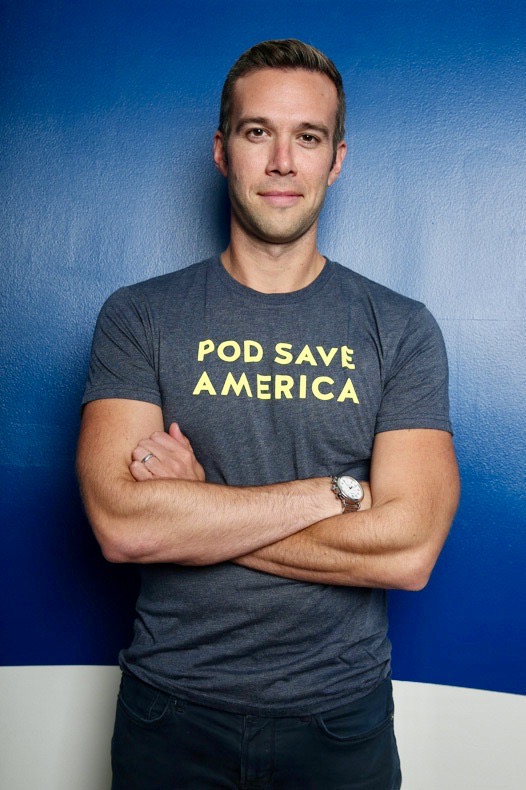
Following up on yesterday’s (3/12) posting “Masculine flamboyance” about the political commentator Jon Favreau’s presentation of himself in an advertisement for Crooked Media’s Pod Save America show: as an impish hunk: impish via a half-smile; hunk via a display of his muscular forearms, signs of a ripped body. (I could also have noted his neck muscles and the solid torso beneath his t-shirt):

(#1) JF on display
This is a pose for the camera, so what we see is some mixture of (a) what we might think of as a picture of one of his “natural” personas (unconsciously composed), just being who he is (as if that were a simple thing) and (b) a calculated presentation, with some conscious thought devoted to choosing elements of his presentation for the photo. I would guess that some part of the image was calculated — perhaps, the light dusting of facial scruff, conveying masculinity (in case you might have doubts, given the flamboyance of JF in action, as described in yesterday’s posting).
(more…)
Posted in Books, Effeminacy, Facial expression and gesture, Gender and sexuality, Homosexuality, Identities, Language and politics, Language and the body, Language of sex, Masculinity, Movies and tv | Leave a Comment »
March 12, 2026
adj. flamboyant: (of a person or their behavior) tending to attract attention because of their exuberance, confidence, and stylishness … [from NOAD]
Last Saturday I made the acquaintance (in the first Crooked Media show on MS NOW) of this exemplar of masculine flamboyance, presenting himself in this IMDb photo as an impish hunk:

Jon Favreau (advertising Crooked Media’s Pod Save America show)
Inexplicably, I seem not to have noticed JF before, though he’s someone of great substance. Meanwhile, his performance on the show was hugely entertaining — cutting criticism of our overlord Grabpussy and his administration, flamboyantly delivered. The deep moral commitment of Stephen Colbert performed in a wildly expressive style.
(more…)
Posted in Effeminacy, Facial expression and gesture, Gender and sexuality, Homosexuality, Language and politics, Language of sex, Morality, Movies and tv, Performance, Personas | Leave a Comment »
December 4, 2025
(deeply not for kids or the sexually modest: it’s all about man-on-man sexual acts, though the really hard-core stuff will come in a later posting; this one is mostly about lexicography, but even so, there’s a lot of guys pronging guys going on)
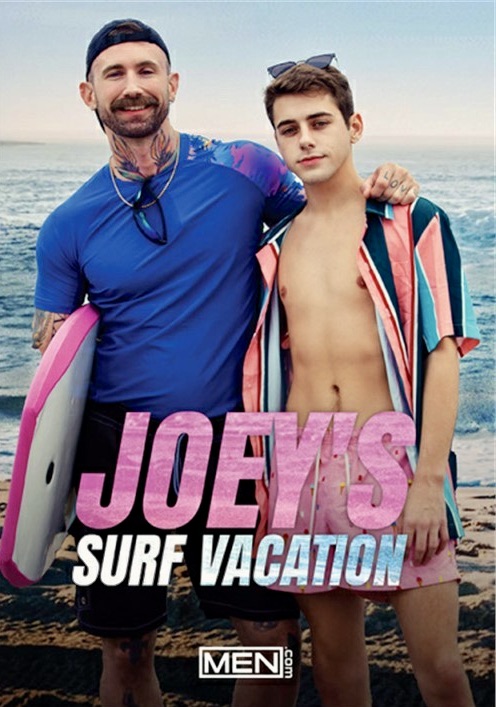
In this morning’s crop of gay porn ads, in a TitanMen store mailer, the charmingly titled (and apparently single-entendre) Joey’s Surf Vacation, with a dvd cover featuring a porn actor new to me, the boyish twink Joey Mills (paired with a familiar muscle twink, Dean Young, in a scene I’ll write about in a later posting). The cover of the 2024 dvd from MEN.com:

Troy Daniels and Joey Mills (from a different scene in the dvd)
On to the lexicography, starting with various attested verbs, while working towards what would seem to be a fresh metaphorical verb surf.
(more…)
Posted in Figurative language, Gay porn, Gender and sexuality, Language and society, Language of sex, Lexicography, Metaphor | 3 Comments »
November 22, 2025
Yesterday, a news story (from an Ohio site) with this summary of its subject, Madelyn Varela:
Ohio’s viral lesbian cheesemonger
This builds in sound from its onset to its cheesemonger climax, which was something of a surprise (just on likelihood, I was expecting goatfarmer); and its content comes across like a series of random pings: Ohio; then a lot of followers (viral here means, roughly ‘widely circulated, with many followers’); then, whoa, a dyke; and, who would have guessed, a seller of cheese (in a word, a cheesemonger). A lovely bit of found poetry.
So, of course, I gilded it.
(more…)
Posted in Gender and sexuality, Language and food, Language and sexuality, Poetry | Leave a Comment »
November 21, 2025

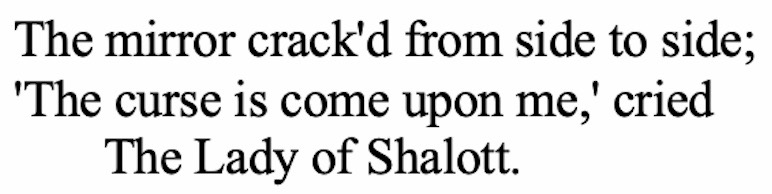
(#1) Alfred Tennyson,”The Lady of Shalott” (1832)
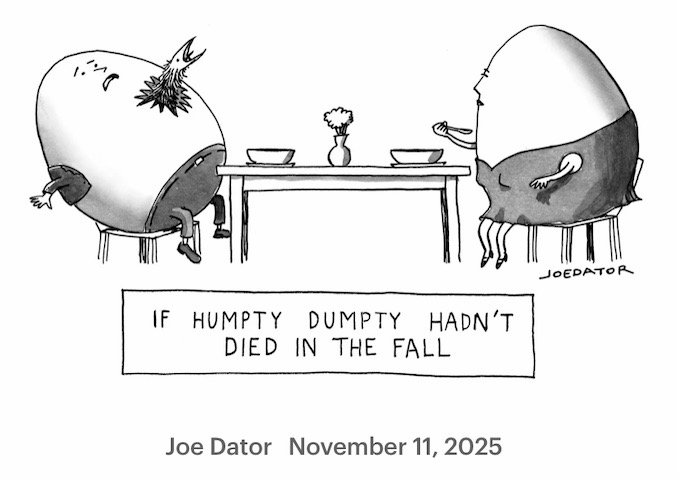
A Joe Dator cartoon in the latest (11/24/25) print issue of the New Yorker poses the question, “What if Humpty Dumpty had survived his fall?”
Humpty Dumpty is an egg. An egg contains a developing chicken embryo. The embryo will eventually mature, crack through the egg, and emerge as a chick. (There is even theme music for this scenario, Mussorgsky’s “Ballad of the Unhatched Chicks / the Chicks in their Shells”, from “Pictures at an Exhibition”.)
JD shows the first moment of emergence, the chick’s head bursting through the chest of a dismayed Humpty Dumpty, who is toppling backwards in his chair — a scene that will be viscerally painful for modern audiences familiar with the 1979 movie Alien, with its famously grotesque Chestbuster scene, but will in any case evoke a fatal heart attack :
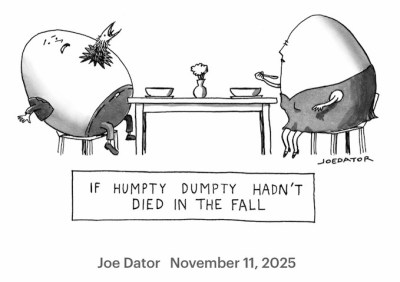
(#2) Humpty Dumpty and his female companion at table, when the mortal wound opens up; it will crack him from side to side
(more…)
Posted in Comic conventions, Gender and sexuality, Language and animals, Language and medicine, Linguistics in the comics, Monsters, Movies and tv, Music, Poetry | 5 Comments »
November 7, 2025
Yesterday’s Wayno/ Piraro Bizarro:

(#1) The coupled life, with cook and diner; cooks — I was the diner and helper in Ann’s and my life, the cook in Jacques’s and my life, and I can say that the cook is often anxious about pleasing their audience, the diner (if you’re puzzled by the odd symbols in the cartoon — Wayno says there are 3 in this strip — see this Page)
Now, highlights of an exchange between Wayno and me that starts out being about this cartoon.
(more…)
Posted in Cartoonists, Gender and sexuality, Language and food, Marriage, Puns, Race and ethnicity | Leave a Comment »
October 28, 2025
Yesterday on this blog, the posting “LSA news bulletin: awards” on (among other things)
Kira Hall — of the University of Colorado, Boulder — as the 5th recipient of the … Arnold Zwicky Award, intended to recognize LGBTQ+ scholars and those whose work in linguistics benefits the LGBTQ+ community.
Now, some basic information about KH, from Wikipedia and from the University of Colorado website; I might add some further information about her in a while.
(more…)
Posted in Anthropology, Awards, Gender and sexuality, Linguists, Sociolinguistics | 1 Comment »
October 27, 2025
Today turned out to be the annual awards announcement day for the Linguistic Society of America. Two awards of special interest to readers of this blog, in e-mail from the LSA (both announcements edited, rearranged, and expanded here):
The Bloomfield Book Award Committee, recognizing a volume that makes an outstanding contribution of enduring value to our understanding of language and linguistics, congratulates George Aaron Broadwell — Aaron Broadwell, of the University of Florida, Gainesville — as an award finalist (there are two finalists) on his book The Timucua Language: A Text-Based Reference Grammar, published by University of Nebraska Press in 2024. The award is named after Leonard Bloomfield, author of the influential textbook Language (1933), one of the founding members of the LSA in 1924, and its president in 1935.
Join the Committee on LGBTQ+ [Z] Issues in Linguistics (COZIL) in congratulating Kira Hall — of the University of Colorado, Boulder — as the 5th recipient of the prestigious Arnold Zwicky Award, intended to recognize LGBTQ+ scholars and those whose work in linguistics benefits the LGBTQ+ community. The award is named for Arnold Zwicky, the first openly LGBTQ+ president of the LSA.
So it’s LSA President’s Day (Bloomfield and me), and also LSA Pride Day (Aaron, Kira, and me).
(more…)
Posted in Academic life, Awards, Books, Gender and sexuality, Linguists, Zwickys | Leave a Comment »