A set of 15 comic homoerotic XXX-rated collages on this theme, along with some commentary on each of them, is now available on my Blog X (here).
Archive for the ‘Gayland’ Category
Have you thought about trying… linguistics?
August 7, 2010Gay flags
August 6, 2010Today’s mail brought me an ad for some Gay Pride underwear, specifically the FreeMen (or Freemen or Freeman, depending on who you read) brand:

(Click on the image to embiggen.)
Who is this message intended for?
August 2, 2010It came a few days ago, a great big heavy box, with a sticker shrieking (in hot pink, such a gay color) DO NOT OPEN:
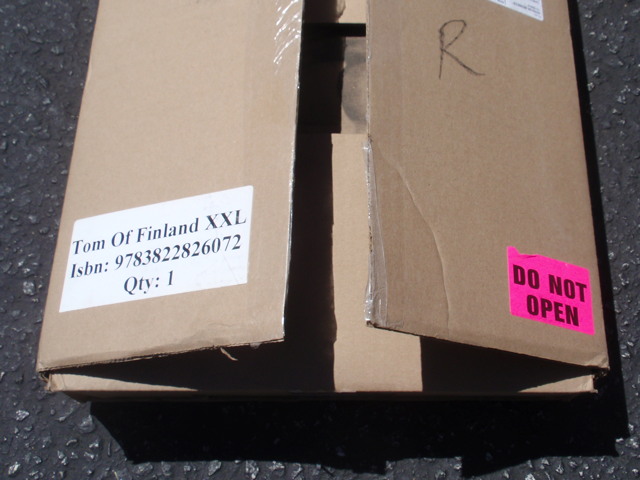
Here’s a puzzle: how can I get my book, without opening the box?
Splitting up: collaborative word-splitting
July 30, 2010This is an extra, a little digression from the main “word splitting” postings — so this is installment 1.5 in the series of 3 — with something similar to the
legen-…wait for it!…-dary
example in my posting on enjambment. This time it’s
antici- …say it!… -pation
Both examples have an expression (in these examples, a multi-word expression, in fact an imperative VP, though these details aren’t crucial) inserted within a word, where it functions much like a pause. Call this Filled Pause Insertion (FPI).
The obvious parallel is to one of the topics of installment 3, Expletive Insertion (EI) in English — Minne-fuckin’-sota — though
the inserted material in EI is chosen from a small set of expletive words, while in FPI the menu of interruptions is much more open;
the inserted material in EI is integrated prosodically into the matrix word (EI is a kind of word formation), while in FPI it’s truly an interruption and is set off prosodically, by pauses; and
the inserted material in EI functions semantically like a modifier of the matrix word (Minne-fuckin’-sota ~ fuckin’ Minnesota), while in FPI it performs a separate speech act (a metalinguistic one) from the surrounding material.
In fact, the inserted material in FPI can come from someone other than the speaker of the matrix word (and the rest of the surrounding utterance), which is what’s happening in “antici- …say it!… -pation”.
Five from 2005: XXX-rated collages
July 27, 2010[Alas, not the collages themselves (which I cannot display here), but brief analytic notes on them, linked to collage essays like the ones in my previous posting.
Another posting in the Gayland category, with nothing on language.]
From e-mail to Linda Williams 11/18/05 about:
… a set of new collages … All except one are constructed from the raw materials I had on display a week ago [at the Stanford Humanities Center exhibition]. Here are some notes on the collages that I wanted to get written out while the composition process was still fresh in my mind…
These notes have been lightly edited and somewhat expanded in 2010.
Collage essays: from concealment to display
July 27, 2010There’s only a little bit of language stuff in this posting, which is mostly in the Gayland category, about the representation of men and male-male relationships (especially, men’s bodies and man-man sex) in material intended for (and/or appreciated by) a gay male audience.
Some of my Gayland essays are in my voice; these are “academic” in tone, despite their subject and (sometimes) their language. But others (the Collage Essays) speak in another voice, that of an alter ego (call me Alex), and are keyed to two sets of images: images in “male art” (including photography, film, and video as well as painting, drawing, etc.), gay porn, ads (for mass market audiences or specifically aimed at gay men), and so on; and the collages I make from such items as raw material.
(Most of this visual material is definitely on the wrong side of the displayable-in-public line, so I can’t show it to you here.)
In the collage essays, Alex’s talk shifts back and forth between (on the one hand) displaying his body and his sexual desires, attitudes, and activities, and (on the other) viewing other men’s bodies and so on in erotic terms — between giving and receiving, or offering (himself) and desiring (another), or in the terms of commercial transactions, between purveying and consuming, or selling and buying, or hustler and john. Take it! / Let me have it!
(I posted one of the collage essays in my piece on shirt-lifing a while back.)
This duality in the way sexuality is configured psychologically is pretty much built into the condition of gay men, and I have simply let Alex embody the duality. (Alex is inclined to give advice to his gay readers, by the way. He fancies himself as a jazzed-up Dan Savage, and he thinks he’s cuter and hotter than Dan, but, frankly, I think he’s deceiving himself.)
This particular set of collage essays is in the Offering Your Body series, under Displaying Your Equipment, in four installments — The Basket, Peekaboo, The Hard Dick, Sweet Cock — moving from (ostentatious) concealment to display, much as with the avoidance vs. open use of taboo vocabulary.
(This material was essentially completed while I was at the Stanford Humanities Center in 2005-06. The Center was hospitable enough to sponsor (in November 2005, on the occasion of a visit from Linda Williams of Berkeley) an exhibition of my XXX-rated collages, plus some raw materials that I was working with at the time and drafts of some of these collage essays. However, the Center is not directly responsible for any of this stuff, and it certainly didn’t pay me to do it, just gave me a free space in my life to play with a project in addition to the one they were paying me for, on the advice literature on English grammar, usage, and style.)
And now I turn to microphone over to Alex.
Like/unlike
July 26, 2010[This posting doesn’t have much about language in it. Like my “Music of ruin” posting, it has some recollections in it; but mostly it’s a posting in the Gender and Sexuality category, in the Gayland subcategory.]
Today I going to put together themes from my posting “The Truly Huge” (on gigantically muscular men in gay porn) and my posting “Safe for public consumption” (on an arty Tom Bianchi man-on-man photo that stays just on the good side of the displayable-in-public line).
Safe for public consumption
July 18, 2010[Notice. This is mostly about imagery rather than language.]
Max sent me a hot-hot man-man postcard, a reduction of a photo by Tom Bianchi. On the back she wrote:
Love this photo, and it is, I believe, amazingly, safe for public consumption according to the US Post Office.
And indeed it came through the mail unscathed and unremarked on. So I’m assuming that it can be exhibited on this blog. That’s one of my topics for today: what’s allowable “in public” — without occasioning sanctions, like having this particular posting deleted by WordPress or having my whole blog closed by them or having me barred from posting anywhere on WordPress, or corresponding actions by Apple’s MobileMe, where my images are currently stored. (Note similar issues about text, like my fiction and poetry.)
I’ll start with an appreciation of Bianchi’s photo and go on very brief comments on this issue and several others.
Ken ‘n’ Joe: an item?
July 15, 2010(I don’t think there’s going to be anything of redeeming linguistic value in this posting, so I’ve categorized it as Not About Language. You’ve been warned. It’s also gay, sexy, and frivolous. You’ve been warned again.)
Following up on my doll-and-action-figure posting, Mara Chibnik wrote me that a couple of weeks ago she saw (in New York City) a one-act play by Andrew Black called “Don’t Toy With Me”. She goes on,
GI Joe drops in on Ken, and they’re about to enjoy their newfound relationship when (Malibu) Barbie walks in on them. The bit I liked best was the embarrassment of Ken’s offered confidence: “I’m, uh, not anatomically correct.”
Ah, the liaison between Joe and Ken that so many gay men have fantasized about.
Dolls and action figures
July 14, 2010It all started when I went searching the web for action figure vs. doll. You see, I have two articulated (and therefore posable) plastic figures of adult humans with removable and exchangeable clothing (and accessories) — yes, I will (sort of) explain, eventually, how a man of my age and station comes to have such things — and objects of this sort are called either dolls (like Barbie) or action figures (like G.I. Joe), according to whether females (mostly girls) or males (mostly boys) play with them, respectively (which means that since the figures function as, among other things, potent models for adult gender roles, dolls of this sort are themselves mostly female, while the corresponding action figures are mostly male).
The crucial factor in the distinction is then not objectively in the figures, but in the function they serve in our culture — a state of affairs that you can find all over the place, as scholars of categorization and the vocabulary that accompanies it have pointed out many times. Objective properties of referents are far from irrelevant, but the functions of those referents play a major role as well, sometimes a deciding role.
Back to the figures. The neat “dolls are for girls, action figures are for boys” split turns out to fail in both directions. The figures I have are meant for use by males (and are themselves male) but are called dolls, while (I discovered in my web searches) there’s a whole universe of figures that are meant for use by females (and are themselves largely female) but are called action figures. On the one hand we have Billy dolls, on the other figma figures. (I didn’t expect these objects or their names to be familiar to you, because each is embedded in a (sub)culture that is not mainstream North American/Western European.)