Archive for the ‘Events’ Category

A lesson in abstraction (and role reversal)

August 10, 2025

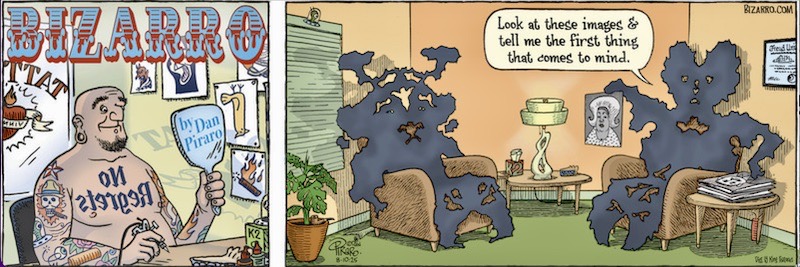
Today’s Dan Piraro Bizarro cartoon, in which the roles of ordinary life are Bizarro-reversed:


(#1) Those are living, breathing inkblots sitting in the chairs: a therapist inkblot showing a picture to a client inkblot; where you expect people, you get inkblot entities, and where you expect the picture of an inkblot, you get the picture of a person (in the title panel and the main panel, there are a ton of odd symbols; if you’re puzzled by them, see this Page)

Abstracting away from the details, we’re looking at two instances of the situation XXY:

— XXY: a situation in which three entities — two Xs (a therapist and a client) and a Y — are participants in an event in which the therapist X shows a reproduction of a Y to the client X

(more…)

The sting in the tail

November 15, 2024

Coming to the Stanford Humanities Center on November 18 at 4:00 p.m., the 2024 Marta Sutton Weeks Lecture, “Caravaggio’s Americas” by the poet and scholar Edgar Garcia of the University of Chicago; the announcement:

This talk relocates the where and when of the baroque to the sixteenth-century Americas, arguing that the anxieties of eroded sovereignty amidst legal heterogeneity that gave rise to the baroque began not in Counter-Reformation responses to Protestantism but earlier in encounters with the legal and cultural others of the indigenous Americas. In this account, the spirit of the Counter Reformation precedes the Reformation and is, in its expression as the baroque, inescapably entangled with Indigenous cultures and polities of the Americas. In turn, this view of the baroque from the Americas helps to recast, interpret, and even re-visualize the works of the iconic late sixteenth-century Roman painter and living catastrophe-on-legs Caravaggio.

Dense with the abstract vocabulary of sociocultural analysis and cultural and literary history — it makes actual claims about the sources of the baroque / Baroque style in the Western arts, but it might take you some work to figure out what they are — the announcement devolves into a vividly earthy thumbnail characterization of Caravaggio as “the iconic late sixteenth-century Roman painter and living catastrophe-on-legs”. A sting in the tail. [Here we laugh and applaud.]

(more…)

Julio Torres

August 11, 2024

In  my e-mail recently, the program for this year’s New Yorker Festival, with some of the interviewees in a display ad:


(#1) No, I don’t know why pink; Cumming, Maddow, and Torres are notably LGBT, but not the other five in this display (maybe 3 out of 8 exceeds some tipping point, but it’s more likely that pink’s just a random color choice, devoid of meaning)

Now, which of these 8 is not like the others? Well, that’s an odd photo of singer-songwriter Sara Bareilles, but it’s an atypical one. Otherwise, Julio Torres’s photo does stand, or leap, out, and for him it’s fairly restrained; his pictures show him with a wide variety of hair colors (sometimes involving henna red or bright blue) and bodily adornments, and sometimes in drag. Meanwhile, he’s young, adorable, outrageous, smart, and dead series about creating comedy in a variety of forms.

(more…)

The intrepid explorer of language and image

September 11, 2023

Aka the deadpan laureate of American art. By Jason Farago in the NYT: 9/7 on-line: “The Deadpan Laureate of American Art: Ed Ruscha, intrepid explorer of language and image, prefigured a digital culture of words on the move. A retrospective at MoMA shines new light on his groundbreaking career: the books, the paintings, the room made of chocolate” | 9/8 in print: “Art’s Deadpan Laureate: Ed Rusch, intrepid explorer of language and image, prefigured a digital culture of words on the move. A show at MoMA explores his career”.

A huge show of Ruscha’s career, with a long and penetrating review by Farago in the Times. A review with an enormous number of images of the exhibition and Ruscha’s works, 7 of which I will reproduce for you here (some edited to fit this space).

So: the beginning of Farago’s review; the 7 images (the published images all credited: “by Vincent Tullo for The New York Times”); and an inventory of some of my earlier postings about his works.

(more…)

Stanford SemFest 20 schedule

February 25, 2019

(with links to abstracts)

For enthusiasts of semantics/pragmatics in all their variety; the public is welcome

All sessions take place in the Barwise Room, CSLI (Panama St. at Campus Dr.)

Friday March 15, 2019

9:00-9:30: Coffee and welcome

9:30-10:00 John Beavers & Andrew Koontz-Garboden, “Two Types of Roots for Internally Caused Change-of-State Verbs”

10:00-10:30 Shiao Wei Tham, “Structural and Contextual Factors in Result Interpretations of Mandarin Locative Compounds”

10:30-11:00 Helena Aparicio, Roger Levy & Elizabeth Coppock, “How to Find the rabbit in the big(ger) box: Reasoning About Contextual Parameters for Gradable Adjectives Under Embedding”

11:00-11:30 BREAK

11:30-12:00 Gregory Scontras, Asya Achimova, Christian Stegemann & Martin Butz, “The Added Informativity of Ambiguous Language”

12:00-12:30 Eric Acton & Heather Burnett, “Markedness, ‘Truth’, and Rationality in Social Meaning Games”

12:30-2:00 LUNCH (and mentoring event w/lunch for grad students and some participants)

2:00-2:30 Arnold Zwicky,“A Natural History of Snowclones”

2:30-3:00 Tatiana Nikitina, “Semantic Maps in a Typologist’s Toolbox: The Challenge of Semi-lexical Networks”

3:00-3:30 BREAK

3:30-4:00 Sunwoo Jeong & James Collins, “Updating Alternatives in Pragmatic Competition”

4:00-4:30 Sebastian Schuster & Judith Degen, “Adaption to Variable Use of Expressions of Uncertainty”

4:30-4:45 BREAK

4:45-5:30 David Beaver, TBA

5:30 Drinks
6:00 Dinner (provided)
7:00-9:00 Party/band

Saturday, March 16, 2019

9:30-10:00 Coffee/breakfast

10:00-10:30 Ashwini Deo, “Identifying the Strongest True Alternative: Marathi =c and its Counterparts”

10:30-11:00 Stefan Kaufmann, “Worlds Are Not Enough”

11:00-11:30 BREAK

11:30-12:00 Sven Lauer & Prerna Nadathur, “Sufficiency Causatives”

12:00-12:30 Yingying Wang & Frank Veltman, “Varieties of Modal Predicates and their Semantic Interpretation”

12:30-1:45 LUNCH (provided)

1:45-2:15 Lelia Glass, “Experimental Evidence that Verbs Describing Routines Facilitate Implicit Objects”

2:15-2:45 Itamar Francez, “Markedness and the Morphosemantics of Number”

2:45-3:00 BREAK

3:00-3:30 Ciyang Qing, “Zero or Minimum Degree? Rethinking Minimum-standard Gradable Adjectives”

3:30-4:00 Judith Tonhauser & Judith Degen, “An Empirical Challenge to the Categorical Notion of Factivity”

4:00 Closing remarks
Julian and Sandy

September 9, 2016

(Some coarse sexual slang, so it might not be to everyone’s taste.)

From the August issue (pp. 37-39) of The Advocate, “Speaking Lavender” by Chadwick Moore, about Bill Leap and the Lavender Languages and Linguistics Conferences (Lav Lgs 23 in February 2016 at American University, Washington DC; Lav Lgs 24 in April 2017 at the University of Nottingham (UK)), with the subtitle: “From Regency England to 1920s Harlem to Miss Piggy, gay vernacular has given voice to homosexual identity and desire in a hostile world. It still does.” and a section on Polari (and its scholar and champiom Paul Baker). Eventually the story leads us to the campy queens Julian and Sandy, and from there by sound associations to the remarkable entertainment (also campy) Façade, uniting the playful poetry of Edith Sitwell and the music of William Walton, notably in the “Valse” / “Waltz” movement beginning “Daisy and Lily”.

(more…)

Fischli & Weiss

November 18, 2015

In the front section of the November 16th New Yorker, under the heading “Winter Preview” (by Andrea Scott):

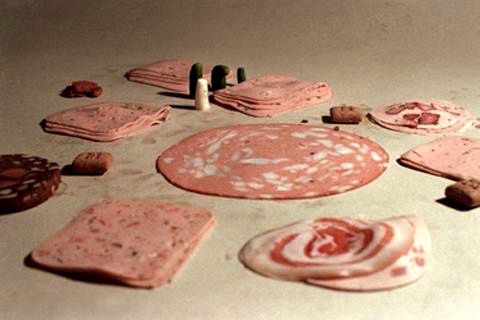
Conceptualism takes a comic turn at the Guggenheim with “Peter Fischli David Weiss: How to Work Better,” a career survey of the two Swiss artists, who met in Zurich in 1977 and collaborated until Weiss’s death, in 2012. Their first project was a series of irreverent photographs, featuring gherkins and sausages as dramatis personae; their most famous is the live-action film “The Way Things Go,” a spectacular chain reaction of unspectacular objects. For more than three decades, Fischli and Weiss uncovered hilarity, and pathos and mystery, in the workaday world. Don’t miss “Suddenly This Overview,” an installation of scores of small, unfired-clay sculptures whose subjects range from the Biblical to the cultural to the banal: the parting of the Red Sea, Mick Jagger and Brian Jones feeling satisfied after writing “(I Can’t Get No) Satisfaction,” a wedge of cheese. (Opens Feb. 5.)

(#1)

At the Carpet Shop from the 1979 sausage series

(more…)

Equality Without Exception (sort of)

June 28, 2015

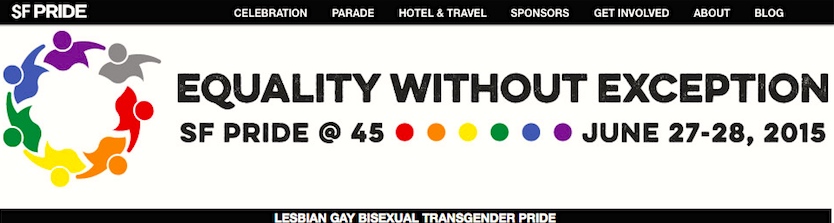
That’s the theme of this year’s San Francisco Pride celebration (which I’m now watching on tv):

As the hosts for the tv coverage point out every whipstitch, this is a fabulous achievement, but it’s marriage equality without exception (in the US), not overall equality, and there are very pressing needs for protections against discrimination in many areas and for support for some groups of lgbt people (especially young people). The fact remains that in a great many places, discrimination in housing, employment, and other areas is entirely legal, and in a fair number of places existing protections are being eliminated, often on religious grounds (references to homosexuality as an abomination are common); a number of religious groups are doubling down on their hostility to homosexuality, which should make any person of charity worry about the state of teenagers.

More on this in a calmer time. Meanwhile, I cry with joy at what’s been achieved so far. And cry for my man Jacques, who died a dozen years ago, having hoped for some years that it would some day be possible for us to be actually married.

(Good lord! The Apple contingent is mind-bogglingly enormous. It just goes on. And on. And on. And then the fire department… And Nancy Pelosi. The Police Department Pride Alliance. Much more to come.)

Stanford news: the Sunday NYT

January 22, 2015

Two Stanford linguistics stories in the Sunday (January 18th) New York Times: Tyler Schnoebelen at the American Dialect Society meetings, Will Leben on product naming.

(more…)

Yesterday’s anniversaries

August 10, 2014

Yesterday, August 9th, was the 40th anniversary of Richard Nixon’s resigning the Presidency of the United States. And the New York Times had an appreciation of Frank O’Hara’s “Lunch Poems”, which was first published in 1964 and has now been reissued by City Lights. A startling juxtaposition of personalities: the awkward, often surly, and fiercely ambitious politician Nixon versus the charming and gregarious poet, with his great gift for friendship.

(more…)