Cartoon traffic since the five items I talked about in this posting: a Bizarro on passwords, then and now; a Benjamin Schwartz New Yorker cartoon on Canadian eh; a One Big Happy on God talk; and a Zippy on Dagwood (Bumstead).
Archive for the ‘Conversation’ Category
… plus four
May 18, 2014A Zippy Czech
October 12, 2013Today’s Zippy continues the traditional Czech triplecoat theme from here:
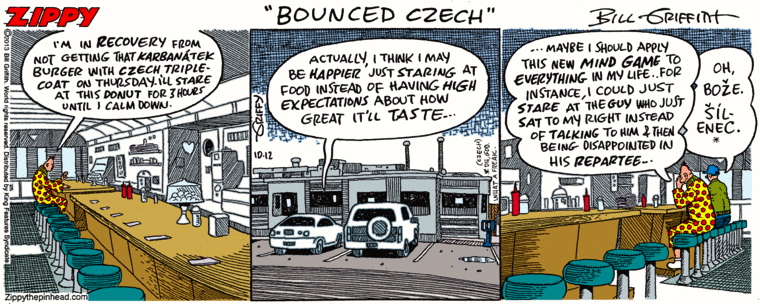
Though there’s an asterisk on that bit of Czech, suggesting that there’s a translation somewhere, I haven’t found it (though Oh, bože is ‘Oh, God’) — but a commenter on the Zippy site suggests ‘freak’ as a translation of śilenec, and Google offers ‘madman’. So, roughly: ‘Oh God, a crazy!’
Three more cartoons for Sunday
August 4, 2013Following on a Zippy and a Mother Goose and Grimm, the day continues with three more cartoons: a Bizarro with sluggish portmanteaus (and a pop culture allusion); a Pearls Before Swine with a preposterous elaborate pun; and a Dilbert on expectations about conversational interactions.
Interacting with Maggie Thatcher
August 3, 2013From John Lanchester’s “1979 and all that: Margaret Thatcher’s revolution”, in the 8/5/13 New Yorker (p. 71), with remarks on her managerial competence and her conversational skills.
Arguing on the internet
July 12, 2013Today’s Scenes From a Multiverse:
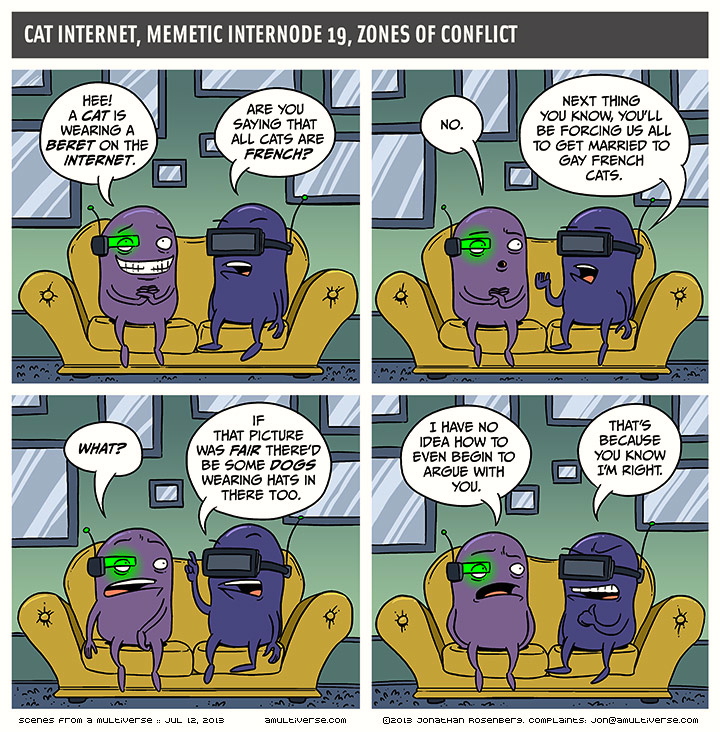
Call them A (on the left) and B (on the right). B’s leaps in conversational reasoning are totally baffling to A (and pretty baffling to me), though they resemble forms of invalid reasoning you can find on the net, most involving aggressive wild overgeneralization (all cats are French, you’ll be forcing everyone to get gay-married, the lack of dogs means unfairness).
Speed dating talk
June 6, 2013In the Stanford Report of 5/6/13, a story by Brooke Daniel about research on speed dating, “New Stanford research on speed dating examines what makes couples ‘click’ in four minutes”:
Stanford researchers analyze the encounters of men and women during four-minute speed dates to find out what makes couples feel connected.
That’s the question at the heart of new research by Stanford scholars Dan McFarland and Dan Jurafsky that looks at how meaningful bonds are formed.
McFarland, a sociologist at Stanford’s Graduate School of Education, and Jurafsky, a computational linguist, analyzed the conversations of heterosexual couples during speed dating encounters to find out why some people felt a sense of connection after the meeting and others didn’t.
Their paper, “Making the Connection: Social Bonding in Courtship Situations,” was published this month in the American Journal of Sociology.
… There is a great deal of uncertainty, the paper notes, about the meaning of signals we send to other people, and how that plays into forging interpersonal connections.
[McFarland] “We wanted to see if there is anything about the interaction that matters or is it really just what I look like, what I do, what my motivation is. Is it all things that are psychological or in my head or is there actually something in how we hit it off?”
Their analysis of nearly 1,000 dates found that words, indeed, do matter. How the words are delivered, when and for how long make a difference to how people feel toward each other, and in this case, whether the men and women sensed that they “clicked” during their encounter.
… “We were looking at conversational behaviors or speech features and how they express characteristics of the social experience, how you feel about the other person,” Jurafsky said.
Women reported a sense of connection to men who used appreciative language (“That’s awesome” or “Good for you”) and sympathy (“That must be tough on you”).
Women also reported clicking with male partners who interrupted them – not as a way to redirect the conversation but to demonstrate understanding and engagement, for example, by finishing a sentence or adding to it.
Both genders reported clicking when their conversations were mainly about the women.
“You could say men are self-centered and women are always trying to please men and dates will go well if they talk about the guy, but it turns out that’s just not true. It’s just the opposite,” McFarland said. “This is a situation in life where women have the power, women get to decide. So talking about the empowered party is a sensible strategy toward feeling connected.”
… Successful dates, the paper notes, were associated with women being the focal point and engaged in the conversation, and men demonstrating alignment with and understanding of the women.
… Further studies could look at same-sex relationships, for example, or could explore the transitions to other states, like marriage.
One commenter on the Stanford mailing list for queer staff and faculty reacted as follows:
Did anyone else think it was odd that the research was exclusively hetero? Cf. this sentence near the end of the article: “Further studies could look at same-sex relationships.”
Do the researchers think our relationships are so different that they need to be studied separately? (BTW, if so, I strongly disagree …
(citing experience in both heterosexual and same-sex relationships).
But of course McFarland and Jurafsky’s research was not about relationships in general, but about them only in a very specific and limited context: dating, in fact speed dating (involving grad students at Stanford). In this context, the chances are very high that gender differences will play a role in how the interactions play out — as indeed this research found — so that cautious researchers will control for the cross-sex/same-sex variable.
As other commenters noted, it would be great to have comparison data for same-sex dating (divided by sex, since the course of dating might well be different for female couples and male couples), though I foresee complexities in the analysis. McFarland and Jurafsky’s research found that successful dates had a focal participant, the woman in the couple; successful same-sex dates might turn out not to have a focal participant, and if there is one, what would predict which participant is focal?