Yesterday’s Dilbert:

There are dumb questions. There are even several different kinds of dumb questions.
Yesterday’s Dilbert:
There are dumb questions. There are even several different kinds of dumb questions.
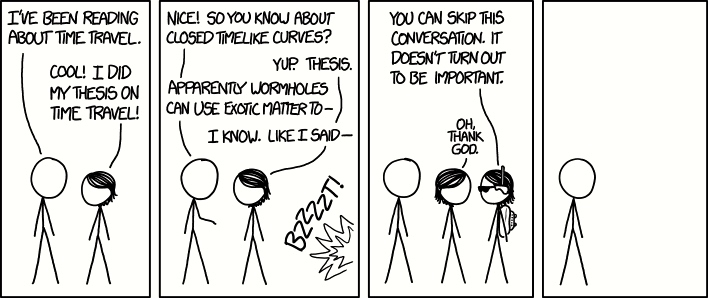
Four recent cartoons in my feed that have to do with language: Mother Goose and Grimm (attachment ambiguity), Zits (greetings), Bizarro (labeling a bat(h)room), xkcd (knowledge about the referents of names).
Some well-known phenomena: ceteris paribus, in conversations between men and women, (a) men speak significantly more than women, and (b) men interrupt women significantly more than vice versa. The effects carry over (not surprisingly) to argument between justices of the U.S. Supreme Court, and there they are augmented by another effect, that conservatives interrupt liberals significantly more often than vice versa. (These results from a study now in press for the Virginia Law Review.)
These effects can be seen as instances of a larger phenomenon: a tendency of those who are, or believe themselves to be, more dominant in an interaction to feel free to impose themselves on their partners and a corresponding tendency of those who are, or believe themselves to be, less dominant in an interaction to avoid imposing themselves on their partners.
The story came to me in the NYT on the 18th, in a piece by Adam Liptak. Well, in print in the national edition on the 18th, under the title “Let Me Finish, Please: Conservative Men Dominate the Debate’ — and on-line on the 17th, under the title “Why Gorsuch May Not Be So Genteel on the Bench”:
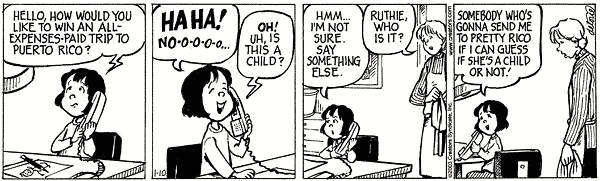
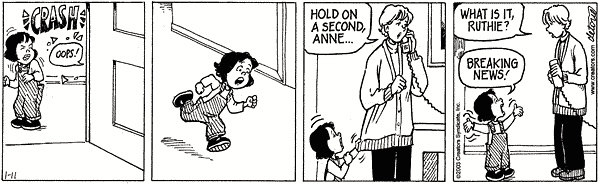
Two recent One Big Happy strips in which Ruthie grapples with language and its uses:
 (#1)
(#1)
 (#2)
(#2)
Pretty Rico and telephonic conventions. #1 is the more complex strip. The easy part is Ruthie’s misinterpretation of Puerto Rico as pretty Rico — another case where she reinterprets an unfamiliar expression in terms familiar to her. The tricky part is where the caller asks, “Is this a child?”, using demonstrative this on the telephone to refer to the recipient of the call: in the telephonic context (and not generally otherwise), “Is this a child?” conveys ‘Are you a child?’
Ruthie seems not to have picked up this piece of conversational convention, but she has learned a related convention, of identifying oneself on the phone (in the U.S. at least) by the formula This is X (conveying ‘I am X’). Armed with this knowledge, she takes the question Is this X? to be just the interrogative version of This is X, thus asking whether the caller is X: she takes “Is this a child?” to be asking ‘Am I a child?’
So clever. And so wrong.
Breaking news. #2, in contrast, turns on a relatively straightforward ambiguity, in the verb break. Two senses from NOAD2:
[state-change sense] separate or cause to separate into pieces as a result of a blow, shock, or strain
[hot-news sense] (of news or a scandal) suddenly become public [especially in the formula breaking news ‘information that has just now become public’, with breaking as a PRP verb form modifying news]
What Ruthie is announcing is indeed brèaking néws in the hot-news sense, but what she intends to be announcing is bréaking nèws (with the N + N compound breaking news ‘news about breaking’, with state-change break).
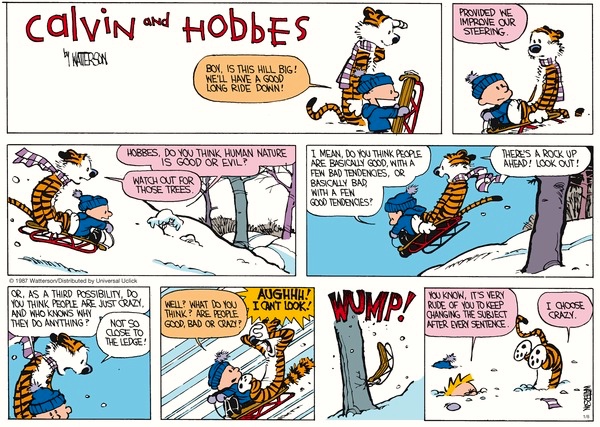
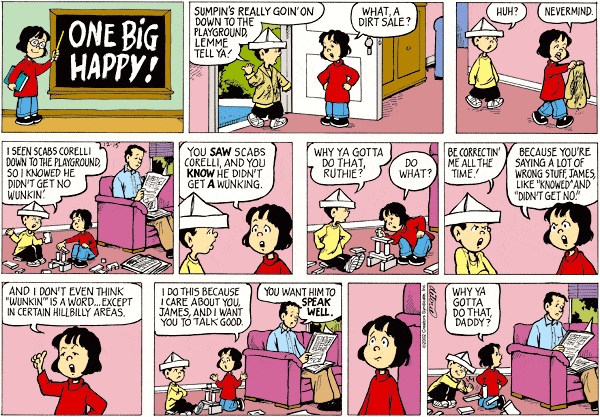
Two comics in yesterday’s feed: an old Calvin and Hobbes (about staying on topic) and a recent One Big Happy (with Ruthie once again correcting a kid’s English — for his own good, of course):
 (#1)
(#1)
 (#2)
(#2)
From the most recent NYT “Metropolitan Diary” (on-line on the 26th, in the national edition on the 28th), a contribution from Michael Joseloff that begins:
Two teenagers with clipboards were stopping passers-by on the Upper East Side. I was in a hurry to get to the bank, so I tried to maneuver past them and avoid their pitch. No luck.
“Me and my friend are trying to raise money to buy uniforms for our basketball team,” one of the boys began, before rattling on with the rest of his memorized speech. To paraphrase Renée Zellweger in “Jerry Maguire,” he had me at “me and my friend.” He seemed sincere. I decided to help.
I was desperately hoping that he was going to help the kid by making a contribution. But no: he proposed to help by correcting the kid’s grammar.
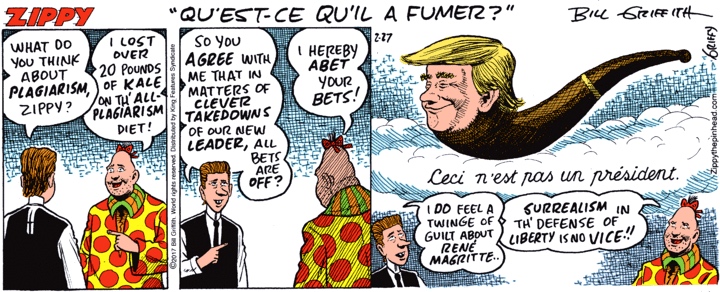
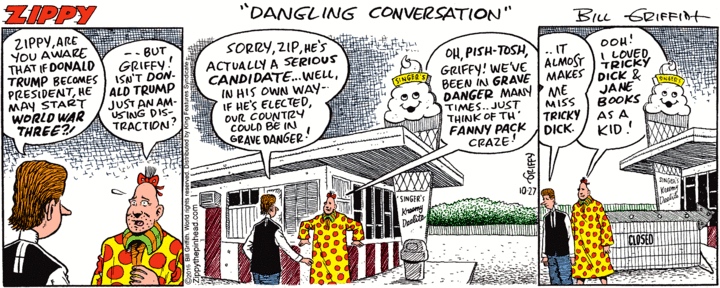
A mildly poignant Zippy, in which things have come to the point where Griffy almost misses Richard Nixon. And another deeply poignant episode in the Doonesbury account of Lacey and Jeremy’s adventures in senior dating.
 (#1)
(#1)
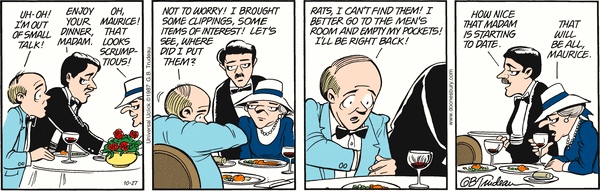 (#2)
(#2)
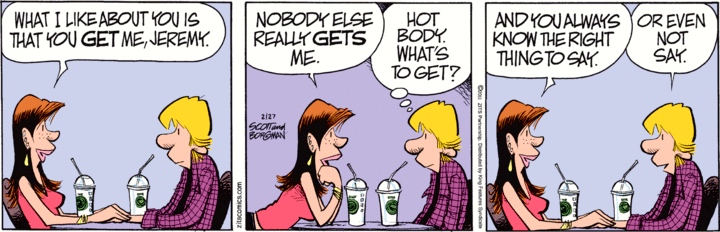
Two recent cartoons having to do with conversation: a Dilbert and a Zits:
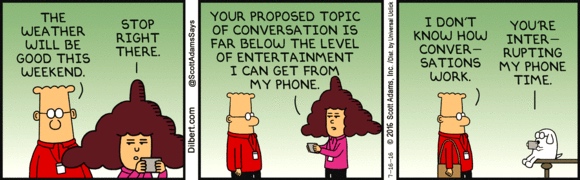 (#1)
(#1)
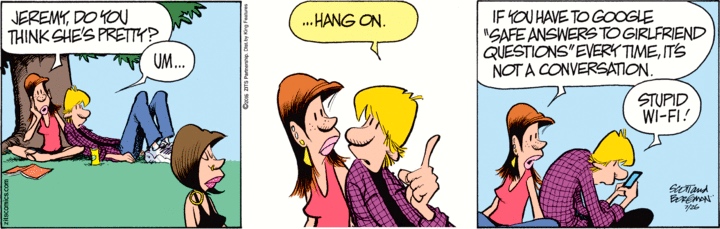 (#2)
(#2)
As background, two brief definitions that get at some of the crucial features of conversation (relevant to understanding #1 and #2), but by no means all:
[NOAD2] the informal exchange of ideas by spoken words; an instance of this
[AHD5] the exchange of thoughts and feelings by means of speech or sign language; an instance of this