Archive for the ‘Categorization and Labeling’ Category

Tomatoes and spices and clams, oh my!

March 27, 2026

In my posting yesterday (3/26), “A fortuitous cold soup” Safeway’s house-brand tomato bisque combined with plenty of chopped clams (and some sriracha sauce for spiciness), served unheated (eventually, actually chilled): a (cold) clam-tomato bisque. With a bow to the movie The Wizard of Oz: tomatoes and spices and clams, oh my!

Which I will build up to by starting with bisques, and then running through

tomato juice, tomato soup, tomato bisque
clam juice, clam soup, clam bisque

and going on, at the urging of Tim Evanson on Facebook, to another meeting of clam with tomato, the commercial product Clamato, created as the basis for cocktails.

(more…)

Category errors as a joke form

November 7, 2025

Let’s dive right in, to a back-and-forth on Facebook yesterday between Gadi Niram and me:

— GN: Pick a color from 1 to 10. [AZ thinks: obviously, lavender 7 — something that’s both a color and also a number from 1 to 10]

— AZ [actual reply]: parsley [something from yet a third, hitherto unmentioned, category, herbs] … alternatively: Benjamin Harrison [US Presidents] [separately, continuing the Still Another Category theme, Sophie Silberpup suggested: antelope, in the animals category]

[now breaking out into the form of three-part solutions to the mystery in the board game Clue] titanium, in 753 BC, with a ball-peen hammer [titanium, located in 753 BC, killed the victim using a ball-peen hammer]

— GN: You crack me up, dude!

— AZ: Three more shots [each a triple: responsible person or thing, location in space or time, instrument or accompaniment], dude, and then I rest.

Minerva, in Flagstaff, with a night-blooming cereus … a jackalope, in Ursa Major, with John Waters … the ulna, in Narnia, with Moomins

I note that the responses seem to be crystallizing, developing some internal organization, over time. Starting to approach poetry, rather than pleasurable nonsense.

Not that there’s anything wrong with pleasurable nonsense.

(more…)

The risks of pedantry

September 20, 2025

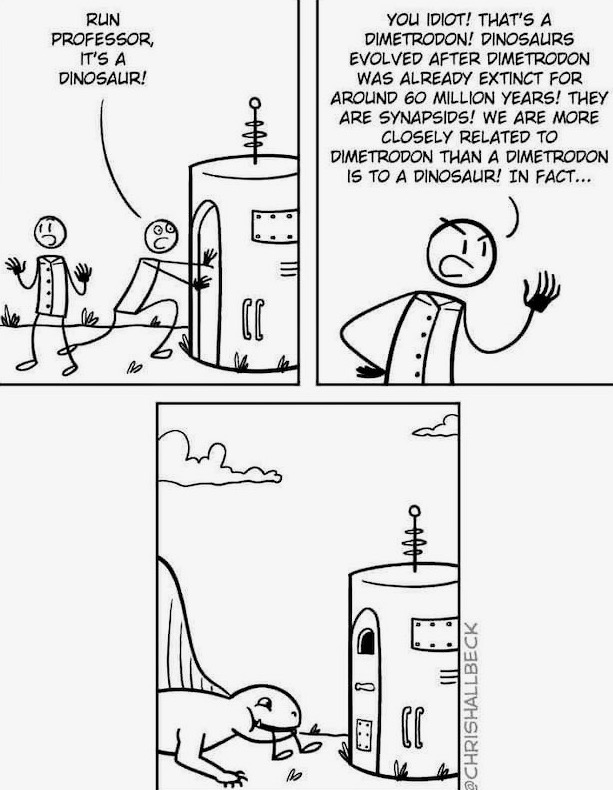
This Chris Hallbeck cartoon came by me on Facebook this morning — a strip packed with matters of science (paleontology, specifically), lexicography and usage (the senses of the noun dinosaur, and the contexts in which they’re used), and pragmatics (the way in which the noun is used in interactions, especially in language about language; in the enforcement of language norms; and, oh alas, in the relevance of things said to the interests of those participating in the speech context):


A Maximumble cartoon from 5/24/14, whose humor turns crucially on the pragmatic foolishness of the (now deceased) professor (in the face of a ravening monster, he stops to insist, irrelevantly in the context, that his companion must use the proper terminology, while the companion flees to safety); and which is based on the usage of the noun dinosaur — for a member of a clade of prehistoric reptiles bearing the zoological taxonomical label Dinosauria; versus, in non-technical American usage, for any dinosaurid creature, resembling the prototypical dinosaurs (many people have seen a family resemblance)

(more…)

I’m Chiquito Quesito …

September 2, 2025

I’m Chiquito Quesito, and I’m here to say,
Cheese dip has to be made the Arkansas way

The jingle to go along with native Arksansan Bill Halstead’s reproducing (on 8/31) this silly dip pun he found on Facebook (from who knows what source):


(#1) The signage is for a dip in NOAD‘s sense 3a, wilfully misunderstood as about sense 2:

noun dip: … 2 a thick sauce in which pieces of food are dunked before eating: tasty garlic dip. 3 [a] a brief downward slope followed by an upward one: the road’s precipitous dips and turns. [b] an act of sinking or dropping briefly before rising again: a dip in the share price.

And queso is short for chile con queso  (‘chili with cheese’), which Wikipedia identifies as:

an appetizer or side dish of melted cheese and chili peppers, typically served in Tex-Mex restaurants as a dip for tortilla chips.

Now three further explorations: about dip signage; about dipspreads and dips in general, and varieties of queso in particular; and then some Facebook exchanges with Bill Halstead about cheese dip as a significant item in Arkansas’s food culture.

(more…)

Words and things in the dining room

August 23, 2025

An object unearthed in my household investigations for dispossession: a woven wool rectangle, two-sided, showing a stylized blooming plant, and relatively small (10×19″, not counting its fringes) —


(#1) What I think of as the recto side

(more…)

RESIST

July 7, 2025

The message from my fellow QUESTer — another Queer University Employee At Stanford — Ryan Tamares, on a postcard mailed to me on 6/19, in the middle of Pride Month:

Happy Pride !
Pride always ! !
— RESIST —

The holiday moment has passed, but now we’re in a world where we have to actively resist, on a daily basis, against the brownshirts and blackshirts serving our overlords. And join with the drag queens and thrown-away club kids who, in one of our foundation tales, fought back against the cops who came to ruin their lives, and ours.

(more…)

Stoop labor

July 6, 2025

Earlier on this blog I’ve had occasion to celebrate the humane gravity of MSNBC commentator Jonathan Capehart, who happens to be both Black and gay. Now in JC talking about his 2025 book Yet Here I Am: Lessons From a Black Man’s Search for Home, an observation about the stoop labor historically done by Black folk in the American deep south (harvesting cotton, tobacco, and sugarcane):

“My cousin Rita and I are the first generation in our family to not have to pick cotton, and for people of a certain age, they will understand what that means,” Capehart said. “… It wasn’t until I was writing this book that I understood, when our parents were our age, they were working. They were working in the fields, picking cotton, picking tobacco. We did not have to do that.

So JC and his cousin Rita represent a shift in the fortunes of Black folk. Here’s JC informing us, explaining things, interviewing political and cultural figures, a figure of importance on national television — and a moving reporter on his own life history in that book. In what I see as the release of great abilities, drive, and insights that follow on opening up opportunity to everyone: excellent qualities that are in fact distributed widely across the population will flourish in new places (and since those who succeed first will have had to run through a lot of tough hoops, they will be seen to be especially talented).

(more…)

Central Europe

September 21, 2024

The term for a region of Europe that’s neither north (Scandinavian) nor south (Mediterranean), but, most significantly, neither west (France, the Low Countries, the British Isles) nor east (Russia plus at least some portion of its sphere of influence, especially in the old Russian Empire). In between lies territory historically under a shifting patchwork of rule, notably including: the Habsburg Empire  and the Austro-Hungarian Empire that succeeded it; the Polish-Lithuanian Commonwealth; Bavaria; Prussia; and eventually a unified Germany.

After World War II the German nation was starkly divided into two: West Germany, allied with France and the UK (and the US); and East Germany, allied with the Soviet Union. Germany was central in Europe only in the sense that that’s where the dividing line between west and east fell.

Somewhere along the line, the region-term Central Europe came to be applied to Germany (plus more) as the hinge between regions called Western Europe and Eastern Europe (as well as between Northern Europe and Southern Europe); I don’t know the history of the term (so I hope someone has already studied it). But if you just look at a map of modern Europe and look only at national boundaries, there’s a huge territory between Germany and Russia, with a swath just to the east of Germany that looks like something that you could reasonably call Central Europe (and brings to mind the Habsburg Empire); without going south and east into the Balkan peninsula:

(A) Poland, Czech Republic, Slovakia, Austria, Hungary, Slovenia

Then there’s a more eastern strip that would (with western Russia) count as Eastern Europe; without going north into the Baltic states, at least:

(B) Belarus, Ukraine, Moldova, Bulgaria

Meanwhile, at the other side of Germany, there’s Switzerland, with strong cultural and linguistic ties to both Germany and France (plus, to confound things further, shared boundaries with Austria and Italy).

I took up some of the nomenclature back in 2018, as an interested party (I am only two generations away from German-speaking Switzerland — canton Glarus in the northeast, to be specific). And then on 9/15, along came another interested party, Hana Filip (born in the Czech Republic — in Moravia in the east, to be specific). Both of us reacting to specific nomenclatural proposals.

(more…)
A smashing time

September 9, 2024

A smashing time: the Economist‘s punning teaser head on its article about demolition derbies in its 8/24/24 issue:


(#1) [Economist caption:] Art for art’s sake (photo: Getty Images)

Frankfort, New York: Where crashing cars is the point

After the formalities are seen to — the national anthem sung, the firemen assembled—the fun starts. The sound brings the first thrill: a dozen engines thundering, each without a silencer, and the crackle-pop of backfire. Then comes the crash and crumple of metal on metal. Tyres go flat, bumpers fall off. Cars catch fire, others get pushed up against the wall. They head-butt like billy goats. They hiss, wheeze, smoke, stall and go kaput. Soon only two are still moving, at which point the announcer might growl: “Finish him!”

Tom Wolfe, a writer*, called demolition derbies “culturally the most important sport ever originated in the United States” — closer to the gladiatorial games of Rome than even boxing. Annihilation is the point. The last car running wins. Sports reporters ignored them, wrote Wolfe, because they thought them puerile and low-class: too many kids with “sideburns, tight Levi’s and winkle-picker boots”.

[* AZ: satirical chronicler of both the counterculture of the 1960s and the elite culture of New York City]

(more…)

Terminology time

August 28, 2024

Well, actually, concept time. First come the useful concepts, then come the terms for them. My comments are prompted by Martin Haspelmath on Facebook today, on the useful terms (due to Alexandre François) colexification and dislexification for the expression, in some language, of distinct concepts in a single lexical form or distinct lexical forms, respectively; with MH citing this 2024 article from the journal Asia Pacific Translation and Intercultural Studies: “Colexification of “thunder” and “dragon” in Sino-Tibetan languages” by Hongdi Ding and Sicong Ding. From the abstract:

[372] languages were classified into colexifying and dislexifying languages, depending on whether the two concepts are associated with shared lexical forms. The findings reveal that 47 languages in the sample exhibit thunder-dragon colexification; most of them are Bodic and Na-Qiangic languages, with a few Sinitic, Mongolic, and Turkic languages. This areal pattern results from both inheritance and language contact.

So, patterns of colexification spread areally, through both inheritance and language contact, just like other linguistic features.

Note that colexification must have arisen in at least one language at some time, but this article isn’t about the mechanisms that might have given rise to colexification of ‘thunder’ and ‘dragon’ or to simple examples of colexification in English: ‘grain stalks’ (in the mass N straw) and ‘drinking tube’ (in the count N straw); ‘riverside land’ (in the count N bank, as in both banks of the Seine) and ‘financial institution’ (in the count N bank, as in savings banks).

But now the terminology.

(more…)