The term for a region of Europe that’s neither north (Scandinavian) nor south (Mediterranean), but, most significantly, neither west (France, the Low Countries, the British Isles) nor east (Russia plus at least some portion of its sphere of influence, especially in the old Russian Empire). In between lies territory historically under a shifting patchwork of rule, notably including: the Habsburg Empire and the Austro-Hungarian Empire that succeeded it; the Polish-Lithuanian Commonwealth; Bavaria; Prussia; and eventually a unified Germany.
After World War II the German nation was starkly divided into two: West Germany, allied with France and the UK (and the US); and East Germany, allied with the Soviet Union. Germany was central in Europe only in the sense that that’s where the dividing line between west and east fell.
Somewhere along the line, the region-term Central Europe came to be applied to Germany (plus more) as the hinge between regions called Western Europe and Eastern Europe (as well as between Northern Europe and Southern Europe); I don’t know the history of the term (so I hope someone has already studied it). But if you just look at a map of modern Europe and look only at national boundaries, there’s a huge territory between Germany and Russia, with a swath just to the east of Germany that looks like something that you could reasonably call Central Europe (and brings to mind the Habsburg Empire); without going south and east into the Balkan peninsula:
(A) Poland, Czech Republic, Slovakia, Austria, Hungary, Slovenia
Then there’s a more eastern strip that would (with western Russia) count as Eastern Europe; without going north into the Baltic states, at least:
(B) Belarus, Ukraine, Moldova, Bulgaria
Meanwhile, at the other side of Germany, there’s Switzerland, with strong cultural and linguistic ties to both Germany and France (plus, to confound things further, shared boundaries with Austria and Italy).
I took up some of the nomenclature back in 2018, as an interested party (I am only two generations away from German-speaking Switzerland — canton Glarus in the northeast, to be specific). And then on 9/15, along came another interested party, Hana Filip (born in the Czech Republic — in Moravia in the east, to be specific). Both of us reacting to specific nomenclatural proposals.
Switzerland as a central European country. From my 12/15/18 posting “Regionally ambivalent Switzerland”:
Another chapter in the delineation of regions (areas, territories) — there’s a Region-talk Page on this blog listing my postings on the topic — prompted by my coming across various sites referring to Switzerland as a central European country. I was puzzled: Poland, the Czech Republic, Slovakia, Hungary, maybe Austria, ok, but Switzerland? If Switzerland is in central Europe, what’s in western Europe?
The answer is: not much. France, Belgium, the Netherlands, the UK, maybe Luxembourg. Having a coastline on the North Sea seems to be a necessary condition, but not a significant one: Denmark, Norway, and Sweden count as northern European (or Scandinavian), and Germany as central European. Whoa, Germany is in central Europe? What happened to the western European alliance, with the UK, France, and Germany as its major elements?
It’s a now-familiar story: different categories are delineated for different sociocultural — or other — purposes, with many transitional zones (lacking clear boundaries) and with political boundaries standing in, faute de mieux, for actual boundaries, though the categories cut across and subdivide political units.
Europe, with its extraordinarily complex cultural, political, economic, ethnic, linguistic, and religious history (not to mention its geographical, climatic, and biological diversity), is naturally going to present a wild patchwork of categorizations into regions, all of which have some claim to validity. In the midst of all this, Switzerland is going to be categorized in a variety of ways.
For some usages from the time, from Wikipedia and the 1998 Brockhaus Enzyklopädie:
Central Europe is a geographical region of Europe between Eastern, Southern, Western and Northern Europe. Central Europe is known for its cultural diversity; however, countries in this region also share historical and cultural similarities. Whilst the region is variously defined, it often includes Austria, Croatia, the Czech Republic, Germany, Hungary, Liechtenstein, Lithuania, Poland, Slovakia, Slovenia, Switzerland and Transylvania in Romania. (Wikipedia link)
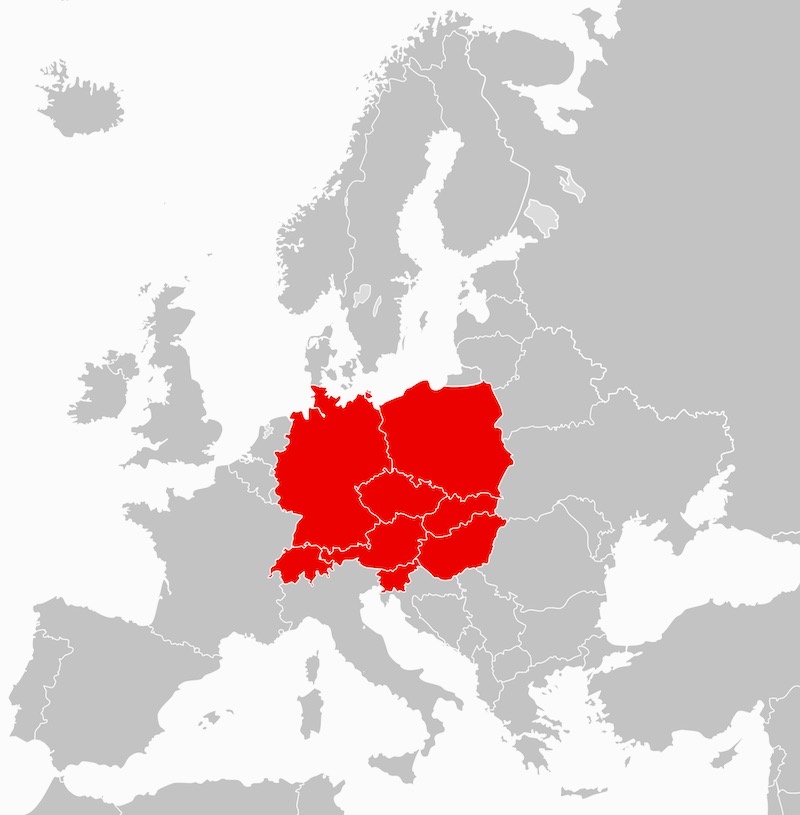
(#1) Central Europe: Germany and Switzerland plus the list (A) countries (1998 Brockhaus Enzyklopädie)
The Czech Republic as a central European country. Not that people have been denying that. But, as Hana Filip wrote on Facebook on 9/15:
So now it’s official. The Czech Republic is in Central Europe, NOT in Eastern Europe, culturally speaking. Notoriously, the delimitation of what counts as “Central Europe” has been shifting constantly.
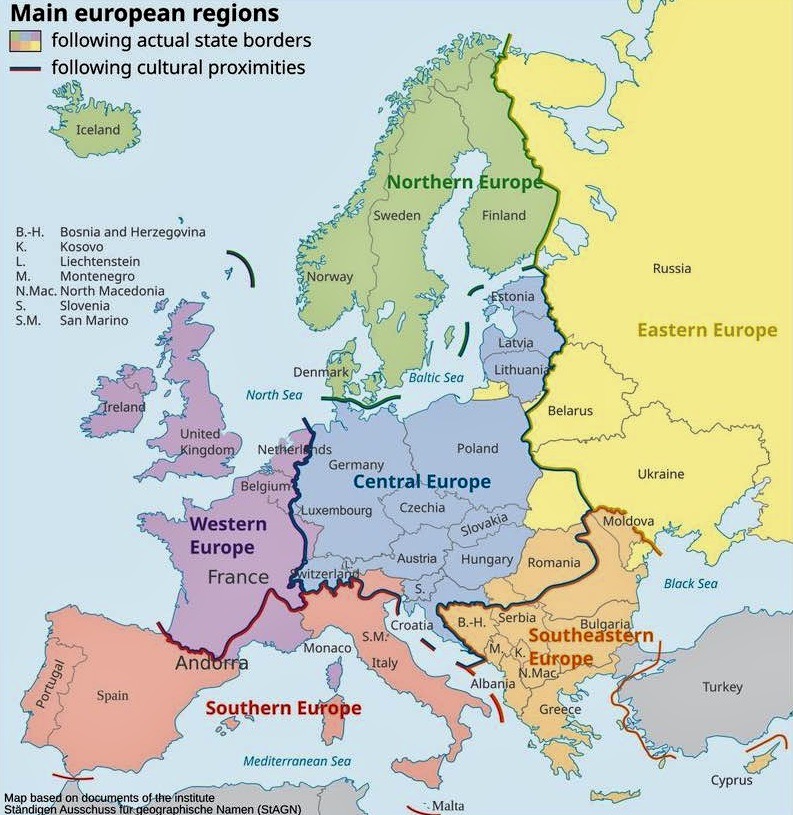
HF is referring to the cultural-spatial borders of Europe according to the 2024 report of the German Standing Committee on Geographical Names:
(#2) A considerably more complex analysis, distinguishing national boundaries from culture-zone boundaries, and including the innovation of Southeastern Europe versus Southern Europe (compare Southeast Asia alongside South Asia and East Asia)
But no analysis is perfect. To start with, culture zones tend to run together, but often cross-cut one another (consider divisions on linguistic grounds, on religious grounds, on food practices, on child-rearing practices, on sexual attitudes, on legal traditions, and so on). And then diversity on these matters within an area is also common.
Leave a Reply