The May Day Bizarro, in Cartoon Cliché Land:

(If you’re puzzled by the odd symbols in the cartoon — Dan Piraro says there are 3 in this strip — see this Page.)
In the February issue of Funny Times, this cartoon by political cartoonist Taylor Jones:
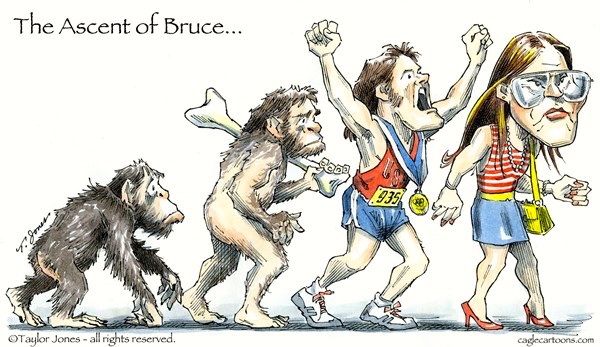
The third figure in the progression is Bruce Jenner, the fourth Caitlin Jenner.
Some words about Caitlin Jenner, and then a few on the Ascent of Man cartoon meme.
It started innocently enough, with a Jack Ziegler cartoon in the January 11th New Yorker:
 (#1)
(#1)
Captain Ahab, identifiable through his peg leg and harpoon, is apparently looking for his whale in a book store (where he will, no doubt, find copies of Moby-Dick, but no whales). Of course, the cartoon isn’t comprehensible if you don’t know the outlines of the story, but more than that, Ahab and the White Whale have become stock figures in popular culture, and, indeed, a conventional theme of gag cartoons: a cartoon meme.
I then went to search on {Ahab cartoon}, so that I could justify the claim that there was such a meme, and was inundated with examples. In fact, I was inundated with examples from the New Yorker alone, including two more by Jack Ziegler. I stopped collecting them when I had 10 single-panel cartoons plus a New Yorker cover. God only knows how many more there are.
Yesterday’s Zippy:
 (#1)
(#1)
This follows on the previous day’s posting on (among other things) manga eyes.
A query from regular reader Andy Sleeper on the 15th, about conventions in the comics. Andy reported on two cases where he’d seen flanking punctuation used to indicate that what was inside the punctuation was spoken in a language other than English. Andy wondered (a) whether this was an established practice in comics, and (b) whether artists have tried to use other means to solve this problem in their work.
I have to confess that I don’t know the answer to either of these questions, though I’ve spent some time looking around. So now I throw the questions open to the world, hoping that someone will know things I don’t.
In the July 2015 Funny Times (p. 10), a cartoon about cartoon conventions, which I’ll have to describe to you rather than show to you (for reasons I’ll explain).
It shows a man standing by a sidewalk in a park, offering balloons for sale. The placard next to him says
THOUGHT
BALLOONS
75¢
And the balloons are labeled:
NOW WHAT?
WHAT’S FOR DINNER?
LIFE IS STRANGE
LIVE IN THE MOMENT
BE HAPPY!
each supplying a thought.
Today’s Mother Goose and Grimm:
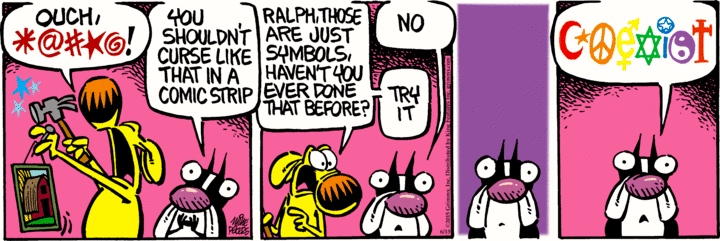
Ralph understands what symbols are, and even that in this context only symbols that aren’t alphanumerics count, but he hasn’t figured out that obscenicons are a conventional subset of these symbols.
Background on this blog in “The obscenicons vs. the grawlixes” of 8/1/10. Obscenicons are frequently discussed (as well as used) in cartoons; among the many examples on Language Log and this blog are a Zits and a Bizarro in this posting.
In response to my Zippy posting earlier today in which I looked for the source of the strip’s title, “Peachy Keen”, Drew Smith suggested that the peach part came from the strip Miss Peach rather than (my suggestion) the game character Princess Peach. At issue was the model or models for a grotesquely big-headed character in the Zippy. I wasn’t entirely convinced, but now I see that Miss Peach seems not to have come up on this blog, so it would be worth discussing.
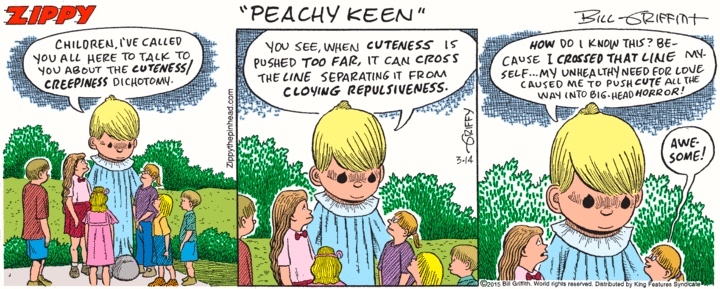
Today’s Zippy:
 (#1)
(#1)
The strip is both entertaining and instructive on its own, but then Bill Griffith would be unlikely to just invent a creepy cartoon character. And then there’s the title, “Peachy Keen”.
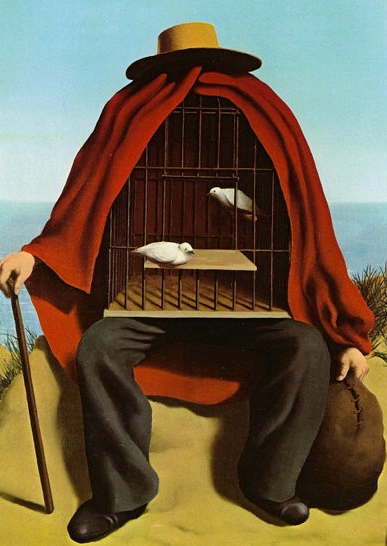
Today’s Zippy, another exercise in cartoonization, a transformation of an image (in this case, Magritte’s Le therapeute) by stages into a Zippy scene:
 (#1)
(#1)
The Magritte original:
 (#2)
(#2)