Archive for the ‘Academic life’ Category

Lament for Manfred

August 4, 2024

Ich weiß wohl, was soll es bedeutenDass ich so traurig bin

An anguish of old age is living immersed in death — of family, friends, loves, colleagues, mentors and models, students, people who have entertained, enriched, and illuminated you — while laboring just to get from day to day yourself. I have failed to memorialize many of the departed, I cannot cope any more, and I am ashamed of all of that. And now comes the death of Manfred Bierwisch, not exactly a surprise, since he was a full decade older than me, but then he was one of the few who should have been granted a life forever. And with a special role in my life.

Martin Haspelmath on Facebook this morning:

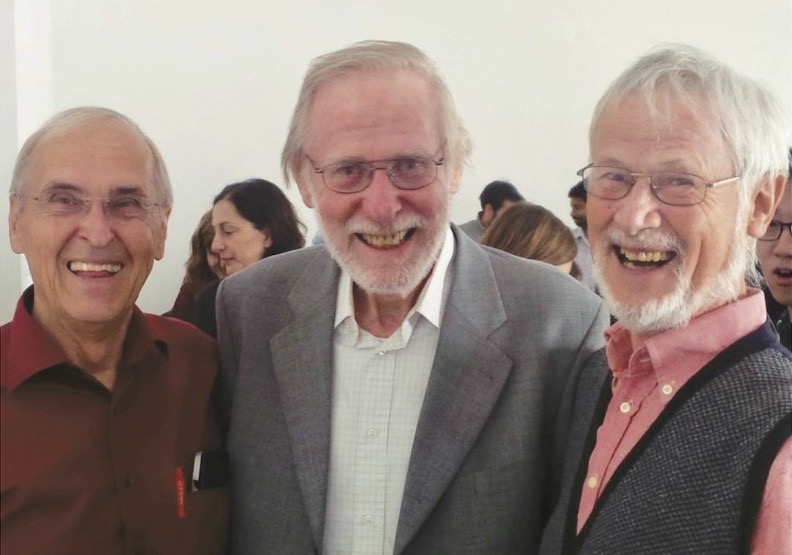
RIP Manfred Bierwisch (1930-2024, in the middle of the picture).


(MH:) The picture shows [MB] with his close friends Paul Kiparsky and Dieter Wunderlich (taken from Kiparsky’s 2023 memoir in the [Annual Review of Linguistics])

He was the GDR’s most prominent linguist, but he made no compromises with the regime. When some people were doing “Marxist linguistics” because it was good for their careers, he kept pursuing “structural linguistics”. Unlike some of his friends from the 1950s (e.g. Heinz Vater and Ewald Lang), he did not try to leave for the freer West Germany, but he stayed in the East. In 2005, he was awarded an honorary doctorate from Leipzig University, where he had studied in the 1950s (and where he was jailed for 10 months for possession of illegal writings).

(more…)

Dr. Cuba, I presume?

July 4, 2024

From Ernesto Cuba on Facebook today, reporting on:

Féminas Speaking Up: Three Papers on Feminine Transgender Identities, Gender Identity Activism, and Language Reform in Lima, Peru (PhD dissertation in Linguistics, Graduate Center, CUNY, 2024)

with this happy note:

Fresh out of the oven! My doctoral thesis on identities, culture and trans linguistic reform in Lima, Peru is now available for download. The thesis is written entirely in English to allow for a more global reading. However, since the work was done with Hispanic-speaking women, the original quotes in Spanish have been maintained. One of the three articles that make up thesis will be published in September this year and the other two are looking for a home in academic journals these months.

You can access the thesis by clicking here.

(more…)

Steven Dashiell

May 28, 2024

From e-mail on 5/5 from interdisciplinary sociologist Steven Dashiell, who pursues research on discourse in male-dominated subcultures (looking at military men, gamers, barbershop patrons, gay men, and more) and has built on a posting of mine on the trope of the pizza boy in gay pornography in a recent essay of his own:

I love your blog.  I was introduced to the study of language in my doctoral program [at the University of Maryland Baltimore County], and I grew from a “social inequality sociologist” to a “sociologist of language who studies male-dominated spaces to understand inequality”.  It’s been a wild ride, because the study of language goes in so many different directions.  I’m glad to have some mentors who help me …

It’s a good day when admirable people like SD write me to tell me they love my blog — in this case, SD likes it because it’s linguistics linguistics linguistics and because it’s gay gay gay, and both of these things are important to SD. But now I’ve had some time to get acquainted with SD’s life history (that being one of my things) and the way he arranges his life now (that being another one of my things), and I can do a lightning survey of this landscape, to make a few general points. One of these being the extraordinary variety of homomasculinities.

Four cases: my own complex story, presented at great length in postings on this blog; Richard Vytniorgu’s story (one significant theme of which is his being a bottom, fem, and submissive — plus British and academic-literary); Troy Anderson’s story (whose life themes include his being a guy guy, a gigantic jock bear into leather, a corporate executive, and a Native American), and now Steven Dashiell’s story (another jock bear (not into leather), an academic, and Black). And this just scratches the surface; I’ve told other even more disparate stories.  Take these stories to heart if you’re inclined to spout generalizations about what gay men are like (or worse, about what men are like).

But now to SD.

(more…)

The discouragements of old age

February 21, 2024

As regular readers will have noticed, things have not been good for me in recent days — physically just hanging on, barely getting through the days; spirits so low I’m almost frozen in discouragement. Many things have no doubt contributed to the fix I’m in, but one part of the story has to do with the late-career recognitions that sum up the accomplishments of the most significant academics: publication of their collected works; a Festschrift from colleagues and students celebrating the influence of their works; honorary degrees; and prizes or awards. I travel in circles where such recognitions are common, but never expected to get them myself: I have genuine talents, with teaching and research ranging over a huge array of topics, and I can pull off an engaging style of presentation, but my achievements are modest.

I’ve had plenty of career recognitions  — a University Professorship at Ohio State; election to the American Academy of Arts and Sciences; the presidency of my learned society, the Linguistic Society of America (LSA); the Sapir Professorship at an LSA Linguistic Institute; an assortment of  grants and fellowships — but these are, as a Stanford dean once explained to me, more than a little haughtily, in what I think of as Harvard Talk — merely what Stanford expects of its faculty members, nothing at all special.

(more…)

Against the chill of winter

November 11, 2023

It’s suddenly wintry-cold here: night-time lows in the low 40s F, day-time highs only flirting with 70 F, and then just briefly for a moment in the afternoon. It’s time to sleep warm — break out the quilts — and dress warm — it’s flannel-shirt weather — and abandon going barefoot, in favor of (if you are me) savoring the warmth of shearling-lined moccasins (which are also kind to my huge and painful bunions). Yes, there will be pictures.

But I will be brief. Like my previous two postings, this is a Posting Through Pain; the middle finger on my right hand is no longer visibly inflamed, but the first joint is still hugely swollen and painful — and, now, so are almost all of the joints on both of my hands, so typing is harrowing, and I can manage only brief bursts of writing at the keyboard.

(more…)

The back-to-school cartoon

August 29, 2023

With artwork by New Yorker cartoonist Brendan Loper, passed on by John McIntyre on Facebook, for the beginning of school (I laughed out loud):


(#1) The original seer-consulting cartoon, from the New Yorker of 12/5/22, had the caption: “The answers you seek shall be revealed to you by shutting up and paying attention to what happens in the movie.” The academic caption was created by someone, maybe even Loper, for Shutterstock

(more…)

A letter from an old friend

July 27, 2023

Among the letters from the 7/31 issue of the New Yorker, under “Cultural Studies”, this erudite letter from Stephen Isard of Philadelphia PA, about Peter Hessler’s piece “A Double Edcation” in the 7/3 issue:

One of the math problems that Hessler’s daughters attempt to solve, as part of their challenging Chinese curriculum, asks them to find the smallest number that leaves the remainders 2, 3, and 4 when divided respectively by 3, 4, and 5. Is this a trick question of the sort that Hessler depicts his children completing in third-grade math class, the kind designed to trip students up? No. What he describes is a simple introduction to a celebrated mathematical theorem known in the English-speaking literature as the Chinese remainder theorem, which guarantees that any such problem has a solution, so long as none of the divisors (in this case, 3, 4, and 5) have a factor in common other than 1. The theorem has been attributed to the Chinese mathematical text “Sunzi Suanjing,” which was completed between the third and fifth centuries A.D., and it plays an important role in Kurt Gödel’s proof of his incompleteness theorem. Applied here, it gives the answer to the twins’ problem as 59.

Wow, Steve Isard is one of my oldest friends, going back to Cambridge MA in the early 1960s. We collaborated on some little papers in mathematics then, and eventually Steve and his wife Phoebe Acheson Isard (long gone, alas) became close friends with me and my wife Ann Daingerfield Zwicky (also long gone, alas). What a delight to see him still in the education business!


More Sally Thomason, and Anne Cutler too

July 25, 2023

A follow-up to yesterday’s posting “The lost penguin art”, about Sally Thomason’s delightful creature-doodle art, with an excursus on Sally herself:

Sally is not just a good friend of very long standing, and an exceptionally talented creator of these creature doodles, but she is also an enormously distinguished colleague. I will now embarrass her by quoting excerpts from her Wikipedia page

… I stand in awe, while noting that she is one of the world’s nicest people, and very funny, but with a quite direct and penetrating manner that crushes foolishness and fuzziness.

As predicted, all this did indeed embarrass Sally, but I pressed my reasons for praising her this way, reasons that took me back to my appreciation of Anne Cutler, another “one of the world’s nicest people, and very funny, but with a quite direct and penetrating manner that crushes foolishness and fuzziness” (an appreciation that somehow never made it into a posting on this blog).

The program from here on: my (e-mail) exchange with Sally on embarrassment; an interlude on the  American folk song “Give Me The Roses (While I Live)”, directly related to the Sacred Harp song Odem (Second); and then a bit of affectionate appreciation of Anne Cutler (who died, suddenly, last year).

(more…)

The lost penguin art

July 24, 2023

I wrote to Sally Thomason in e-mail earlier today:

While I have been recuperating (slowly) from gallbladder surgery, I have a wonderful helper León [León Hernández, in full León Hernández Alvarez] who does many useful thngs for me, though working from pretty rudimentary English. But his great passion is housecleaning, at which he is a remarkable demon. He is even able to dust things and put them back exactly where they were before (whether or not that’s where he would have put things). Having (I thought) cleaned everything there was, today he embarked on moving all the pieces of furniture in the living room and cleaning underneath them. Finding, in the process, a large range of lost things: long-dead pens, a lot of change, a knitting needle for thick yarn (which I didn’t recognize, but León immediately announced was a goncho, and we had to look that up together) (We do a lot of on-line searching together, especially about the trees and flowers we encounter on our neighborhood walks).

And a great prize: your first penguin doodle from many years ago, in a small frame, much bleached by time but still elegant and adorable. León has learned to live in Penguinland, and ManSexLand too — but by random good fortune, he’s gay himself, so the ManSex all over the place is just entertaining. However, he immediately appreciated your doodle as a work of art, and was so delighted to have found it under one of the couches that he brought it to me while I was shaving in the bathroom. I currently have its larger successor on display on the desk in my study, and we have now added the smaller one next to it.

What once was lost has now been found, and we rejoice.

The two penguin doodles, in a photo León took for me about an hour ago:


Side by side by Thomason

Addendum. Sally is not just a good friend of very long standing, and an exceptionally talented creator of these creature doodles, but she is also an enormously distinguished colleague. I will now embarrass her by quoting excerpts from her Wikipedia page:

Sarah Grey Thomason (known as “Sally”) is an American scholar of linguistics, Bernard Bloch distinguished professor emerita at the University of Michigan. She is best known for her work on language contact, historical linguistics, pidgins and creoles, Slavic Linguistics, Native American languages and typological universals. She also has an interest in debunking linguistic pseudoscience, and has collaborated with publications such as the Skeptical Inquirer, The Encyclopedia of the Paranormal and American Speech, in regard to claims of xenoglossy.

… From 1988 to 1994 she was the editor of Language, the journal of the Linguistic Society of America (LSA). In 1999 she was the Collitz Professor at the LSA summer institute. … In  2009 she served as President of the LSA.  In 2000 she was President of the Society for the Study of the Indigenous Languages of the Americas. She was also Chair of the Linguistics and Language Sciences section of the American Association for the Advancement of Science in 1996, and Secretary of the section from 2001 to 2005.

… She is married to philosopher / computer scientist Richmond Thomason and is the mother of linguist Lucy Thomason. Her mother was the ichthyologist Marion Griswold Grey.

I stand in awe, while noting that she is one of the world’s nicest people, and very funny, but with a quite direct and penetrating manner that crushes foolishness and fuzziness.


The Flensburg “Primavera”

July 22, 2023

From Hana Filip on Facebook yesterday, on these two artworks:


(#1) On the left in HF’s presentation


(#2) On the right

[HF] Zeitgeist: “Primavera” (Fritz During, mid 20th cent.), left. The European University of Flensburg removed this statue from its foyer, because the statue has “hips that overemphasize a woman’s reproductive function”. Next to it is a detail from Dürer’s (1504) “Adam and Eve” (where Eve is a typical representation of Dürer’s naked women with wide hips). It does raise questions about what is art, and its reception.

(more…)