Archive for the ‘Initialisms’ Category

Capades on ice

September 28, 2025

From Benjamin Dreyer on Facebook yesterday:

It’s once again been brought to my attention that many people seem not to grasp that Ice Capades is a play on words and that they are not in fact capades on ice.

(I myself learned this at a rather advanced age, but: earlier than today.)

Well, Ice Capades originated as a play on words, but that doesn’t mean it still is (only) a play on words. History is not destiny. BD tells us, in fact, that many people — I would say almost all of us — don’t appreciate that it originated as a play on words. Which is to say that for all these people it is not a play on words, but an odd compound of ice and capades. Just as, for almost everyone these days, the name of SRI International (a Silicon Valley R&D nonprofit institute) is just a string of letter names, not an abbreviation for anything, despite the fact that the organization began its life as the Stanford Research Institute (I know this, but I’m a very old man, 6 years older than the Stanford Research Institute); SRI is now an orphan initialism.

So now, a lot of facts.

(more…)

Annals of mishearing: effing gee, the carpet store

September 16, 2024

A frequently experienced tv commercial in recent days, encountered at first only through the audio, which I heard to be for a local carpet company called, apparently, effing gee or effing G, involving the verb F or eff /ɛf/, an initialistic euphemism for fuck. Given my nature and my professional interest in taboo vocabulary, it would be fair to think of my perception as Freudian mishearing, of who knows what original. But, surely, a carpet company wouldn’t choose a name with fucking encoded in it, maybe playfully conveying that it was fucking good (though that would be a bold commercial move).

The next time I heard the ad, I understood the company name to be effigy, which is at least an English word (and not a swear), but baffling as a company name. Significantly, having heard the name originally as beginning with /ɛf/, that perception persisted.

Next time around, I shifted my perception to something more likely, in which /ɛf/ is in fact a letter name: FnG, that is F&G. This would be a common pattern in company names; a sampling of F&R companies:

F&R Auto Repair (Woodland CA), F&R Auto Sales (Hialeah FL), F&R Towing (San Jose CA), F&R Engineering (Roanoke VA), F&R American Fine Fragrance (Winston Salem NC)

Finally, I looked at the screen, and saw that the company’s name was indeed initialistic, but was S&R, not F&R. /f/ and /s/ are minimally distinct acoustically, so are often confused in perception. My initial perception was skewed towards /f/ because of my bias towards fucking — and so towards fucking and effing — and once established that perception persisted, despite repetitions of /s/.

(more…)

VIO

September 26, 2023

Received in e-mail this morning, from Dave Sayers on the Variationist mailing list:

We are delighted to announce the next in the 2023-24 series of online guest seminars here in the English section at the University of Jyväskylä, Finland — open to all!

On Tues 10 Oct at 11:00 East European Summer Time Mie Hiramoto (National University of Singapore) and Wes Robertson (Macquarie University, Australia) will give a talk titled ‘Framing masculinity and cultural norms: A case study of male VIO hair removal in Japan’.

That’s it. I was baffled by VIO hair removal; it has two possible parsings, and some large number of possible interpretations. And I was baffled by what looked like an unfamiliar initialism, VIO. Masculinity and cultural norms being one of my areas of interest within the G&S (gender and sexuality) field, I wasn’t willing to let these puzzles just slide.

Two parsings (and many interpretations).

 [ VIO [ hair removal ] ‘hair removal related to VIO’, where VIO is one of: a social group, the removers of hair (cf. born-again hair removal, transsexual hair removal, Ainu hair removal, Japanese hair removal ‘hair removal by Japanese (people)’), a method of hair removal (cf. laser hair removal), a philosophy of hair removal (cf. Buddhist hair removal), a place where hair removal is practiced (cf. Japanese hair removal ‘hair removal in Japan’), or any number of other interpretations

[ [ VIO hair ] removal] ‘removal of VIO hair’, where VIO hair is hair related to VIO, VIO admitting of a wide variety of interpretations: an area of the body (cf. armpit hair, pubic hair), a racioethnic group (cf. Black hair, Jewish hair), an evaluative characterization (cf. ugly hair, unwanted hair), a physical characterization (cf. kinky hair), a color (cf. gray hair), and much more

The (apparent) initialism VIO. Acronym dictionaries list a great many unpackings for VIO, but none even remotely hair-relevant. Searching on “VIO hair removal”, I eventually discovered that VIO is Japanese terminology for the bikini zone, with the initials standing for

V line (the pubes and genitals), I line (the perineum), O line (the anus)

So: the three Latin letters are to be understood as iconic signs, as (highly abstract) pictures of the three bodyparts, not as an acronym, not as the initials in an abbreviation. I don’t think that such an interpretation would ever have occurred to me.

No doubt it never occurred to Hiramoto and Robertson, steeped as they are in Japanese sexual culture, that the letter-sequence VIO would be utterly opaque to outsiders, but it is; I had no clue as to what their paper is about, except that hair removal and males are involved, and that the removal takes place in Japan.

Missing lexical items. A recurrent theme on this blog is that languages regularly lack ordinary-language, widely used lexical items for referential categories of things that are in fact relevant in the sociocultural context the language is embedded in.

So it is for English and the body region that extends from the waistline under the crotch to the anus: the pubes, genitals, perineum, and anus, taken together. This is a region of modesty, and it’s socioculturally highly salient in English-speaking communities generally, but English has no lexical item covering just that territory.

The composite phrase private parts would have been a good choice, but it’s already taken, as a euphemism for the central portion of the region of modesty, the genitals. In this case, it’s hard to see how we could get by with a narrow sense of the phrase (the current usage) alongside a broad sense (for the region of modesty). So we’ll bump along with things as they are, as we do in lots of other cases; people cope. Maybe someone can start a fashion for VIO in English.

Cover your VIO, dude! Were you born in a barn? (And while you’re at it, close the front door!)

Today’s satiric artwork

July 24, 2023

Also today’s food art. From Bill Badecker on Facebook this morning:

[The Orange Menace]’s lawyers have assailed the Georgia case in their efforts to derail it ahead of any indictments. “It is one thing to indict a ham sandwich,” some of his lawyers said in a recent court filing. “To indict the mustard-stained napkin that it once sat on is quite another.” – NYT, July 22

With this portrait of Helmet Grabpussy, a.k.a. Mustard Staining Cheesy Ham Sandwich:

Fond as I am of my own mocking names — do not utter the true name of the demon, lest you invoke him — Helmet Grabpussy and The Orange Menace — I admire Mustard Staining Cheesy Ham Sandwich. It is, alas, unwieldy, though I suppose it could be initialized to MSCHS (which has a nice rhythm). Or condensed to MusChee.


SUMC moments: NPO

June 27, 2023

On the nurses’ board, under “diet”, it said NPO; and if you asked if you could have some juice or whatever, nurses would tell you no, you were NPO — and then maybe they’d explain that meant ‘nothing by mouth’.

Why should NPO be an abbreviation of Nothing By Mouth? If they’d once learned why, they’d forgotten, and now it was just medical jargon with this meaning, and many of them no longer realized that ordinary people might be baffled by the claim that NPO was an abbreviation for Nothing By Mouth (for which the alphabetic abbreviation would be NBM).

But it is an abbreviation. Of Latin Nil Per Os — more exactly, Nil / Nihil Per Ōs, where nil is a contraction of nihil ‘nothing’ (as in English nihilism) and ōs (the object of the preposition per) is the acc sg of the 3rd-declension ‘mouth’ noun with nom sg ōs and gen sg ōris (as in English oral).

But in any case, users of jargon — expressions associated with particular occupations or activities — are very often not aware of its in-group status and aren’t prepared to explain it to outsiders; it’s just the way you talk in this context.

In the mail: an 8-noun pile-up

December 4, 2022

Remarkable e-mail. Two days ago (12/2), a message on Sutter Health’s My Health Online site with the header:

Sutter Palo Alto Center Laboratory Patient Experience Questionnaire

This is an 8-noun pile-up — not by any means a record, but definitely notable, and absolutely baffling as an announcement of a request for feedback from patients using Sutter Health’s services, in particular the services of the laboratory at Sutter Health’s PAMF Palo Alto Center (which I use with regrettable frequency).

I am now going to complain, briefly but with great feeling, about a range of things, starting with Sutter’s extraordinarily user-unfriendly, intensely corporate-oriented on-line interface. That 8-noun pile-up is fine for corporate-internal use in labeling its files, but it’s no way to get people to do a favor for you, which is what filling out  an opinion survey for them is.

This is a follow-up to yesterday’s posting “In the mail: the sleep of reason produces snowmen”, on e-mail announcing the holiday issue of the New York Review of Books. Just notes on stuff that turns up in my e-mail.

(more…)

BFD is ASC

September 18, 2022

Yesterday, in my posting “This week’s astounding job offer”:

All of this is suppositional, and I haven’t found any source of information about the entity I’ve been calling YangCo and its programs that is not provided by YangCo. There is, however, such an entity, with a legal name I’ll conceal as the name BFD (for Big Fucking Deal) Research.

In a comment, Stewart Kramer went looking for information about a BFD organization — but BFD is my mocking concealment of the actual initialism, so he found nothing useful. I reacted to his efforts:

On the chance that the actual organization was a legitimate enterprise (with woolly, largely empty, p.r. text) being exploited by someone, I concealed its identity. But now I have been to the ASC (American Scholastic Convention) website and can say that it’s a bizarre and baffling pile of stinking dead fish.

Now I explain.

(more…)

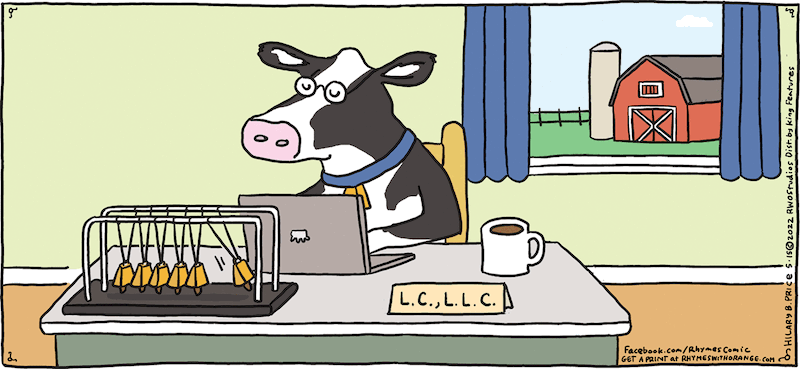
The heifer executive

May 17, 2022

Yesterday’s wry Rhymes With Orange strip, wordless and spare-looking, but packed with tons of meaning on two fronts, the dairy and the managerial; meanwhile, it presents a challenging exercise in cartoon understanding.


(#1) If you see that there’s something sweetly funny about a dairy cow managing a business, well, that will do — but the pleasure of the cartoon is in the details

(more…)

FREDs and their kin

February 24, 2022

(References in plain language to men’s bodies viewed as sexual objects, with a photo, so not suitable for kids or the sexually modest.)

On Facebook yesterday, information from train-watcher Ned Deily about FREDs. That’s FRED, an acronym for flashing rear-end device — an alternative name for end of train device, no doubt devised to provide a pronounceable acronym (FRED) rather than a mere initialism (like ETD). But then we get then nominal rear end, referring not only generally to the back part of something, but also specifically to a person’s buttocks. Which takes us into racy or frankly raunchy territory.

FRED 1, the flashing rear-end device. In brief, from Wikipedia (a) on the end of train device; and then from the Trains & Locomotives Wiki (b) on “End of Train Device” (edited for readability):

(more…)

Frequently asked questions

January 31, 2021

A Roz Chast cartoon in the latest (2/1/21) New Yorker:

Questions asked often enough that they border on clichés. They’re frequently asked questions — but they’re not Frequently Asked Questions, Frequently Asked Questions being an idiomatic expression usually reduced to an alphabetic abbreviation, the noun FAQ.

(more…)