Author Archive

The headline writer’s dream story

March 21, 2024

Yesterday’s news from East Sussex (the old original Sussex, in southern England), a Sussex News story (by Jo Wadsworth) that kicks off with this juicy summary sentence:

A handyman who masturbated over a tenant’s knickers has been acquitted of criminal damage. 

The story is pretty much unavoidably raunchy, given the nature of the offense; nobody writes stuff like commit an obscene act these days. The reporter used the technical and punchier masturbated in the intro, I’d imagine because it was compact, but then opted for the euphemistic pleasured himself in the full story, which continues:

Simon Lawrence, 55, had been called to fix a faulty washing machine when he entered Joanna Hatton’s bedroom at the cottage she rented with her partner Thomas Jones.

But he didn’t realise the couple had installed a motion sensor camera there to watch their cat.

The couple were driving to Somerset for Christmas when Joanna got an alert on her phone that the camera had been activated on 19 December, 2022.

She watched in horror as Lawrence laid out her underwear on the bed and began pleasuring himself.

The reporter must have yearned to use the British slang wanked, which is vulgar but what ordinary people say in the UK. But you can’t talk like that in a respectable newspaper (though the tabloids can go pretty far).

But there would be room to veer towards vulgarity in the head; in fact, this is a dream story for an alert headline writer, who while casting about for alternatives to masturbated, to knickers (which is kind of giggly slang but not vulgar, and which doesn’t have to get into the head), and to be acquitted (which is legalese), might hit on the possibility for a somewhat rude pun on ‘masturbate’ vs. ‘be acquitted ‘, via the phrasal verb get off.

Or, of course, a headline writer might go for get off rather than be acquitted just because it’s a bit shorter (writing heads is sometimes like solving a devilishly complicated puzzle), in which case they could come up with the actual Sussex News headline in all innocence (until the laughter rolled in):

(more…)

Trendy menu language

March 21, 2024

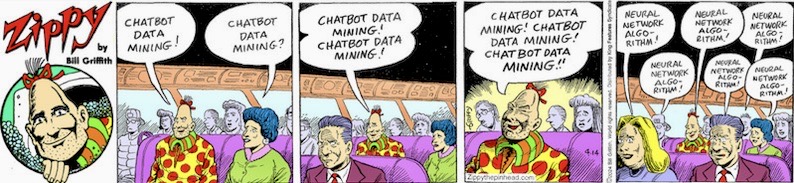
Briefly noted: today’s Zippy strip, in which our Pinhead reflects on trendy menu language at a carnival food stand:


(#1) Corn-dog foam is all the rage, especially if you can get it artisanal, curated, hand-selected, rustic, on a stick, buddy, on a fuckin’ stick, with almond milk, 2 pumps of caramel, cold foam, extra crispy with locally sourced tripe in Sichuan chili sauce, oh I seem to have lost track of things, what were you asking?

(more…)

Etheric armies cloud the sky

March 21, 2024

From Tim Evanson on Facebook yesterday, this splendid piece of cover art for the May 1954 issue of Mystic Magazine, an illustration by Malcolm Smith showing a sci-fi Archangel Michael (as I see it) leading his etheric army of the skies in a charge into battle:


(#1) Smith’s diaphanously robed Michael, shining in white, muscular, with long arms, long legs, enormous wings, wielding a beautiful bright sword (have I mentioned that I have a thing for hunky well-um-armed men with wings?)

Etheric armies — armed men flying through the ether, the air, the sky — literally struck a chord for me. Well, they came with a specific tune, fierce and haunting, and the words etheric armies cloud the skies, which I eventually recognized as a Mystic Magazine-fostered amalgam of ten thousand angels filled the sky and a solemn darkness veils the skies. Both texts by Isaac Watts (from 1719 and 1709, respectively), tunes by William Billings (from 1778, a bright celebration of the angels attending to the resurrection and glorious ascension of Christ, while those heavenly guards around thee wait like chariots that attend thy state) for the first and by Amos Pilsbury (from 1799, that fierce and haunting tune for the same occasion, on which cherubic legions guard Him home and shout Him welcome to the skies) for the second.

(more…)

They’re a stink

March 20, 2024

(Very much a brief MQoS Not Dead Yet posting on my part, while I cope with a complex posting on the wonders of VPE in English)

In an old One Big Happy strip that came up in my comics feed this morning, two of the kids — Ruthie and the neighbor boy James — undertake to go on a dinosaur hunt, expecting the creatures to be easy to find because, according to James, they’re a stink:


Ruthie’s grandfather is about to explain to James the difference between extinct and a stink

Once again, the kids are coping with unfamiliar, technical vocabulary by interpreting it, eggcornishly, as more familiar material. Something of a stretch in this case, though extinct and a stink are indeed phonologically similar. I do wonder if there have been kids who reinterpreted extinct this way, or whether Rick Detorie (the cartoonist) merely imagined a reinterpretation that might have happened. Oh, the things that might have been!

(The adjective extinct is historically a specialized variant of extinguished, so calls to mind the vivid image of these creatures having their flame of life quenched, put out.)


Dynamic semantics wins a prize

March 19, 2024

🧨 🧨 🧨 Firecrackers! For a prize from the Swedish royal academies, something  you might think of as a Nobel Prize’s little brother, awarded to two colleagues in linguistics and philosophy, one an old friend (and exact contemporary) of mine. From the website of the Swedish royal academies, “Science, art and music meet in the Rolf Schock Prizes 2024”, a press release of 3/14/24:

2024 Rolf Schock Prize in Logic and Philosophy is jointly awarded Hans Kamp, University of Stuttgart, Germany and Irene Heim, Massachusetts Institute of Technology, Cambridge, USA

“for (mutually independent) conception and early development of dynamic semantics for natural language.”

Natural languages are highly context-dependent – how a sentence is interpreted often depends on the situation, but also on what has been uttered before. In one type of case, a pronoun depends on an earlier phrase in a separate clause. In the mid-1970s, some constructions of this type posed a hard problem for formal semantic theory.

Around 1980, Hans Kamp and Irene Heim each separately developed very similar solutions to this problem. Their theories brought far-reaching changes in the field. Both introduced a new level of representation between the linguistic expression and its worldly interpretation and, in both, this level has a new type of linguistic meaning. Instead of the traditional idea that a clause describes a worldly condition, meaning at this level consists in the way it contributes to updating information. Based on these fundamentally new ideas, the theories provide adequate interpretations of the problematic constructions.

Kamp was born in the Netherlands in 1940. He received his PhD from University of California, Los Angeles, in 1968 and has been a professor at University of Stuttgart, Germany, since 1988.


(#1) Hans Kamp (photo: Kerstin Sänger)

Heim was born in Germany in 1954. She received her PhD from the University of Massachusetts, Amherst, in 1982 and has been a professor at the Massachusetts Institute of Technology (MIT), Cambridge, USA since 1997.


(#2) Irene Heim (photo: Philipp Heim-Antolin)

(more…)

The decade of no skateboarding

March 18, 2024

An old One Big Happy strip that’s been hanging around on my desktop for a couple of years. When you go to explain why it’s so weirdly funny, it turns out to be a complex exercise in what’s known in the linguistics trade as quantity implicature: someone uses a quantity expression, like 6 people or 18 years old, and we understand the speaker’s intentions to be to suggest exactly that quantity, or at least that quantity, or no more than that quantity — in technicalese, we take the speaker’s words to implicate one of these things — depending on the context and our assessments of the speaker’s reasons for mentioning that quantity in the context.

The standard discussions of quantity implicature are about reports of states of affairs. If, for example, a well-intentioned speaker tells you that there were 6 people at their birthday party, you take them to be conveying that there were exactly 6 people. I mean, if there were 8 people at the party, it would be true that there were 6 people; but then it would be uncooperative to say that there were 6 people, because if you knew there were 8 you should and would have said so, therefore saying there were 6 implicates that there were exactly 6. (This would be a good time to take a deep breath and rest for a moment.)

(more…)

On being, turning, and wearing green

March 17, 2024

(Part of this posting will dive right into gay porn for the day, with street-talk musings on man-on-man sex that’s totally off-limits for kids and the sexually modest; I’ll hold this part off until the end, so if you need to you can bail out then)

☘️ ☘️ ☘️ It’s St. Patrick’s Day, and in my e-mail: two Bob Eckstein cartoons for the day (on turning and wearing green for the day); and a Falcon  Studios sale on gay porn, made holiday-appropriate by the mere addition of a shamrock, but which opens the topic of gay porn with actual St. Patrick’s day themes.

(more…)

The three Larrys

March 16, 2024

A complex tale that begins with a follow-up to my 3/1 posting “The grace of lovers”, about the sharing of enthusiasms with my first male lover, Larry (the pseudonymous Danny Sparrick in my writings about my sexual life). That’s Larry1. There are gripping stories about our time together and his life now, but the tale of the three Larrys is fabulously intricate as it is, so I’ll put off posting about these parts of Larry1’s life for another time. And focus on our exchange of enthusiasms, which will lead, circuitously, to Larry2 (in NYC, some years after Larry1). And then, a recent posting about a French conference on interjections, in which a 1982 dissertation on discourse particles I directed at Ohio State brings us Larry3, who wrote it.

There is still more, a epic of geographical (and social) wandering for both Larry1 and me; he grew up in Del Mar, a beach community in San Diego County, and ended up in provincial Japan; I grew up in little suburbs of Reading, in the Pennsylvania Dutch country, and ended up on the San Francisco peninsula; in between these terminal points, he and I more or less wandered the world (we both taught in China along the way, but not in the same place or at the same time; we both lived in England at one point and were able to get together in London then; and once we rendezvoused in Washington DC). Perhaps these odysseys will make another posting — but, again, too much for today.

(more…)

Grunt Oil

March 15, 2024

(Man-man sex discussed in street language, so not for kids or the sexually modest)

It’s 3/15, the day after Pi/Pie Day (in the US), and the Ides of March (everywhere), and also (in ZwickyWorld) Higashi Day — when, back in the last century, Jacques and I set off from Palo Alto CA (and Stanford) on our annual journey east (higashi) back to Columbus OH (and Ohio State); Nishi Day, for embarking on  the journey to the west, was on 12/15.

My Higashi Day was enlivened by a Fort Troff e-mail sale ad for their Grunt Oil silicone-based lube (named for the sound men make during anal intercourse). A tube of the actual product, with a plug for it that gives a relatively straightforward description of the stuff:


(#1) The packaging varies; there are less raunchy variants (missing the finger and the FUCK ME, COCK TOY! graffiti) and even raunchier ones, as we’ll see in a moment

Description: Hands-down, silicone is the gold standard for durability and slickness. Sure, water-based lubes are good when you need a quick clean up… but nothing beats the smooth, silky feel of pure high-grade silicone. Grunt Oil is super-concentrated for max longevity. It doesn’t break down in water, so you can use it in the shower. Clean up with soap and water.

Fort Troff caters to what I’ve called Ruff Dudes, hypersexual hypermacho anally hyperreceptive man-oriented men (with a fetish for sex machinery), existing in some paradoxical liminal world between actual leathermen and fantastical bdsm creatures. So #1 counts as vanilla in Fort Troff’s world.

But that’s not what assaulted my eye this morning. It turns out that the exciting feature of Grunt Oil is that it looks like cum. Creamy white jizz. This is supposed to be incredibly hot to Fort Troff’s clientele, and I’m really into cum, but an anal lube that looks like cum strikes me as a goofy idea. Even goofier than dildos scrupulously designed to replicate actual penises. (In both cases, the appeal is to the imagination, not to the senses.)

(more…)

The history-rebooted Easter egg

March 14, 2024

In the Economist‘s 2/10/24 issue, early in the piece “Chronicling the past: The present as prologue” (a review of 2020 by Eric Klinenberg, a book treating the Covid pandemic, still unfolding, as a historical event), this passage:

It has been an alarming few years. History — widely assumed to have stopped somewhere around the fall of the Berlin Wall and the Spice Girls’ first record — has got going again, with gusto.

The implicit claim is that any history worth recording came to an end with the fall of the Berlin Wall, in 1989 (the end of an old political order), and the Spice Girls’ first record, in 1996 (the end of an old pop-cultural order), but sprung back to life with the onset of the pandemic; things are happening again.

Readers with a keen ear, especially if they are British (the Economist is a British publication), might have detected something vaguely familiar in the way that claim has been worded; it’s a distant, glancing allusion to the first verse of a famous (in some circles) poem by British poet Philip Larkin — easy to miss, especially since it contributes nothing of substance to a review of Klinenberg’s book, but is just a little gift to readers who recognize the allusion to a culturally significant text: it’s what I’ve called an Easter egg quotation.

(more…)