From Tim Evanson on Facebook yesterday, this splendid piece of cover art for the May 1954 issue of Mystic Magazine, an illustration by Malcolm Smith showing a sci-fi Archangel Michael (as I see it) leading his etheric army of the skies in a charge into battle:
(#1) Smith’s diaphanously robed Michael, shining in white, muscular, with long arms, long legs, enormous wings, wielding a beautiful bright sword (have I mentioned that I have a thing for hunky well-um-armed men with wings?)

Etheric armies — armed men flying through the ether, the air, the sky — literally struck a chord for me. Well, they came with a specific tune, fierce and haunting, and the words etheric armies cloud the skies, which I eventually recognized as a Mystic Magazine-fostered amalgam of ten thousand angels filled the sky and a solemn darkness veils the skies. Both texts by Isaac Watts (from 1719 and 1709, respectively), tunes by William Billings (from 1778, a bright celebration of the angels attending to the resurrection and glorious ascension of Christ, while those heavenly guards around thee wait like chariots that attend thy state) for the first and by Amos Pilsbury (from 1799, that fierce and haunting tune for the same occasion, on which cherubic legions guard Him home and shout Him welcome to the skies) for the second.
The context of #1. More on the two hymns I just quoted from below. But first the context of #1, about which Tim Evanson posted exclamatorily on Facebook:
These 1950s paranormal / Fortean/pseudoscience magazines were such camp!
Unintentional camp, for the most part, but camp they often were. On Mystic Magazine, from Fancyclopedia 3:
Mystic Magazine was a bi-monthly occult fiction magazine, published by SF personality Raymond A. Palmer. The magazine featured weird and fantasy fiction from November, 1953, until December, 1954, for a total run of 7 issues. Gradually the fiction was edged out by stories of “true experience”.
And then on the artist. From Wikipedia:
Malcolm H. Smith (1910–1966) was an American artist identified with the retro-futurist tradition.
… In the mid to late 1930s, [he] started working as a freelance artist for the various pulp publishers in Chicago. He did illustrations and paintings for mystery, romance, detective, western, and sci-fi pulps. He was, for a while, the art director at Ziff-Davis Publishing. At other times he worked in a Chicago-based artist’s cooperative … [He] often used himself, his friends, and family members as models for his works.
In the latter part of 1959, [he] moved his family to Huntsville, Alabama, where he worked as a concept artist and animator for the Marshall Space Flight Center of NASA. … [He] is considered by many sci-fi fans to be one of the founding fathers of this genre of art.
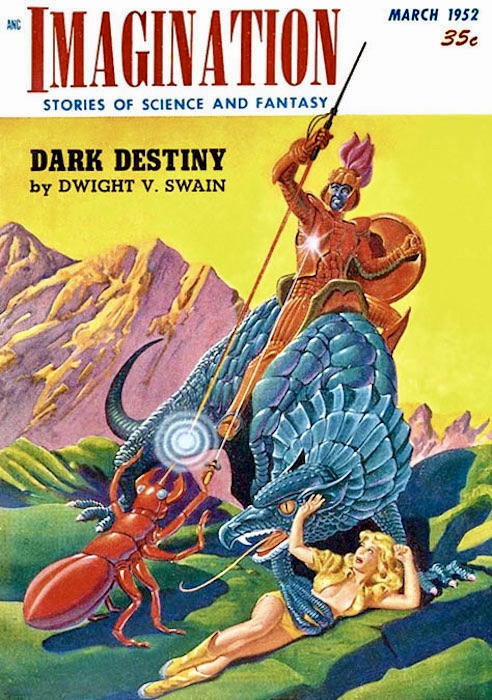
Two other covers by Smith, for Imagination magazine, with more campy sci-fi art:
(#2) Imagination issue of February 1957
(#3) Imagination issue of March 1952

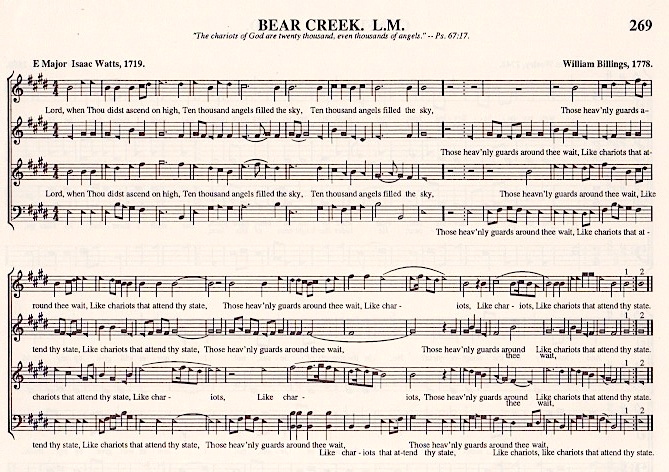
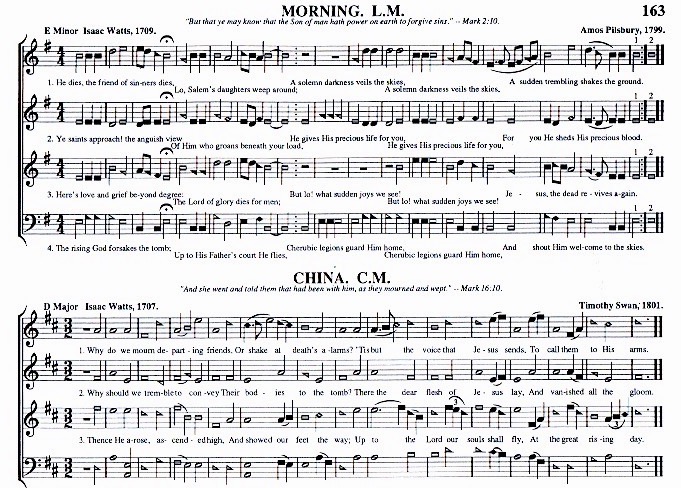
The hymns. From the shapenote songbook The Sacred Harp (1991 Denson revision): Bear Creek (SH269) and Morning (SH163t). (I sing in this tradition, and have posted about it on this blog many times; I’m a male treble, singing high harmony or a countermelody, but an octave below the female trebles.)
Bear Creek. Discussed in my 12/27/12 posting “Confidence and Bear Creek”. The song has one verse
Lord, when Thou didst ascend on high, / Ten thousand angels filled the sky.
and a fuguing chorus:
Those heavenly guards around thee wait, / Like chariots that attend thy state.
The music (in 4-shape shapenote notation, with the melody line in the tenor — 3rd — line):
(#4) Bear Creek: ten thousand angels fill the sky
Morning. With a fuguing chorus for each of the four verses:
for verse 1: A solemn darkness veils the skies, / A sudden trembling shakes the ground.
for verse 4: Cherubic legions guard Him home, / And shout Him welcome to the skies.
The music:
(#5) Morning: cherubic legions guard Him home (and we get the lovely China for free)
Now just swap those legions of earnest Christian angels for etheric armies from outer space, and you’ve got #1.
Leave a Reply