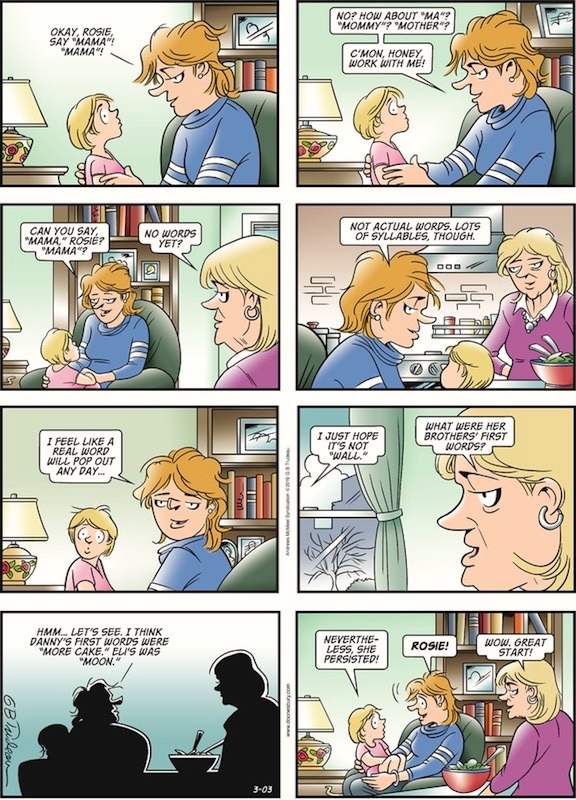
From the Doonesbury cartoon of 3/3/19 on baby’s first words:
(#1) Alex Doonesbury, watched by her mother, coaches her infant daughter Rosie to say mama — and is rewarded with Nevertheless, she persisted!
From the Doonesbury cartoon of 3/3/19 on baby’s first words:
(#1) Alex Doonesbury, watched by her mother, coaches her infant daughter Rosie to say mama — and is rewarded with Nevertheless, she persisted!
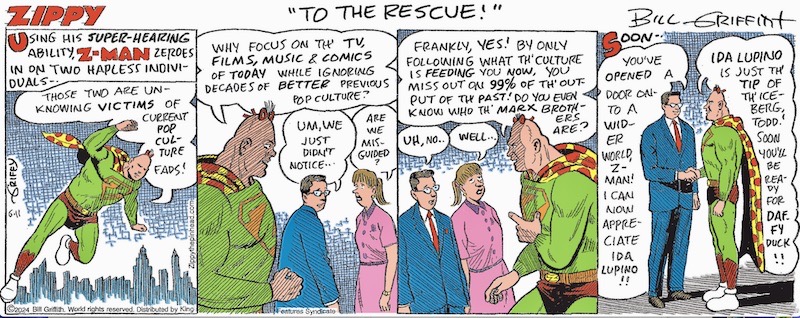
That would be old original Z-Man, who is now (according to today’s Zippy the Pinhead strip) your flight-empowered guide into the pop-cultural past:
(#1) The first of (at least) three incarnations of Z-Man since he entered the Zippyverse in 2005
As a Z-person, I am especially attentive to words with Z in them (like whizz), especially names (like Buzz and Graz), especially names beginning with Z (like Zelda, Zorn, and Zorro). So Zippy and his superhero Z-Man characters catch my eye and get my attention, independently of the absurdist attractions of the strip (and, in the case of #1, without regard for my appreciation of the Marx Brothers, Ida Lupino, and Daffy Duck).
Passed on by Lisa Cohen on Facebook on 6/2: a bulletin about the world’s largest perogy, in Glendon AB. From the Atlas Obscura site, in “Giant Perogy… Roadside tribute to a staple of eastern European cuisine”, published on 9/5/10:
In 1993, Glendon, a village in Alberta …, unveiled its roadside tribute to the perogy. The town’s [fiberglass and steel] Giant Perogy, complete with fork, stands 27 feet tall, weighs approximately 6,000 pounds, and is considered one of the “Giants of the Prairies,” a collection of massive sculptures that can be found across this geographic region of North America.
The fork was added to the sculpture so that people would have some idea as to what it was supposed to be. The first design, without the fork, left passersby baffled. “The first design wasn’t [with] a fork, but then people went by and they responded that it looked like a cow pie or something,” said Johnny Demienko, who dreamed up the sculpture when he worked as the town’s mayor and also a school bus driver.
Apparently, a Perogy Cafe, serving “Ukrainian and Chinese perogies”, was located next to the sculpture for some years.
To come: photos of Glendon’s Giant Perogy; the spelling PEROGY; for comparison to the Glendon dumpling, actual pierogies; the Giants of the Prairies.
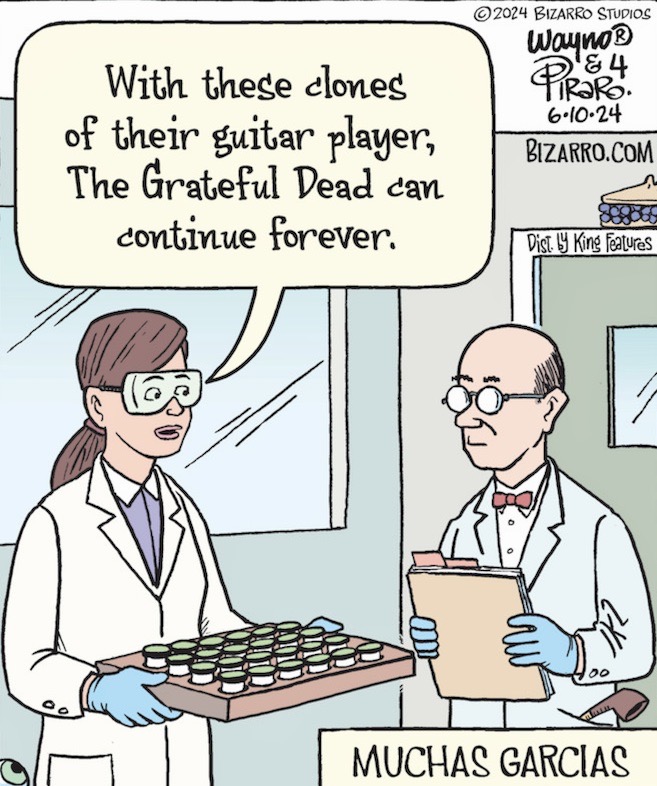
To begin the new week, a bilingual rock-music groaner in today’s Wayno / Piraro Bizarro:
To understand this cartoon, you have to know the Spanish gratitude formula muchas gracias ‘many thanks’, and you have to know that Jerry Garcia was the lead guitarist of the rock group The Grateful Dead; otherwise, the cartoon is just baffling (if you’re puzzled by the odd symbols in the cartoon — Dan Piraro says there are 4 in this strip — see this Page)
Garcias (the plural of the name Garcia) is a pun on gracias ‘thanks’ in muchas gracias — but it works better as orthographic play (just AR for RA, a reversal) than as phonological play, since Garcias and gracias are strikingly different in their prosody (second-syllable accent in Garcias, first-syllable accent in gracias); and if Garcias is pronounced in English and gracias in Spanish, they’re also segmentally distinct, notably in the final syllable, [ǝz] in English, [as] in Spanish, and in the phonetics of the r.
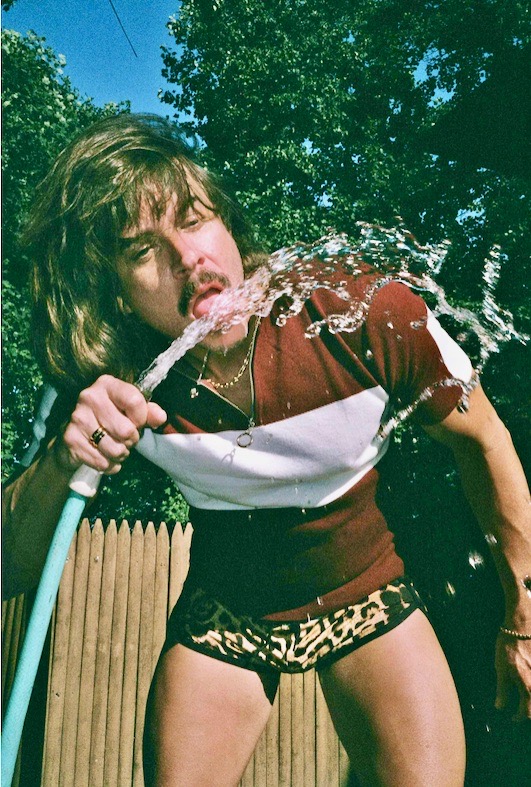
… the hunky way-gay electroclash musician and performance artist, who somehow escaped notice on this blog until a photo from a 2017 Out magazine piece (“Gallery: Wet n Wild With Casey Spooner”) about him popped up on my Pinterest yesterday, with this, um, hose-drinking shot:
(#1) There are contexts in which this would be innocent fun — but this is not one of them
The rest of this posting will be soaked through with playful, entertaining queerness, from a performer who deploys his very muscular high masculinity to jab at and undermine conventional notions of gender, sexuality, identity, and relationships. That might not be to your taste; use your judgment,
(entirely unsuitable for kids and the sexually modest, even after some judicious fuzzing of body parts in the visual)
Very briefly noted, a spectacularly bad kerning in a Gay Empire e-mail ad (this very morning) for video on demand; background from NOAD:
noun kerning: the spacing between letters or characters in a piece of text to be printed: I am very concerned about the kerning as it just looks awkward.
Briefly noted. Michael Covarrubias — an American, from Battle Creek MI, who lives and works in Turkey, and is now on holiday in Madrid — has been reporting on Facebook on the texture of the life around him in Madrid, taking photos with a keen eye for little bits of beauty, oddity, and humor. Today’s MC observations included a surprise: state-fair concession food from the farmlands of middle America. That edible and portable triumph of Americana, the corndog / corn dog: a hot dog coated with cornmeal batter and deep fried, on a stick. The Perrito Nebraska ‘little Nebraska dog’, an exotic specialty of the little restaurant La Españolita (I’m sorry; we’re all awash in diminutives).
As a bonus, it comes with some truly grotesque ad design that undercuts the natural goofy-phallic attractions of the corndog as art object.
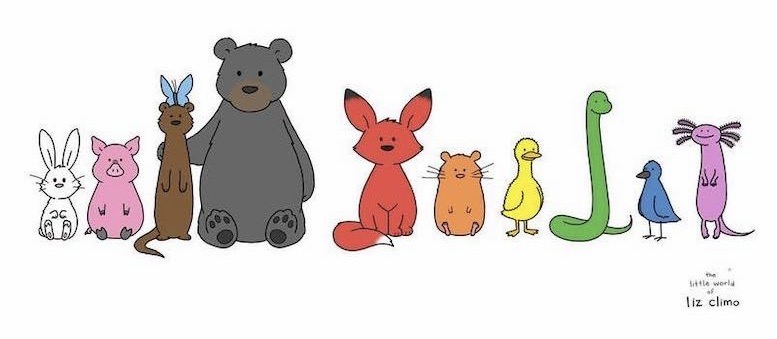
Briefly noted. Passed on by Evan Randall Smith on 6/6 on Facebook, this Liz Climo celebration of Pride month, featuring her congenial cartoon animals:
(#1) The color sequence — white, pink, light blue; brown, black; red, orange, yellow, green, blue, purple — reproduces the bands of the Progress Pride flag
(There’s a Page on this blog on my postings about Climo’s work.)
An Amy Hwang cartoon in the latest — 10/23 — issue of the New Yorker that I found hugely funny, for reasons I couldn’t at first explain:
(#1)
Well, there are people who can fall asleep (pretty much) anywhere, as they say — I’ve been such a person for about 70 years now — but I have never just lain down for an impromptu nap on the ground out in the world, as the snail in #1 seems to have done, preposterously.
Actually, the cartoon snail is lying flat as a flounder, in such a way that it’s hard to be sure that it’s only somnolent and not in fact deceased. It could well be not merely sleeping, but dead — reversing the customary formula, of many applicabilities, that someone or something isn’t dead, but only sleeping. Snail3 in the cartoon looks a lot like the Monty Python pet-shop parrot: this is an ex-snail, gone to meet its maker, and its snail buddies are just slip-sliding along in denial.
So #1 is wonderfully absurd. It’s also an excellent example of a cartoon existing equally in two worlds: visually, the world of snails (lacking males, since snails are generally hermaphroditic; bereft of speech; and also exhibiting dormancy but not, apparently, actual sleep); behaviorally, the world of human beings (where Snail1 can remark that he — Snail3 — can fall asleep anywhere).
But then I was carried away into the complexities of sleep in human beings and in other creatures (where it contrasts with rest and dormancy, not to mention death) and into the behavior of snails, where I will report — surprise! — on a 2011 study from the Journal of Experimental Biology about a common pond snail:
Behavioural evidence for a sleep-like quiescent state in a pulmonate mollusc, Lymnaea stagnalis (Linnaeus)
The title is a play on the song title “A Nightingale Sang in Berkeley Square” (that’s Berkeley pronounced like Barclay, not like Burkley), and after an introduction to my colleague Asya Pereltsvaig this posting goes with her on a recent visit to Belgrave Square — Berkeley Square (in Mayfair) and Belgrave Square (in, yes, Belgravia) being two delightful green spaces in the toniest parts of central London — and I will celebrate the Vitruvian Man statue Homage to Leonardo in Belgrave Square. But in the end, today’s essay is about penises — the one on Vitruvian Man, the one on Michelangelo’s David, and the one on Astrid Zydower’s Orpheus — and their acceptability in a variety of cultural contexts.
So, while I have labored to keep the crude references to a minimum, there’s no denying that this posting will end up being, um, phallically rich — which some of my readers will find unsavory and unwelcome; this is a warning about what’s to come.