Joel B. Levin has sent me e-mail from a stopover in Reykjavik, where he enjoyed a tour “to see and smell sulfurous hot water at the original Geysir” and was treated to a viewing of the wrestlers statue outside the Geysir Glíma Restaurant. So, knowing my interest in artworks and also in men’s bodies, JBL sent me his photos of the sculpture:
(#1) Side view of the Glíma wrestlers
(#2) Front view of the Glíma wrestlers
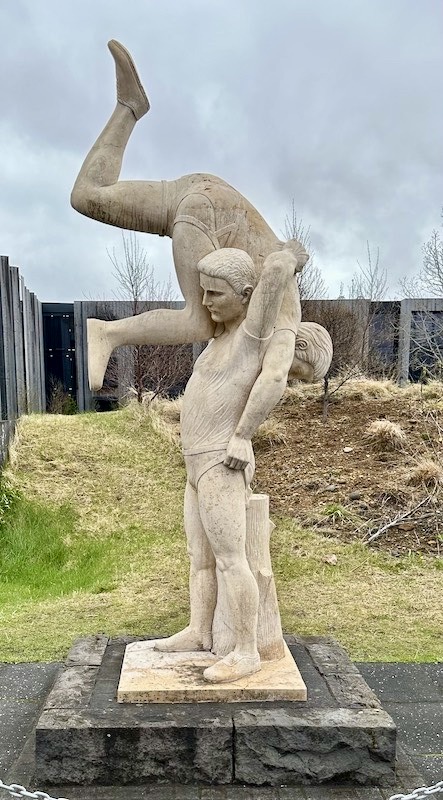
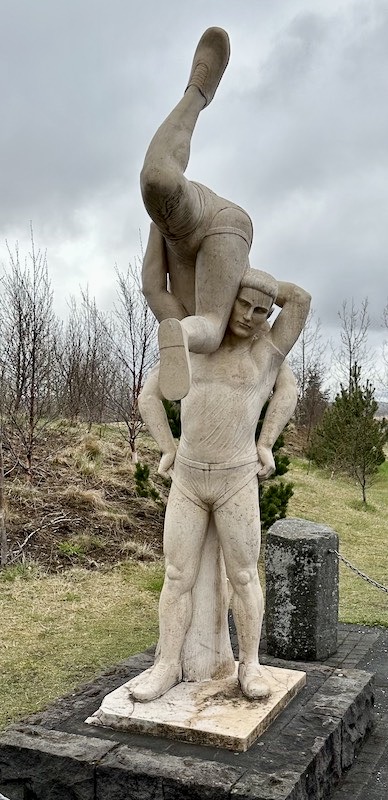
At least four things here: the Viking sport of Glíma; the statue’s association with the restaurant; the statue as artwork; and the problematics of intimate contact between men’s bodies in wrestling.
Glíma and the restaurant. From the Atlas Obscura site, “Geysir Glíma Restaurant, Iceland: A restaurant devoted to “trouser grip” wrestling, an ancient form of Viking wrestling that is Iceland’s national sport”:
Glíma, the most widespread sport of the Viking Age, was the foundation of self defense for Viking warriors. Scandinavian children started learning the martial art as early as 6 years old. Its earliest mention comes from a poem about Thor (the Viking god of wrestling) by the 9th-century Norwegian poet Bragi Boddason.
Glíma is practiced in three different styles. The most common form in Sweden and Iceland is called Brokartök (trouser-grip), which focuses on technique rather than strength. Opponents must remain erect and are only permitted to move clockwise around each other, like a waltz.
Glíma is the national sport of Iceland. It’s been taught in Icelandic primary schools since 1987 and the country has held championships since 1906. The winner of the highly celebrated event is called Glímukóngur (Glíma king).
The Geysir Glíma Restaurant has only been around since 2012. The family who owns it uses the space to celebrate and educate diners on the finer points of Glíma, which is now the Icelandic word for “wrestling” or “struggle.”
Sigurdur Greipsson, a famous wrestler and ancestor of the owners, is honored with a statue of two men doing Glíma outside. Inside, there are six televisions that are all dedicated to footage of the sport. The restaurant also displays the Grettisbeltið, a belt given to the winner of the 1906 match, and the oldest trophy in Iceland.
Opponents in a Glíma match are encouraged to look over each other’s shoulders as much as possible, to make moves based on touch rather than sight. The televisions displaying their avoidance of eye contact mirror any awkward dates going on in the restaurant.
Looking ahead: avoiding eye contact is one strategy for reducing the homoerotic potential of wrestling; wrestling only in a standing position (rather than down on a mat) is another.
The statue as artwork. The statue is meant as an enduring illustration of the sport — permanent in a way that the action on the televisions in the restaurant is not, and three-dimensional in a way photographs are not. It’s excellently crafted for this purpose, but of little interest as a work of art.
The wrestler’s faces are stock images, devoid of individuality or any expression of emotion (details that would only distract the viewer from Glíma technique), and their bodies show no signs of strain or effort, such as what you’d see in an actual sweaty wrestling match (but again, the statue is designed to abstract away from such things to illustrate how Glíma works).
(I’ve been unable to find out who sculpted the Glíma wrestlers, when, and in what circumstances. Presumably on commission from the restaurant, so quite recently.)
The sexual problematics of wrestling. To appreciate the issue, consider two postings of mine. First, from 5/6/22 in “Getting him on the mat”, on wrestling singlets as homowear (vs. as athletic wear) and on sexual stances (vs. wrestling stances), with the note that
videos with hot wrestlers grappling sexually are a subgenre of gay porn
As noted in my 1/6/16 posting “Wrestling with gay porn”:
Wrestling flicks as a gay porn genre. Such flicks are so numerous that they constitute a whole genre on their own. The attractions of these scenes for gay men are obvious: they are sports-related flicks, and so resonant with the high masculinity of men’s sports (and locker rooms); they feature sweaty muscular young men in minimal clothing; and they show these men engaged in more or less constant intimate contact, body on body.
Of course, actual wrestling, of all sorts, is combative, not seductive, and its customs are designed to facilitate vigorous but fair combat while minimizing its homoerotic potential (in Glíma, as noted above).
May 21, 2024 at 5:55 am |
On the other hand, the position of the downward-facing man’s hands – presumably illustrating the “trouser grip” – does rather suggest that he is attempting to (or about to) remove the other man’s briefs.