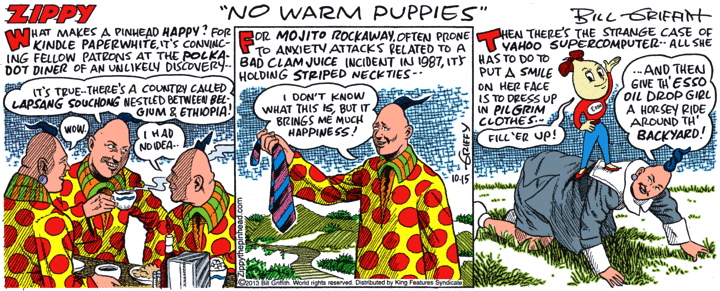
Today’s Zippy, with preposterous names for pinheads and references to commercial products (plus a diner):
 (#1)
(#1)
Kindle Paperwhite, Mojito Rockaway, and Yahoo Supercomputer at the Polka Dot Diner. With the Esso Drop Girl in the last panel.
Today’s Zippy, with preposterous names for pinheads and references to commercial products (plus a diner):
(#1)
Kindle Paperwhite, Mojito Rockaway, and Yahoo Supercomputer at the Polka Dot Diner. With the Esso Drop Girl in the last panel.
From Karen Chung on Facebook, this story from 8/21/12 (note the date), “The Latest Chinese Beach Craze – Face-kini”:
A new kind of swimwear trend is sweeping the Chinese beaches in Qingdao in eastern China’s Shandong province. As the weather get hotter, both men and women are seen appearing on the beaches wearing full body suits that cover from head to toe. The upper part of the swimsuit has a ski-mask with holes cut out at appropriate places to leave the eyes, nose and mouth exposed, giving the wearer an odd Lucha libre look. The Netizens are calling the swimwear “face-kinis”
The mask[s] are a way for Chinese bathers to protect their skin from the sunburn, but it turns out that they are equally handy at repelling insects and jellyfish.
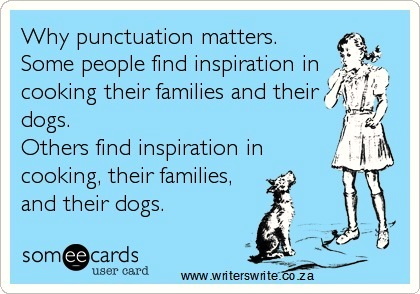
Three e-cards. The first is one in a long series illustrating the perils of going without punctuation — in this case, without commas that mark off syntactic constituents (in a way that receives expression in speech as well as on the page):
 (#1)
(#1)
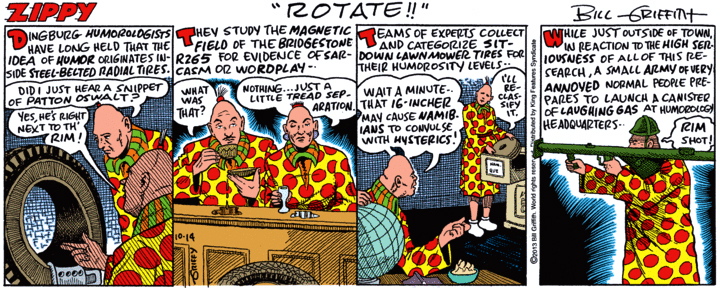
Today’s Zippy, on the origin of humor:
 (#1)
(#1)
Bill Griffith is fond of playful morphology: here, humorology ‘the study of humor’ and humorologist, plus humorosity ‘humorousness’.
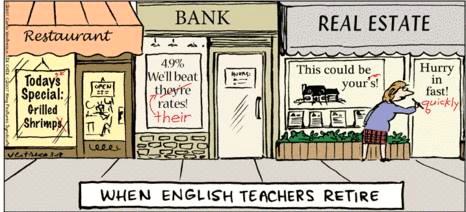
A Carla Ventresca cartoon that came to me via Mar Rojo on Facebook:
 (#1)
(#1)
It turns out that Mark Liberman posted this one on Language Log back on 3/18/07, with a nice discussion of the teacher’s incorrection (of fast to quickly) in the last panel. There’s another incorrection in the first panel, of shrimps to shrimp; as Mark noted, both forms are standard plurals for shrimp. (The remaining three corrections concern spelling and punctuation and are appropriate.)
Searching for this posting of Mark’s led me to more cartoons with English teachers in them.
Chris Ambidge announced on Facebook that today is the anniversary of A. A. Milne’s publishing Winnie the Pooh (which came out on 10/13/26, 87 years ago today). A Bizarro cartoon for the occasion:

The reference is of course to Edgar Allan Poe’s story “The Tell-Tale Heart”.
And then there’s the pun in the title.
In the midst of my posting “More dipspreads”, this sentence:
Taramosalata … is a Greek and Turkish meze.
So: meze. From Wikipedia:
Meze or mezze … is a selection of small dishes served in the Mediterranean, Middle East and Balkans as breakfast, lunch or even dinner, with or without drinks. In Levantine cuisines, in the Caucasus region, and in parts of Balkans, meze is served at the beginning of all large-scale meals.
The word is found in all the cuisines of the former Ottoman Empire and comes from the Turkish meze “taste, flavour, snack, relish”, borrowed from Persian … mazze “taste, snack” < mazīdan “to taste”. The English word was probably borrowed from the Greek version mezés (μεζές).
(Mostly about food.)
A return to the dipspread, first posted about here, where I wrote:
Dipspreads are thick enough to function as spreads … But dipspreads are also thin enough (or can easily be thinned a bit) to function as dips … Dipspreads are also thick enough to serve as fillings, particularly for sandwiches, and many are substantial enough to serve as small appetizers, side dishes, or salads. On the other hand, many are thin enough (or can easily be made so) to serve as dressings or sauces.
In that posting: Benedictine, tzatziki, pimento cheese, Liptauer. And pictured, but not written up, in this posting: hummus, tapenade. And in a later posting: tarator, raita.
Now to add to the inventory.
In yesterday’s NYT, an obit, “James A. Emanuel, Poet Who Wrote of Racism, Dies at 92” by William Yardley, concluding:
In his later years, Mr. Emanuel claimed to have invented a new form of literature: the jazz haiku, stanzas of 17 syllables he read to the accompaniment of jazz music. Like the music, they felt improvisational even as they respected structure:
Four-letter word JAZZ:
naughty, sexy, cerebral,
but solarplexy.
Googling on “jazz haiku” pulls up a considerable number of haiku about jazz.
From a reader of this blog:
A linguist named d’Armond Speers has been in Colorado news lately because his wife is running for the school board in Denver. Some years ago, Speers decided to speak to his baby son only in Klingon, while his wife used English. This continued for five years until the kid refused to respond to Klingon. I am wondering what your opinion is of an experiment like this? Good for the kid, or just notorious for the dad?