Author Archive

Cellarettes and cabinet drinks

October 9, 2025

Adventures in furniture inspired by a Benjamin Dreyer posting on Facebook yesterday:

Goshamighty, I completely forgot to mention, when I posted my Old Acquaintance piece a few hours ago, that in commencing this morning to read John Van Druten’s 1942 The Damask Cheek (co-written with one Lloyd Morris), I learned a new word! It’s cellarette: “a movable cabinet or container, often made of wood, designed to store and secure alcoholic beverages.”

If there’s a more perfect word to turn up in a play set in “The library of MRS. RANDALL’s house in the East Sixties, New York. December 1909,” [the  setting of The Damask Cheek] I can’t think of it.

BD locates the sociocultural milieu of the item (and then its name as well) as privileged urban upper class — traditional, elegant, and elite — and we will see that his classdar is first-rate.

I then broke in with the news that I have one of these things, a very nice one, of Danish design, made of teak, on wheels, with a durable bar top, in two parts that slide open to reveal the storage spaces within (there will be photos). I am neither elegant nor elite — I have several good points, but they are not these — but this clever and handsome object suits me (and it was mine and Jacques’s, and before that mine and Ann’s, so it comes with with waves of sweet memory; I will soon pass it on to my grand-child Opal).

But first, the cellaret / cellarette. The object and the name.

(more…)

The flannel frontier

October 9, 2025

The 10/7 Wayno / Piraro Bizarro strip, posted here because it’s sweetly bizarre (true to the strip’s title), multifariously playful, cleverly goofy. Something to enjoy for a moment in the midst of terrible times.


(#1) It’s all about the original Star Trek tv series (if you have somehow missed learning about the show, the cartoon will be incomprehensible to you); the top-level joke is in the title: the flannel frontier, a silly pun on the final frontier — but there’s a lot more (if you’re puzzled by the odd symbols in the cartoon — Wayno says there are only 2 in this strip — see this Page)

(more…)

The duck drops down

October 6, 2025

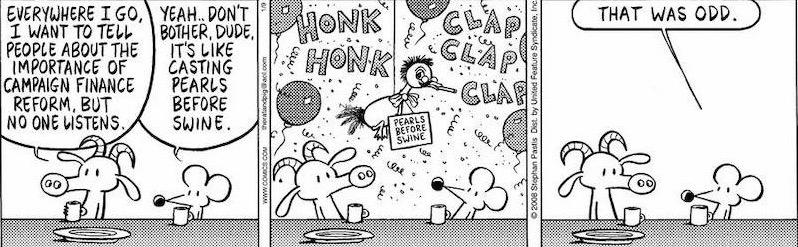
Say the secret word, and a prop duck made in the image of Groucho Marx drops down, to riotous applause and blaring horns — and you get prize money. That was American tv’s You Bet Your Life from 1950 to 1961 (roughly, my teenage years). And then in a Pearls Before Swine comic strip from 2006:


(#1) Another self-referential strip by Stephan Pastis (it’s one of his specialties) — the secret word is the idiomatic (originally biblical) phrase (cast) pearls before swine —  turning on shtick that disappeared from live tv about 65 years ago (but apparently lives on in pop-cultural consciousness, or at least in Pastis’s)

(more…)

October’s song: amid rueful jesting, they slip into death

October 5, 2025

A comic poem and a cartoon for October.

(more…)

The view from the troubled fringes

October 5, 2025

From the New Yorker issue of 10/13/25 (which has not yet arrived at my house), on-line on 10/5, “Takes: Rebecca Mead on Mary Ellen Mark’s photo from the Puerto Rican Day Parade” — from the New Yorker Classics, about “Forward, March” by MEM, in the 6/23/2003 print edition. This photo:


[caption:] Candice Lozada, nine, and Fantashia Toro, eleven, of the S.B.K. (South Bronx Kids) Dance Group, waiting for the Puerto Rican Day Parade to start

(more…)

The FY restaurant

October 5, 2025

Following on my 9/27/25 posting “From the annals of remarkable commercial names” (about the Chew Chew Grill / Chew Chew’s Diner in Toronto), Sim Aberson wrote on Facebook on 10/3:

— SA > AZ: While discussing commercial names, a very good Vietnamese restaurant in Miami, Phuc Yea — of course it’s pronounced fook yeh. [I omit commentary on the well-deployed SPAR (aka dangler) and the NP (topic-introducing) sentence fragment]

— AZ > SA: Oh my. No doubt intentional. Though I’ll point out that the enthusiastic intensive-modifier use of the F-word in Fuck yeah! is pretty much as low on the raunchiness scale as the F-word gets.

As it turns out, definitely intentional. And cheeky.

(more…)

50!

October 4, 2025

From Beth Levin to the Stanford linguistics department on 9/10:

The Department of Linguistics was officially established on September 1, 1975, and so this year is our 50th anniversary!  In celebration, we will be hosting a reception from 4-6pm on Friday, October 10 in the Linguistics Courtyard behind Margaret Jacks Hall. We have invited our many Ph.D. alumni and emeriti to attend, and we are anticipating a good turn out.

An astounding number of PhD alumni have said they’re coming (going back to 1970, from the precursor to the department). I don’t know how many emeritus faculty are coming. And then there are the people currently in the department. So it will be quite a scene.

(more…)

Three more years

October 3, 2025

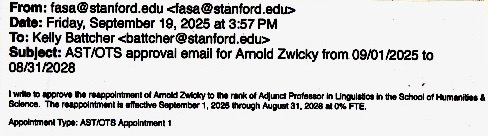
The reward at the end of an extravagantly difficult week (don’t ask): confirmation that I have actually been appointed for three more years at Stanford. No longer do I get a letter of appointment from the cognizant dean; instead, my department’s administrator (the Kelly Battcher in this e-mail) gets a notice from FASA — Faculty and Academic Staff Appointments, the online integrated management system for academic appointments at Stanford. This notice:


Thus implying that the cognizant dean did in fact approve the appointment; there is an actual human being in the middle of all this, you just can’t see them

(more…)

entre más carne mejor

October 3, 2025

More from the annals of commercial names, thanks to this Facebook report from Steven Levine, on the road in Asbury Park NJ:

On the way to Ocean Grove NJ for a weekend with some friends, our culinary tour of the Jersey Shore, I passed this sign:


(#1) The Meat & More Corporation of Asbury Park: a butcher shop, noted here for its double entendre name

(more…)

Can I help?

October 1, 2025

🐇 🐇 🐇 rabbit rabbit rabbit for the new month, which is coming in locally with October showers (a tiny amount of rain, but always an excitement in what is still the dry season in this part of the world)

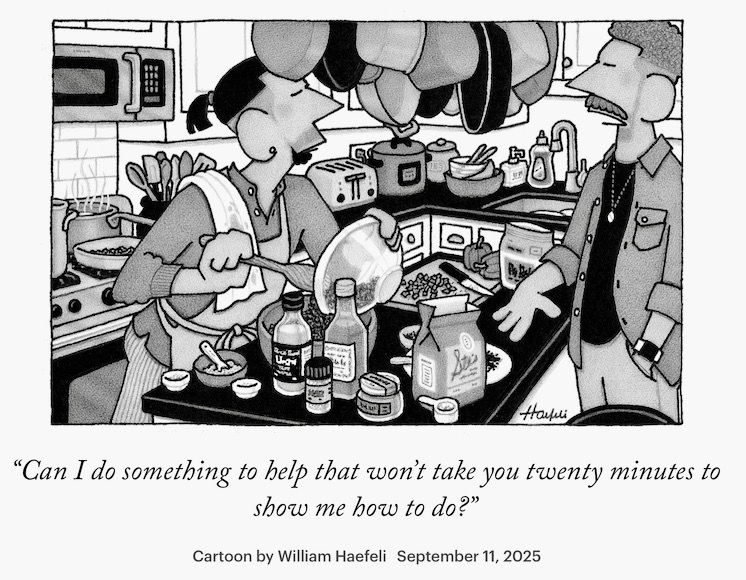
And now I turn to a William Haefeli cartoon from the New Yorker issue of 9/22/25 (this is only a bit behind the times; I have promised follow-up postings to first installments going all the way back to January, and my life is now spectacularly more difficult than it was before, so I’m just taking random shots). This cartoon:


(#1) All about the complexities in offers of help — from anyone, from someone who shares your household, from your spouse (or equivalent partner), or specifically from your same-sex partner, or (since this is Haefeli) even more specifically from your gay male partner; and also about the division of labor in households of all sorts

The cartoon is in face exceedingly rich, readable at several different levels. It is, in fact, funny even if you eliminate all the rich social specificity Haefeli has built into it.

A thought experiment: replace the highly socially located characters in #1 by cute indistinguishable cartoon creatures not identifiable by species or sex. One is engaged in some neutral task, like sorting unidentifiable objects; the other, standing by and observing, asks (in a way that presupposes that the observer doesn’t already know how to do the task):

Can I do something to help that won’t take you twenty minutes to show me how to do?

(This is an offer to help, couched indirectly, as a question, and also hedged, with a precondition on the offer.)

It’s still funny — because all tasks require skills, which must be learned (by observation or instruction, and then by practice), but there’s a wide range of complexity and difficulty for these skills, and at the upper end of the range, it could take a significant amount of time for a new helper to pick up the skill, so the observer conveys that their offer is conditional on the learning time being short; 20 minutes would be too great an investment for them. We then have some wry mockery of the observer’s attitudes — that they’ll do it, but only if it’s not too much trouble. They want the credit for offering, but don’t want to commit much to the task.

In real life, I have often had the experience, in difficult times, of having someone turn up offering to give me whatever help is needed, but then when asked to do some specific task, demurring on the grounds that “Oh, I couldn’t do that!” I have an especially unpleasant memory of my stepmother-in-law arriving in Cambridge MA (in the middle of a bitter winter, from Florida), after our daughter Elizabeth was born, to help out with the baby. Almost anything that would have helped us — doing some cooking, getting groceries, taking clothes to the laundromat, whatever — was greeted with “Oh, I couldn’t do that!”. After a few days she went back to Florida and out of our lives for a while, to our great relief.

But now in the social context. As soon as you add some social context, the cartoon becomes much richer.

First, the task is cooking, which is famously complex and time-consuming. And look at that kitchen! Crowded with pots and pans and, everywhere, ingredients. Conveying that helping out is likely to be no small undertaking.

Second, the the cartoon is about a cook and their housemate, so the division of household labor now comes to the fore: how does it come about that one person does all the cooking while the other merely observes, sometimes extending a conditional offer of help?

Third, domestic cooking in our sociocultural context is “women’s work”, so we would guess that the cook is female and the observer male, that these roles are assigned by gender-normative conventions, with the result that the observer is being cast as normatively masculine: pointedly not doing women’s work, because that would be feminine. But he might, um, lend a hand to the little lady. As a favor. If it wasn’t too much trouble. Then the cartoon is a poke at the pretensions of the observer.

But, wait! Fourth, the couple in the actual cartoon are both men. Whatever their relationship, if they are at least housemates, tasks have to get done, and somebody’s got to take the cook role. The roles have to be negotiated. And the cartoon is, again, a poke at the pretensions of the observer.

And then, in fact, the cartoon comes from Haefeli-land, a place of urban (very likely, NYC) upper middle class couples, many of them gay men. So fifth, the men in the cartoon are in fact a gay couple — and they are differentiated as two different types of gay men: the observer presenting himself as normatively masculine in appearance, the cook as deviating from these norms (earring, fashionable haircut, ponytail). Which, by playing on the norms (real men don’t cook), makes the cartoon an actual swipe at the pretensions of the observer.

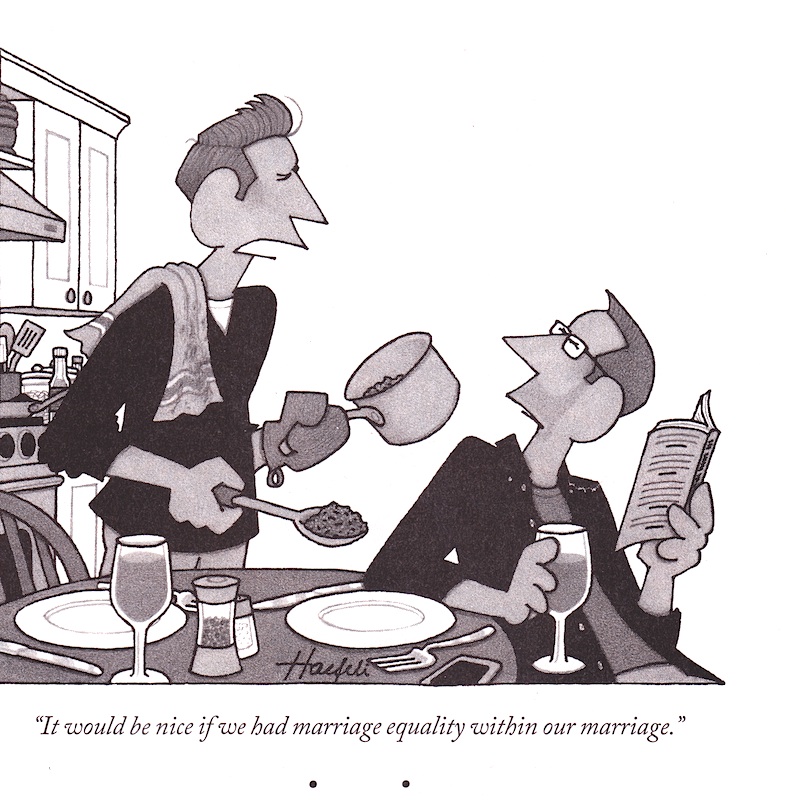
The cartoon might have been titled “Sympathy for the Cook”. See, in this light, an earlier Haefeli cartoon:


(#2) Again, the cook

Real life is, of course, immensely complicated, and roles and presentations are distributed in all sorts of ways, at different times, in different contexts, for different purposes. This is literally the cartoon version.