Another chapter in the musical world of Europe in the early 19th century, in the transition from Classical to Romantic times. Today’s transitional figure, Johann Nepomuk Hummel, started his musical career as a child-prodigy pupil of the former child prodigy Wolfgang Amadeus Mozart and went on from there. I’ll start by reviewing some postings of mine on others in this transitional cohort; then turning to his Wikipedia entry, focusing on his music (rather than his life); and ending with information about the one album of Hummel’s music I have in my Apple Music, which provides some pleasant surprises.
Archive for March, 2024
Johann Nepomuk Hummel
March 24, 2024Chopin x Gottschalk
March 23, 2024This morning I awakened to a sparkly, flashy, melody-filled piano concerto that I didn’t recognize — it sounded like a cross between Chopin (but much more expansive) and Louis Moreau Gottschalk (but without the Caribbean flavor) — which turned out to be by Friedrich / Frédéric Kalkbrenner (hereafter K): his Piano Concerto #4 in A Flat, Op. 127 (of 1835). K, a major figure of the transitional period between the late Classical music of Beethoven (1770 – 1827) and Schubert (1797 – 1829) and the early Romantic music of Mendelssohn (1809 – 1847) and Chopin (1810 – 1849) who was in fact admired by both Chopin and Gottschalk (1829 – 1869).
From Wikipedia:
Friedrich Wilhelm Michael Kalkbrenner (7 November 1784 – 10 June 1849), also known as Frédéric Kalkbrenner, was a pianist, composer, piano teacher and piano manufacturer. German by birth, Kalkbrenner studied at the Conservatoire de Paris, starting at a young age and eventually settled in Paris, where he lived until his death in 1849. Kalkbrenner composed more than 200 piano works, as well as many piano concertos and operas.
… It was not until the late 1830s that Kalkbrenner’s reputation was surpassed by the likes of Chopin, Thalberg and Liszt. Author of a famous method of piano playing (1831) which was in print until the late 19th century, he ran in Paris what is sometimes called a “factory for aspiring virtuosos” and taught scores of pupils from as far away as Cuba. His pupils included Marie Pleyel, Marie Schauff, and Camille-Marie Stamaty. Through Stamaty, Kalkbrenner’s piano method was passed on to Louis Moreau Gottschalk and Camille Saint-Saëns.
He was one of the few composers who through deft business deals became enormously rich. Chopin dedicated his first piano concerto to him.
Despite all this, you’ve probably never heard of K, or of Johann Nepomuk Hummel, or of Ignaz Moscheles, two other figures of this transitional period who, like K, were once really famous and then largely vanished from sight.
Lots of people in its name
March 23, 2024An old One Big Happy strip in my comics feed today — posted here on 3/28/14 in “OBH roundup”, but with little comment — in which Ruthie reveals her aide-memoire for the name of a fish her mother sometimes cooks for dinner:
(#1) buncher, crowder? — or flocker, packer, ganger, batcher, schooler? — but actually grouper
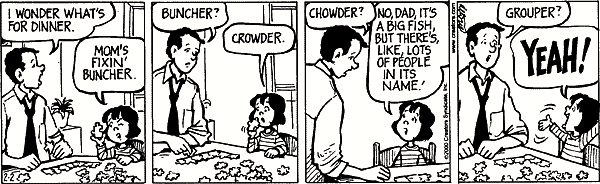
At this point, you’re probably thinking that groupers are so called because they travel in schools, that is, in a kind of group. But no; there’s an etymological surprise here.
Yet another band name pun
March 22, 2024Today’s Wayno / Piraro Bizarro cartoon, with yet another pun on the name of a rock band; this time it’s Rage Against the Machine that’s being punned on:
(#1) Wayno’s title: “Tomato Based Ideology”, alluding to the fact that what’s commonly called ragu (or Bolognese sauce) in the US is tomato-based (and sometimes meatless, as in the “traditional” variety of the commercial brand RAGÚ), though classic Italian ragù (aka Bolognese sauce) is a meat-based sauce with only a bit of tomato in it, and though the most common US name for meatless tomato-based pasta sauce is just spaghetti sauce (in fancier settings, AmE marinara sauce) (if you’re puzzled by the odd symbols in the cartoon — Dan Piraro says there are 3 in this strip — see this Page)

The text in the speech balloon — with a RATM anti-corporate political message — coming from a thoroughly American source, emphasizes the meaty side of (some) American ragu; this is ragu used to name what is mostly called just spaghetti sauce in the US (a tomato-based sauce with substantial amounts of browned minced meat, usually ground beef, in it), though in fancier settings this everyday pasta sauce might be billed as AmE Bolognese sauce.
Obviously, food naming in this domain is a gigantic rat’s nest, but vocabulary isn’t the point of the cartoon, the band name pun is, so I’ll put off the lexicography for the moment and focus first on the pun and the rock band.
The headline writer’s dream story
March 21, 2024Yesterday’s news from East Sussex (the old original Sussex, in southern England), a Sussex News story (by Jo Wadsworth) that kicks off with this juicy summary sentence:
A handyman who masturbated over a tenant’s knickers has been acquitted of criminal damage.
The story is pretty much unavoidably raunchy, given the nature of the offense; nobody writes stuff like commit an obscene act these days. The reporter used the technical and punchier masturbated in the intro, I’d imagine because it was compact, but then opted for the euphemistic pleasured himself in the full story, which continues:
Simon Lawrence, 55, had been called to fix a faulty washing machine when he entered Joanna Hatton’s bedroom at the cottage she rented with her partner Thomas Jones.
But he didn’t realise the couple had installed a motion sensor camera there to watch their cat.
The couple were driving to Somerset for Christmas when Joanna got an alert on her phone that the camera had been activated on 19 December, 2022.
She watched in horror as Lawrence laid out her underwear on the bed and began pleasuring himself.
The reporter must have yearned to use the British slang wanked, which is vulgar but what ordinary people say in the UK. But you can’t talk like that in a respectable newspaper (though the tabloids can go pretty far).
But there would be room to veer towards vulgarity in the head; in fact, this is a dream story for an alert headline writer, who while casting about for alternatives to masturbated, to knickers (which is kind of giggly slang but not vulgar, and which doesn’t have to get into the head), and to be acquitted (which is legalese), might hit on the possibility for a somewhat rude pun on ‘masturbate’ vs. ‘be acquitted ‘, via the phrasal verb get off.
Or, of course, a headline writer might go for get off rather than be acquitted just because it’s a bit shorter (writing heads is sometimes like solving a devilishly complicated puzzle), in which case they could come up with the actual Sussex News headline in all innocence (until the laughter rolled in):
Trendy menu language
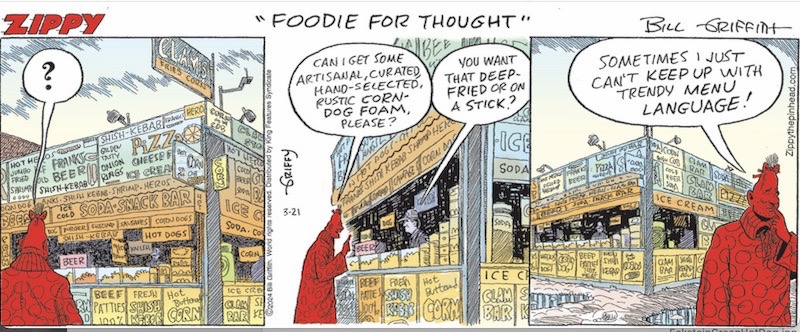
March 21, 2024Briefly noted: today’s Zippy strip, in which our Pinhead reflects on trendy menu language at a carnival food stand:
(#1) Corn-dog foam is all the rage, especially if you can get it artisanal, curated, hand-selected, rustic, on a stick, buddy, on a fuckin’ stick, with almond milk, 2 pumps of caramel, cold foam, extra crispy with locally sourced tripe in Sichuan chili sauce, oh I seem to have lost track of things, what were you asking?
Etheric armies cloud the sky
March 21, 2024From Tim Evanson on Facebook yesterday, this splendid piece of cover art for the May 1954 issue of Mystic Magazine, an illustration by Malcolm Smith showing a sci-fi Archangel Michael (as I see it) leading his etheric army of the skies in a charge into battle:
(#1) Smith’s diaphanously robed Michael, shining in white, muscular, with long arms, long legs, enormous wings, wielding a beautiful bright sword (have I mentioned that I have a thing for hunky well-um-armed men with wings?)

Etheric armies — armed men flying through the ether, the air, the sky — literally struck a chord for me. Well, they came with a specific tune, fierce and haunting, and the words etheric armies cloud the skies, which I eventually recognized as a Mystic Magazine-fostered amalgam of ten thousand angels filled the sky and a solemn darkness veils the skies. Both texts by Isaac Watts (from 1719 and 1709, respectively), tunes by William Billings (from 1778, a bright celebration of the angels attending to the resurrection and glorious ascension of Christ, while those heavenly guards around thee wait like chariots that attend thy state) for the first and by Amos Pilsbury (from 1799, that fierce and haunting tune for the same occasion, on which cherubic legions guard Him home and shout Him welcome to the skies) for the second.
They’re a stink
March 20, 2024(Very much a brief MQoS Not Dead Yet posting on my part, while I cope with a complex posting on the wonders of VPE in English)
In an old One Big Happy strip that came up in my comics feed this morning, two of the kids — Ruthie and the neighbor boy James — undertake to go on a dinosaur hunt, expecting the creatures to be easy to find because, according to James, they’re a stink:
Ruthie’s grandfather is about to explain to James the difference between extinct and a stink
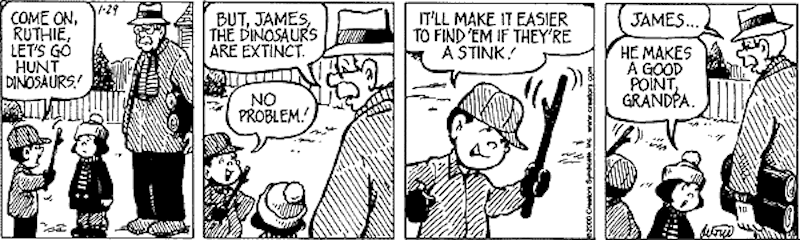
Once again, the kids are coping with unfamiliar, technical vocabulary by interpreting it, eggcornishly, as more familiar material. Something of a stretch in this case, though extinct and a stink are indeed phonologically similar. I do wonder if there have been kids who reinterpreted extinct this way, or whether Rick Detorie (the cartoonist) merely imagined a reinterpretation that might have happened. Oh, the things that might have been!
(The adjective extinct is historically a specialized variant of extinguished, so calls to mind the vivid image of these creatures having their flame of life quenched, put out.)
Dynamic semantics wins a prize
March 19, 2024🧨 🧨 🧨 Firecrackers! For a prize from the Swedish royal academies, something you might think of as a Nobel Prize’s little brother, awarded to two colleagues in linguistics and philosophy, one an old friend (and exact contemporary) of mine. From the website of the Swedish royal academies, “Science, art and music meet in the Rolf Schock Prizes 2024”, a press release of 3/14/24:
2024 Rolf Schock Prize in Logic and Philosophy is jointly awarded Hans Kamp, University of Stuttgart, Germany and Irene Heim, Massachusetts Institute of Technology, Cambridge, USA
“for (mutually independent) conception and early development of dynamic semantics for natural language.”
Natural languages are highly context-dependent – how a sentence is interpreted often depends on the situation, but also on what has been uttered before. In one type of case, a pronoun depends on an earlier phrase in a separate clause. In the mid-1970s, some constructions of this type posed a hard problem for formal semantic theory.
Around 1980, Hans Kamp and Irene Heim each separately developed very similar solutions to this problem. Their theories brought far-reaching changes in the field. Both introduced a new level of representation between the linguistic expression and its worldly interpretation and, in both, this level has a new type of linguistic meaning. Instead of the traditional idea that a clause describes a worldly condition, meaning at this level consists in the way it contributes to updating information. Based on these fundamentally new ideas, the theories provide adequate interpretations of the problematic constructions.
Kamp was born in the Netherlands in 1940. He received his PhD from University of California, Los Angeles, in 1968 and has been a professor at University of Stuttgart, Germany, since 1988.
(#1) Hans Kamp (photo: Kerstin Sänger)Heim was born in Germany in 1954. She received her PhD from the University of Massachusetts, Amherst, in 1982 and has been a professor at the Massachusetts Institute of Technology (MIT), Cambridge, USA since 1997.
(#2) Irene Heim (photo: Philipp Heim-Antolin)


The decade of no skateboarding
March 18, 2024An old One Big Happy strip that’s been hanging around on my desktop for a couple of years. When you go to explain why it’s so weirdly funny, it turns out to be a complex exercise in what’s known in the linguistics trade as quantity implicature: someone uses a quantity expression, like 6 people or 18 years old, and we understand the speaker’s intentions to be to suggest exactly that quantity, or at least that quantity, or no more than that quantity — in technicalese, we take the speaker’s words to implicate one of these things — depending on the context and our assessments of the speaker’s reasons for mentioning that quantity in the context.
The standard discussions of quantity implicature are about reports of states of affairs. If, for example, a well-intentioned speaker tells you that there were 6 people at their birthday party, you take them to be conveying that there were exactly 6 people. I mean, if there were 8 people at the party, it would be true that there were 6 people; but then it would be uncooperative to say that there were 6 people, because if you knew there were 8 you should and would have said so, therefore saying there were 6 implicates that there were exactly 6. (This would be a good time to take a deep breath and rest for a moment.)