Yesterday’s Rhymes With Orange:
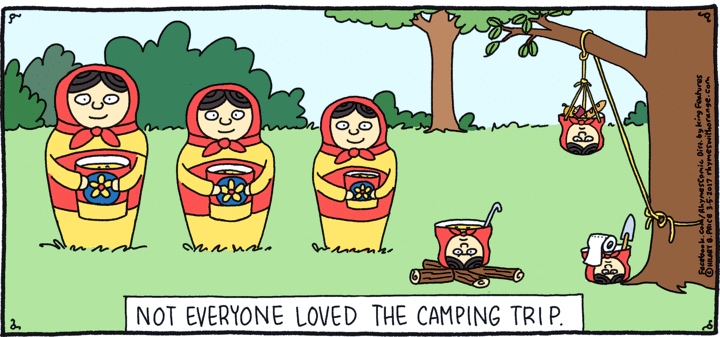
Another note on what it takes to understand the cartoon and to see what’s funny about it.
Yesterday’s Rhymes With Orange:
Another note on what it takes to understand the cartoon and to see what’s funny about it.
(Various sex acts playfully portrayed in neon, but still…)
The last of yesterday’s four “Body works” postings (about San Francisco artist Keith Boadwee) ends with a discussion of Bruce Nauman’s neon sculpture Eat War (1986), echoed in Boadwee’s photo composition Eat Shit. And so to the incredibly multifaceted (and very often unsettling) artist Nauman, who is, among other things, a playful language artist and a chronicler of human connection, especially through sex.
(About art, but since it’s about Keith Boadwee, with a lot of male bodyparts and studied outrageousness. Not for kids or the sexually modest.)
On the 3rd, a piece about dancers performing with laser cartridges up their butts — a defiant and entertaining artistic move — prompted Aric Olnes to remind me about San Francisco artist Keith Boadwee and his brand of playful (and also deeply serious) in-your-face, up-my-butt art.
(The third part in the “Body work” series; Part I here, Part II here. This one’s on armpits, with a bow to crotches. Sex talk, but not particularly crude. Still…)
Today’s Steam Room Stories, “Scents That Attract Men”, about men’s fragrances. And the smell of a man. You can watch the episode here. The core of the episode has a guy, call him SniffPit, who is into men’s fragrances and can describe them in perfumer’s jargon. He exclaims over another steamroom guy’s scent; guy says it’s Paco Rabanne (mighty expensive); SniffPit leans over to sniff it up close —
 (#1)
(#1)
which creeps the guy out, so he bails. Next guy up hasn’t showered, is powerfully musky, driving SniffPit wild. SweatDog reaches under his towel to offer SniffPit a finger smelling of ball stink (SweatDog’s phrasing), which prompts SniffPit to offer his armpit and its pit reek to SweatDog. Lust rolls over them, they rush out to hook up.
(Some frank discussion of the female body, with a racy food photo. Use your judgment.)
A photo on Facebook from John Dorrance, with the comment “These things are obscene”:
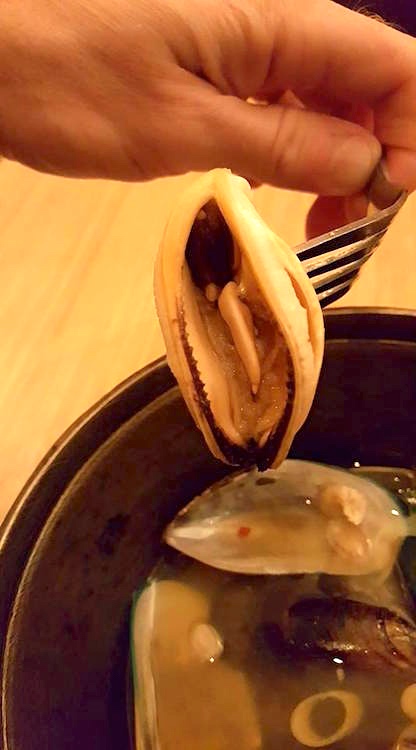
Well, they’re striking vaginal symbols (vulvar symbols would be more accurate anatomically, but just think of this commonplace use of vagina as metonymic).
(Frank talk about the male body, but no sex in this particular posting. Use your judgment.)
Four body items that have come my way recently: bouncing penises and testicles (and other intimate views of the body) in a new computer game; mussels as vaginal symbols; axillary delights; and anal art.
This is Part I: Dangly Bits.
The most recent One Big Happy:
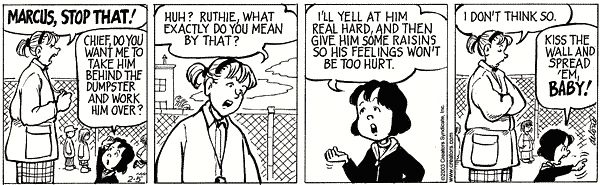
A not uncommon theme in strips with kid characters: the kid who’s learned how to “do” characters, mimicking styles and registers, prosodies, jargon, and so on. They practice from a very early age, talking in imaginative play in imitations of motherese, for instance.
Here, Ruthie does Tough Cop, except for the panel 3 side business in her own voice, with her own opinions (the soothing raisins are a nice touch).
This is my grand-daughter Opal’s birthday (an excellent day) and also National Grammar Day (a very odd occasion), always together on this date, and this year, it’s also a Saturday and the fourth day of Lent. On this date in Australia (which was yesterday here), the 2017 Sydney Mardi Gras Parade (billed as an LGBTI — I for intersex — pride celebration) happened. Yes, the Mardi Gras Parade was held four days after Shrove Tuesday and on a Saturday — Mardi Gras the religious holiday, celebrated secularly as the culmination of a festival season, a day of wild indulgence before the religious season of Lent, a long period of “prayer, doing penance, repentance of sins, almsgiving, atonement, and self-denial” (link) before the Easter season.
 (#1)
(#1)
In collecting material for blog postings on recent exhibitions at the Cantor/Anderson galleries at Stanford, I came across a staff page with an excellent photo of Matthew Tiews, Associate Vice President for the Arts at Stanford:

I first knew Matthew as the Associate Director of the Stanford Humanities Center, a position that calls for a serious scholar who is generally knowledgeable about the humanities, social sciences, and the arts, and is also an able administrator, good at working with people, and (very important) with a solid sense of humor. Now Matthew oversees the arts programs and the arts complex at Stanford, which has developed into an entire campus neighborhood, or zone (three museums, a very spiffy concert hall, and more).
So I wrote Matthew about my Stanford art museum postings (which I thought might interest his staff), and now I’m reporting all this to you.
Over on ADS-L yesterday, Wilson Gray reported the following example from his reading:
(X) A nine-year-old boy is being hailed a hero for saving his mother’s life after being struck by lightning.
Merriment ensued on the mailing list over the boy’s impressve act, his toughness, and the like — all these responses indicating that readers interpreted (X) as asserting that the boy performed his heroic act after he had been struck by lightning.
The phrase after being struck by lightning is a SPAR (a Subjectless Predicative Adjunct Requiring a referent for the missing subject), and virtually everyone reading the phrase in the context above will take the required referent to be the referent of the subject in the main clause (a nine-year-old boy), rather than the referent of an NP closer to the SPAR: his mother’s life, an unlikely candidate, since that referent isn’t even a concrete object that could be struck by lightning; or, better, his mother, surely the NP the writer of (X) had in mind as supplying the required referent.
If the writer had absorbed the lessons of their school grammar, they would in fact have expected that the boy’s mother would be supplied as the required referent — because that school grammar tells you, very firmly, that a SPAR will (indeed must) pick up its referent from the NP nearest to it (the Nearest Rule). (That’s not the way school grammars, and books of usage advice, talk about these things — they speak of nouns and dangling modifiers — but here I’ve cleaned up the deep conceptual confusions in the traditional way of talking about these things.) Unfortunately, the empirically more adequate general principle isn’t a Nearest Rule, but a Subject Rule (and even that’s just a default, not an inviolable law of grammar).