Note: this posting is about pickles (in the American sense: pickled cucumbers) and uses of the word pickle, especially in proper names; my main theme is that pickles and the word pickle tend to be intrinsically funny, inherently risible. I’ll be citing a whole bunch of uses, but I do not intend this posting to be a complete inventory of uses of the word, so if I don’t mention some example that you know or especially like, please add it in a comment, but don’t do this by accusing me of having failed or neglected to mention your example; that would just be gratuitously insulting.
It started with an entertaining piece by Winnie Hu in the NYT on the 15th: (on-line) “At United Pickle, Preserving the Standards of a Deli Staple”, (in print) “Family-Run Supplier Preserves Standards For a Briny Deli Staple”, beginning:
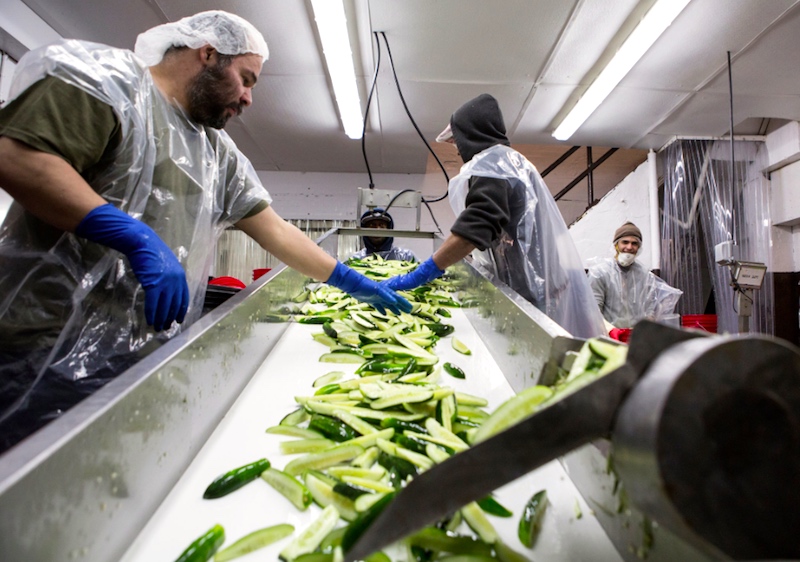
Not every cucumber has what it takes to be a pickle. As dozens of them tumbled from a steel hopper onto a conveyor belt in a Bronx factory, two workers enforced a strict pickle standard.
Bruised. Broken. Too curvy. Too short. Sorry, no exceptions.
The rejects — about one in 10 — were tossed into plastic bins, destined to become relish.
“You can’t just pickle any produce,” said Stephen Leibowitz, the self-described “chief pickle maven” of this operation, as he reached past the workers to personally pluck out an offending cucumber. “I can put in the best ingredients, and they still won’t turn out right.”
Mr. Leibowitz is the man to see if the pickles at your local deli, diner or burger joint have lost their crunch. Whether kosher dills, sours, half-sours or bread-and-butters, chances are they got their start on the production line at United Pickle, the largest family-owned supplier of pickles and pickled condiments in New York City.
Or as Mr. Leibowitz, 73, ever the pickle pitchman, put it, “If you’re in a pickle, call United Pickle.”
Kosher dill spears in preparation:
 (#1)
(#1)
(more…)
 (#1)
(#1) (#2)
(#2)