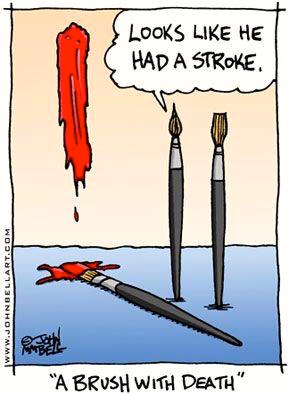
From Facebook friends, this John Bell cartoon:
 (#1)
(#1)
A wonderful double pun, on stroke (‘brushstroke’ or ‘cerebrovascular accident’) and brush (‘implement for painting etc.’ or ‘light and fleeting touch’).
From Facebook friends, this John Bell cartoon:
(#1)
A wonderful double pun, on stroke (‘brushstroke’ or ‘cerebrovascular accident’) and brush (‘implement for painting etc.’ or ‘light and fleeting touch’).
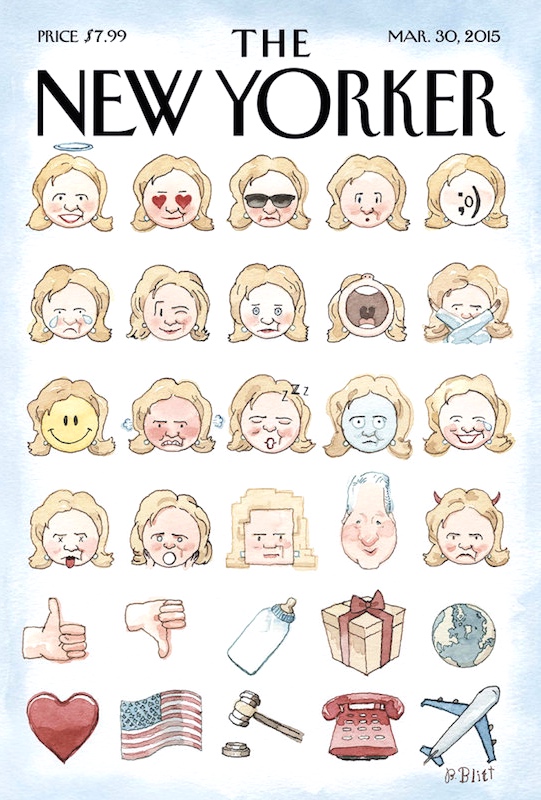
The cover of the March 30th New Yorker, “Clinton’s Emoji” by Barry Blitt:
From the cover story by Mina Kaneko and Françoise Muhly:
“Where would we be without emoticons, emoji, and sideways winky faces typed out of punctuation marks?” Barry Blitt, the artist behind this week’s cover, says. “Seriously, how does anyone understand anything that’s written with only letters?” he continues. “I feel sorry for the alphabet. I’m waiting for the first original novel to be composed solely with emoticons. Oh, and Hillary Clinton.”
Making the rounds in science reporting recently: newly discovered peacock spiders. From National Geographic on the 24th. the story “Behold Sparklemuffin and Skeletorus, New Peacock Spiders: A few new species of these colorful, dancing spiders have been found in eastern Australia” by Carrie Arnold:
If you don’t think of spiders as cute and cuddly, then you’ve never met Sparklemuffin, Skeletorus, and the elephant spider. Scientists have identified these three new species of peacock spiders in various parts of eastern Australia.
Less than a quarter-inch long (five millimeters), male peacock spiders are known for their bright colors and a rolling-shaking mating dance that would make Miley Cyrus jealous.
Two of them:
 (#1)
(#1)
A new species of peacock spider, nicknamed “Sparklemuffin” by the graduate student who discovered it, performs a leg-waving mating dance.
 (#2)
(#2)
The peacock spider Maratus sceletus earned the nickname “Skeletorus” for its black-and-white markings.
On a report (from the 25th) on a recent Arby’s ad:
Arby’s Reuben Gets a New “Rachel” Variant: Arby’s latest sandwich is the new, limited-time Turkey Rachel, which is being offered as a variant on their Reuben that comes with roast turkey and housemade coleslaw rather than the corned beef and sauerkraut
 (#1)
(#1)
To come: the sandwiches, their ingredients, their names.
Two names this morning: Quetzalcoatl (the mythical plumed serpent), Hoatzin (the extravagantly plumed bird).
A Benjamin Schwartz cartoon from the March 30th New Yorker:

Some friends have written me to ask for an explanation of this cartoon. The key part is the name Schrödinger. The cartoon is about Schrödinger’s cat, which has a certain fame in theoretical physics
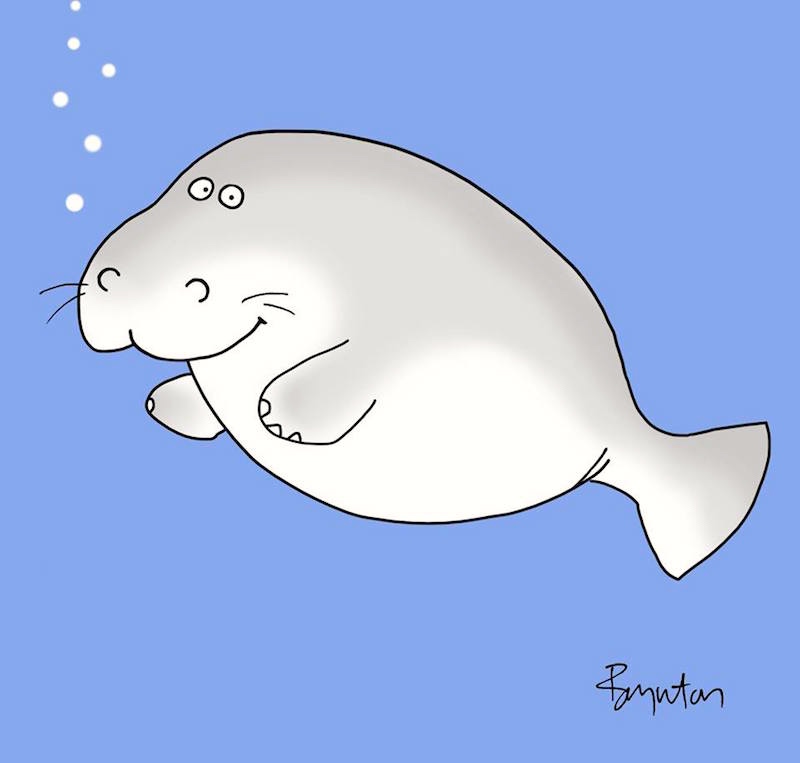
Two images on Facebook recently: a Sandra Boynton drawing for Manatee Appreciation Day (March 25th, yesterday); and a wordless cartoon (on the “Mermaid Melissa” site, artist uncredited) picturing a narwhal as a unicorn in disguise):
 (#1)
(#1)
 (#2)
(#2)
(#2 has an actual narwhal for comparison.)
Frank Bruni in an NYT opinion piece, “Too Much Prayer in Politics: Republicans, the Religious Right and Evolution” on February 15th:
Faith and government shouldn’t be as cozy as they are in this country. Politicians in general, and Republicans in particular, shouldn’t genuflect as slavishly as they do, not in public. They’re vying to be senators and presidents. They’re not auditioning to be ministers and missionaries.
… Mike Huckabee, who is an ordained minister in the Southern Baptist church, put God in the title of a new book that he wrote and just released on the cusp of what may be another presidential bid. He ran previously in 2008, when he won the Iowa caucuses.
The book is called “God, Guns, Grits, and Gravy.” These are a few of his favorite things.
During a recent appearance on a Christian TV program, he explained that he was mulling a 2016 campaign because America had lost sight of its identity as a “God-centered nation that understands that our laws do not come from man, they come from God.” The way he talks, the Constitution is a set of tablets hauled down from a mountaintop by a bearded prophet.
The notion that God’s law is above man’s law is widespread these days, especially among politicians. This is disturbing, especially since it comes from people who claim to know the mind of God. Certainly it wasn’t what the Founding Fathers had in mind.
A March 15th NYT piece by Kevin M. Kruse, “A Christian Nation? Since When?” begins:
America may be a nation of believers, but when it comes to this country’s identity as a “Christian nation,” our beliefs are all over the map.
Just a few weeks ago, Public Policy Polling reported that 57 percent of Republicans favored officially making the United States a Christian nation. But in 2007, a survey by the First Amendment Center showed that 55 percent of Americans believed it already was one.
The confusion is understandable. For all our talk about separation of church and state, religious language has been written into our political culture in countless ways. It is inscribed in our pledge of patriotism, marked on our money, carved into the walls of our courts and our Capitol. Perhaps because it is everywhere, we assume it has been from the beginning.
But the founding fathers didn’t create the ceremonies and slogans that come to mind when we consider whether this is a Christian nation. Our grandfathers did.
In yesterday’s NYT, in a letter to the editor from NPR talk show host Diane Rehm:
In a March 23 letter about the desire of my husband, John Rehm, to end his life after years of suffering from Parkinson’s disease, the writer described Parkinson’s as a chronic and progressive but not terminal condition. In fact, after suffering two bouts of pneumonia, brought on by John’s loss of muscular ability to swallow correctly, his doctor determined that John had six months or less to live and prescribed hospice care.
Pulling out the main part of the last sentence gives us:
(1) after suffering two bouts of pneumonia, … his doctor determined that John had six months or less to live and prescribed hospice care.
This has a subjectless predicational adjunct, after suffering two bouts of pneumonia, that does not pick up a referent for that missing subject from the subject of the main clause, his doctor — so it’s a classic dangling modifier (a non-default SPAR, in my terminology). Well, the determiner in the subject, the possessive his, does supply the required referent, even though the whole subject does not. This is a pattern I’ve posted on before, and other factors work together to make a modifier that should be acceptable to almost everyone.