Archive for November, 2015

Novelty ties

November 17, 2015

On the penguin watch.

On the front page of yesterday’s NYT, a color-splash of an ad for Salvatore Ferragamo ties, one of which clearly had litte penguins on it. Ferragamo novelty ties, 100% silk, selling for $190 each (fashion doesn’t come cheap) from Ferragamo, somewhat less at fine men’s clothing stores. The fish and penguin tie, in a thumbnail:

(#1)

(more…)

Male friendships

November 16, 2015

In watching tv series on cable, I’ve been struck by the variety in the forms that close male friendships take (something similar can be said for close female friendships, though I suspect that the dynamics are different in the two cases, so here I’ll look only at the men). These are social relationships closer than those with people we refer to as acquaintances, and even closer than the bulk of relationships with people we refer to as friends, in that the men involved see them as central to their lives.

The three cases that I’m going to look at are all free of romantic or sexual involvement; all were established via the characters’ work, in some form of a law enforcement setting; and in all three cases the men are involved in one another’s lives outside the workplace. These are:

(1) the relationships (which I would chaacterize as basic close male friendships) between the central character Nick Burkhardt  in the series Grimm (set in Portland OR) and his partner in police work Hank Griffin and also his personal friend (and in a sense collaborator) Monroe (the series posted about here);

(2) the relationship (which I would describe as a “best buddy” relationship) between team leader Greg Parker and team member Ed Lane on the crisis response unit drama Flashpoint (set in Toronto ON) (the series posted about here);

and (3) the relationship (which I would characterize as brotherly, incorporating the common competitiveness and rivalry between brothers) between team commander Steve McGarrett and his partner Danno Williams in the state police force drama Hawaii Five-0 (set in Honolulu HI) (the series posted about here).

(more…)

Les Danseurs

November 15, 2015

(Another posting about the male body, but with some fine photography.)

From the models.com site on the 11th, a piece by Jonathan Shia, “Matthew Brookes’ Ballet Dancers”. Highlights:

Flip through the pages of Les Danseurs, the photographer Matthew Brookes’ new book devoted to the male dancers of the Paris Opéra Ballet, and you might take him for a lifelong fan of the artform. The intimate black-and-white photos offer a personal and powerful look at their bodies, shaped by lifetimes devoted to dance, combining both grace and power as the best performers do. But Brookes, a frequent contributor to various Vogues, Interview, and Vanity Fair who has also lensed campaigns for Giorgio Armani, Cartier, Burberry, and Berluti, says he knew nothing about dance before being introduced to one of the dancers through a casting director he was working with, a chance encounter that eventually blossomed into this monograph.

… The photographs, shot in a clean studio against a rough cloth backdrop, are guided by an abstract and almost sculptural sense of form. There are no arabesques or pirouettes, just shapes and compositions reminiscent of flowers and what Brookes calls his initial inspiration of “birds falling from the sky,” with hints of Rodin’s muscular sculpture thrown in. The photographer says that his driving instinct was to capture the dancers’ strength as athletes, rather than following the stereotypical ideas of classical ballet as “sensitive” and “ethereal.”

(more…)

Title generator, Pavlov

November 15, 2015

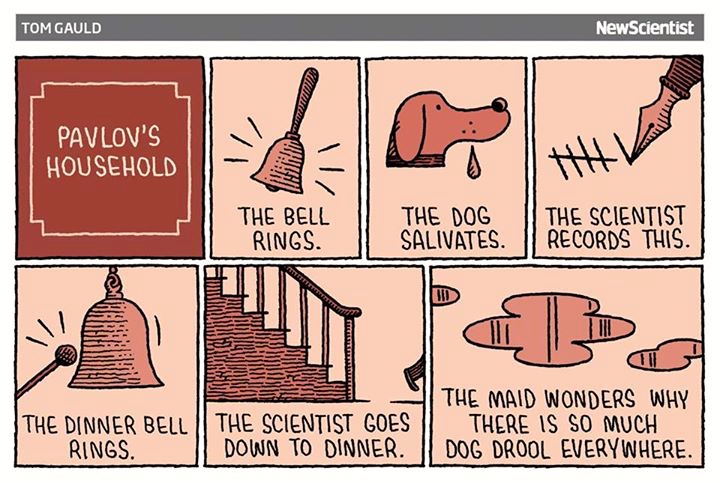
Two Tom Gauld cartoons in New Scientist, from August 14th and August 31st:

(#1)

(#2)

(more…)

fish food, fish flakes

November 15, 2015

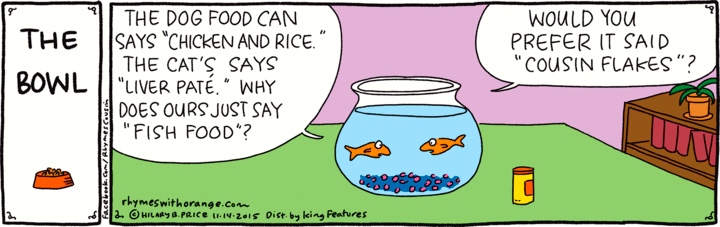
Yesterday’s Rhymes With Orange:

Hilary Price returns to the ambiguity of compounds every so often, and I return to the topic myself fairly often, noting that even if we set aside Type X, or “distant”, compounds (where you have to know a story about some situation to understand what the compound means) and stick to Type O, or ordinary, compounds (where there’s a relatively small set of patterns for interpretation), there’s still plenty of room for ambiguity. As here: food / flakes for fish (to eat) OR food / flakes (made) from/of fish?

(more…)

Octavio Pinto

November 15, 2015

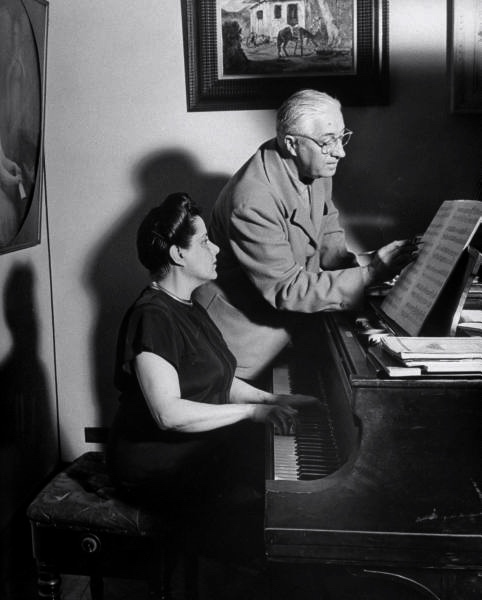
Heard on WQXR (classical music in NYC) last night, three of the charming piano pieces in Scenes from Childhood by Octavio Pinto, played by Byron Janis. A performance of the full set of five (“Hobby-Horse”, “March, Little Soldier!”, “Ring Around the Rosie”, “Run, Run!”, “Sleeping Tim”) by Guiomar Novaes, Pinto’s wife, for whom they were written:

Novaes and Pinto:

(more…)

Annals of zeugma

November 15, 2015

From Ann Burlingham, this zeugmatic dialogue from the tv series Leverage (“The Long Way Down Job”, season 4, episode 1, first aired 6/26/11), at 17:27:

(1) Drexel gets paid and away scot-free

(Drexel is the character John Drexel.)

The verb gets here represents two different lexical items, with very different meanings, one in construction with the PSP verb paid, the other in construction with the particle away and the adverb scot-free: the first is the main verb in a passive construction (the so-called “get-passive”, an alternative to the be-passive), and the second is the main verb in a (metaphorical) motion construction.

So we have zeugma — plus a massively non-parallel coordination paid and away scot-free. Overall, (1) is a major WTF sentence, of a sort that is often concocted as a joke, but that doesn’t seem to the case here.

(more…)

Prefix + FN

November 14, 2015

In yesterday’s posting on “Address terms in service encounters”, I looked at an unfortunate confluence of two patterns of vocatives: one in address terms used to me by some Hispanic servers at the restaurant Reposado in Palo Alto (in particular, the address term Mr. Arnold), and one in address terms used by slaves to their masters in plantation days (in particular the address form Mr. FN, as in Mr. Simon used by slaves to address their master Simon Legree) and (historically, a continuation of the slave practice to post-slavery contexts, but still involving blacks addressing whites) by employees in some parts of the South to their employers (again, the address form Mr. FN, as in Mr. Keene used by a stableman to address his employer Keene Daingerfield in Lexington KY a couple generations ago). The two address forms are formally identical, and both are used by speakers providing a service to the addressee, but the sociocultural contexts are very different, and the (inadvertent) echo of slave usage in a Mexican restaurant is unpleasant.

Now it turns out that Prefix (Mr./Miss) + FN turns up in a number of circumstances where providing services is not at issue, including some in which the form is not at root a vocative, but functions instead as a kind of professional name, which can be used referentially or vocatively. In these contexts, race is not in the mix, and there are no unfortunate echoes of slavery. Get ready for teachers of young children, psychics, and male hairdressers.

(more…)

cioppino, sopa de mariscos

November 14, 2015

Yesterday’s lunch special at the Mexican restaurant Reposado was billed as cioppino, though it was recognizably a Mexican-style sopa de mariscos ‘seafood soup’. Meanwhile, cioppino is standardly described as a fish stew (as in the Wikipedia article on the dish), though it too is a seafood soup, essentially a clear tomato soup with a whole lot of seafood (ncluding fish) in it. Exactly what Reposado was serving yesterday, with some significant differences in details: the basic soup at Reposado had no wine in it; the Reposado dish had a lot of vegetables in it (not just the sauteed onions in the basic sauce, but also potatoes, carrots, poblanos, and zucchini); and the Reposado dish had some Mexican ingredients (fresh chiles, cilantro, and lime) rather than the Mediterranean ingredients of classic cioppino (shallots and bay leaves, in particular; the two soups share basil, oregano, and an anise-flavored ingredient, either aniseed or fennel).

Cioppino is a San Francisco dish (so it’s no surprise that sopa de mariscos would be billed as cioppino in a Bay Area restaurant), but its roots lie in Italy; the sopas / estofados / caldos de mariscos of Latin America, Mexico included, have their roots in Spain; so both originate in the fish soups and stews of the maritime Mediterranean, from Greece and Italy to France and Spain, which vary locally but share a family resemblance.

After a celebration of cioppino and sopa de mariscos, I’ll go to a linguistic question, namely the soup vs. stew question.

(more…)

Address terms in service encounters

November 13, 2015

A Bizarro from long ago (May 25th), with a groan-worthy pun on senior and señor (roughly ‘Mr.’ in referential use):

Now some words about referential vs. vocative uses of names (Arnold Zwicky, Arnold, Zwicky, Mr. Arnold, Mr. Zwicky, Prof. Zwicky) and prefixes (like Mister or Professor on their own), both in English and Spanish, all this as a preface to some discussion of address terms in service encounters, where servers have a complex task in balancing the desire to show respect to the customer and the desire to express closeness and friendliness.

(more…)