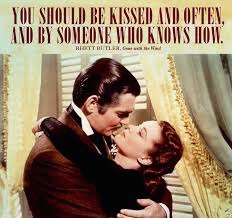
Heard in passing on KFJC’s Norman Bates show Saturday morning, Rhett Butler (Clark Gable) to Scarlett O’Hara (Vivien Leigh) in the 1939 movie of Gone With the Wind, what I heard as:
No, I don’t think I will kiss you, although you need kissing, badly. That’s what’s wrong with you. You should be kissed and often, and by someone who knows how.
I’m interested in the third sentence, boldfaced above. Transcribed as here:
 (Kiss1)
Two modifiers of kissed in the VP: often and by someone who knows how. These modifiers can be tightly adjoined (in speech, not set off prosodically; in writing, not set off by punctuation) or loosely adjoined (in speech, set off prosodically; in writing, set off by a comma); and the modifiers can be syntactically unmarked, or marked as coordinate (with and). The version in #1 has both modifiers marked with and, with the first tightly adjoined, but the second loosely adjoined.
My question about these matters is to what extent they involve linguistic structure, and to what extent they are (more or less literally) choices in performance, options indicated in writing in the fashion of stage directions, or options taken by actors.
(more…)
 (#1)
(#1)