Archive for October, 2014

The plural of Miss Subways

October 24, 2014

In the current (10/27/14) New Yorker, an entertaining “Where Are They Now Dept.” feature by Michael Schulman, “Underground Beauties”, beginning:

Long before Dr. Zizmor and Poetry in Motion, beauty on the subways came in the form of the Miss Subways competition, which ran from 1941 to 1976. The idea, hatched by the New York Subways Advertising Company, was to prettify the train cars while drawing eye traffic to the surrounding ads for chewing gum or cigarettes. Every few months, a new glamour shot would appear on posters underground, along with a few lines describing the winner’s hobbies (“modern dance, piano and ceramics”) and aspirations (“plugging for B.A. but would settle for M.R.S.”). Nearly two hundred women claimed the title.

Over the years, nearly two hundred women served as Miss Subways. So there were nearly two hundred Miss Subwayses? No that can’t be right: Subways is already plural. The obvious solution is a zero plural, with only one realization of plural inflection: nearly two hundred Miss Subways. And that’s the solution in the New Yorker piece.
(more…)

Cultural commentary

October 23, 2014

A recent op-ed column in the NYT from David Brooks, who fancies himself a critic of the sociocultural scene, on hysterical responses to Ebola: “The Quality of Fear: What the Ebola Crisis Reveals About Culture” on October 21st, beginning:

There’s been a lot of tut-tutting about the people who are overreacting to the Ebola virus. There was the lady who showed up at the airport in a homemade hazmat suit. There were the hundreds of parents in Mississippi who pulled their kids from school because the principal had traveled to Zambia, a country in southern Africa untouched by the Ebola outbreak in the western region of the continent. There was the school district in Ohio that closed a middle school and an elementary school because an employee might have flown on the same plane (not even the same flight) as an Ebola-infected health care worker.

The critics point out that these people are behaving hysterically, all out of proportion to the scientific risks, which, of course, is true. But the critics misunderstand what’s going on here. Fear isn’t only a function of risk; it’s a function of isolation. We live in a society almost perfectly suited for contagions of hysteria and overreaction.

Here we get the trope of Decline — things are getting worse, as hysteria and paranoia spread — combined with the claim of Recency — the decline has been steep recently — all of this, according to Brooks, explained by a social change: the fragmentation of American society as social, cultural, and political groups isolate themselves from one another.

Now, Decline and Recency are, in principle, testable matters. And since Brooks presents himself as a fan of work in social science (he occasionally publishes summaries of social-science research he finds significant, or at least thought-provoking), you’d expect him to provide evidence for Decline and Recency in social hysteria, but no: like so many cultural commenters he merely retails his subjective impressions as truths, and then conjures up an explanation for them.

(more…)

Miss Florence and the Paleo Diet

October 23, 2014

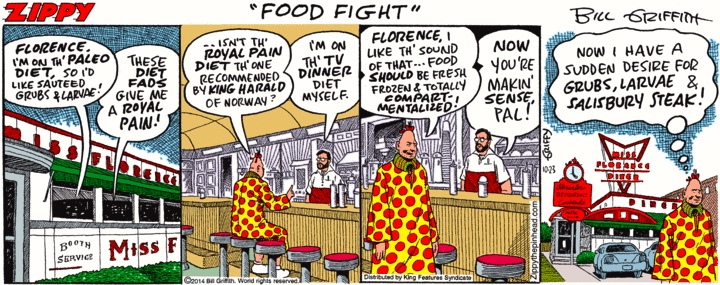
Today’s Zippy, in the Land of Diners:

  (#1)

The diner is easily identified. Then there’s King Harald of Norway, the TV Dinner Diet, and the Paleo Diet.

(more…)

Green Eggs and Ham

October 22, 2014

From Facebook friends, this use of Dr. Seuss’s Green Eggs and Ham:

(#1)

The Muppets Kermit the Frog and Miss Piggy inquire of the narrator of Green Eggs and Ham about their missing son, who is presumably green (like Kermit) and porcine (like Miss Piggy) and so, ewww, might be the source of that green ham on the platter.

Two things: one, about the source of this cartoon; two, about the children’s book and, especially, about the parsing of green eggs and ham.

(more…)

What was that word?

October 22, 2014

Two cartoons for today, both involving relationships between phonologically similar words: a Dilbert and a One Big Happy:

(#1)

(#2)

(more…)

Erson of Pinterest

October 21, 2014

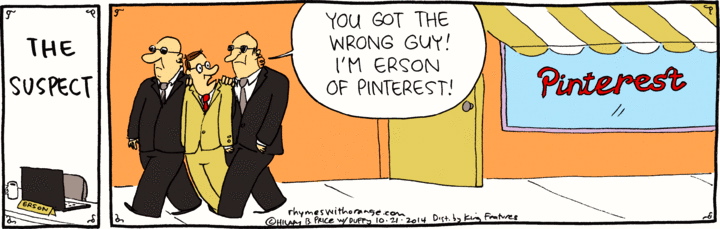
Today’s Rhymes With Orange:

A Spoonerism for playful purposes, based on the expression (a) person of interest, and using the name of the software tool Pinterest.

(more…)

Abbott and Costello’s band

October 20, 2014

The Pearls Before Swine from yesterday (October 19th):

Rat and Goat reproduce a famous Abbott and Costello routine, “Who’s on First”, which has baseball players named Who (on first), What (on second), and I Don’t Know (on third). Another version in my posting “Chinese Abbott and Costello” of 3/18/11, with a play on the Chinese names Hu and Xi (the government figures Hu Jintao and Xi Jinping), and then a real-life basball player named Hu (the Taiwanese infielder Hu Chin-Lung, playing in Major League Baseball as Chin-Lung Hu) appears in the posting “Hu on base” of 3/30/14, with a video of the A&C routine. Now: bands (The Who, with drummer Keith Moon and guitarist Pete Townshend) and musicians (Charlie Watts, drummer for the Rolling Stones; Bob Weir, guitarist for The Grateful Dead; Steve Howe, guitarist for the band Yes; and Steve Winwood, guitarist for the band Traffic). An elaborate riff on the A&C original.

(That’s the cartoonist Stephan Pastis in the last panel, about to be punished for his puns by Rat.)

A youth hostile?

October 19, 2014

Today’s Bizarro:

A pun on the noun hostel vs. the adjective hostile — a perfect pun for those who have /ˈhastl/ (with syllabic l) for both (so that it’s ambiguous), an imperfect pun for those who have this pronunciation for hostel, but have /ˈhaˌstajl/ for hostile.

Animals on duty

October 19, 2014

In the latest (10/20/14) New Yorker, a hilarious and simultaneously disturbing piece by Patricia Marx, “Pets Allowed: Why are so many animals now in places where they shouldn’t be?” (starting on p. 36), about emotional-support animals. From p. 37, on E.S.A.s vs. service dogs:

Contrary to what many business managers think, having an emotional-support card merely means that one’s pet is registered in a database of animals whose owners have paid anywhere from seventy to two hundred dollars to one of several organizations, none of which are recognized by the government. (You could register a Beanie Baby, as long as you send a check.) Even with a card, it is against the law and a violation of the city’s health code to take an animal into a restaurant. Nor does an emotional-support card entitle you to bring your pet into a hotel, store, taxi, train, or park.

No such restrictions apply to service dogs, which, like Secret Service agents and Betty White, are allowed to go anywhere. In contrast to an emotional-support animal (E.S.A.), a service dog is trained to perform specific tasks, such as pulling a wheelchair and responding to seizures. The I.R.S. classifies these dogs as a deductible medical expense, whereas an emotional-support animal is more like a blankie.

In the piece, Marx attempts (sometimes successfully, sometimes not) to take (purported) E.S.A.s into places where animals are in fact not allowed, using creatures borrowed from acquaintances: a turtle, a (large) snake, a turkey, an alpaca, and a pig.

Tove Jansson tomorrow

October 19, 2014

From the “Goings On About Town” section in the 10/20/14 New Yorker:

Tove Jansson Celebration: N.Y.R.B. Classics and Scandinavia House mark the hundredth anniversary of the birth of the Finnish writer, known for the Moomin cartoon series and other works, as well as the publication of a new collection of her stories, “The Woman Who Borrowed Memories.” The novelists Philip Teir and Kathryn Davis will discuss Jansson’s fiction, the actor Thomas Hiltunen will give a reading, and the journalist Anu Partanen will moderate. (58 Park Ave., at 38th St. scandinaviahouse.org. Oct. 20 at 6:30.)

Another multiple talent who doesn’t usually get pegged as Artist (without qualification), like many others I’ve written about on this blog (Edward Gorey, for instance). Charming but complex books for children (a favorite in our household when my daughter was young), among other things.

(more…)