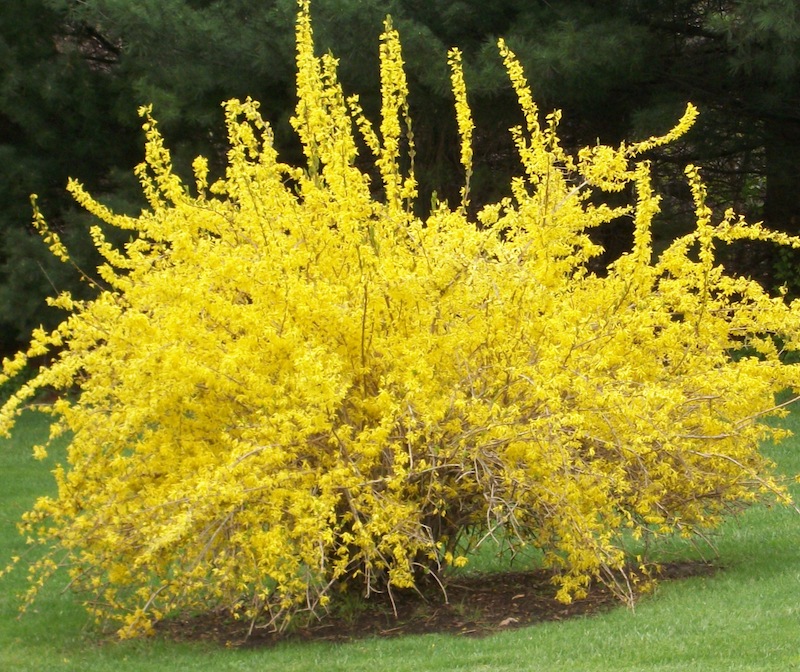
People back East are enjoying one of the exhuberant signs of spring: bright yellow blooming forsythias. Two photos: as a whole shrub and in close-up:
 (#1)
(#1)
 (#2)
(#2)
People back East are enjoying one of the exhuberant signs of spring: bright yellow blooming forsythias. Two photos: as a whole shrub and in close-up:
(#1)
(#2)
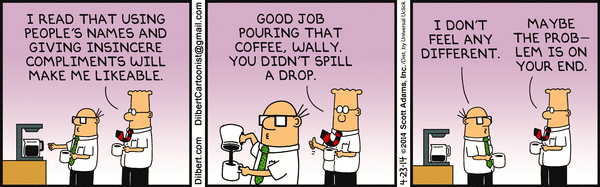
Thursday’s Pearls Before Swine:

Spreading the Gospel.
Fred Shapiro on ADS-L yesterday:
Since I am now working on the second edition of the Yale Book of Quotations, let me ask, were there any particularly memorable catchphrases or one-off quotations from the Krazy Kat strip?
John Baker replies:
Well, Krazy Kat referred to Ignatz Mouse as “Li’l Dollink,” and the strip’s captions referred to Joe Stork as “purveyor of progeny to prince & proletarian.” I don’t know if either of those really qualify as particularly memorable.
KK’s Dollink (for Darling): it’ sounds like Yiddish-English, but it begins to look like KK’s dialect is sui generis.
I heard it on NPR’s Morning Edition, who got it from the BBC, in this story: “Shakespeare a ‘cultural icon’ abroad”:
William Shakespeare is the UK’s greatest cultural icon, according to the results of an international survey released to mark the 450th anniversary of his birth [traditionally celebrated on April 23rd].
Five thousand young adults [note that: young adults are the arbiters of popular taste] in India, Brazil, Germany, China and the USA were asked to name a person they associated with contemporary UK arts and culture.
Shakespeare was the most popular response, with an overall score of 14%.
The result emerged from a wider piece of research for the British Council.
The Queen and [footballer] David Beckham came second and third respectively. Other popular responses included JK Rowling, Adele, The Beatles, Paul McCartney and Elton John.
Shakespeare, the Queen, and David Beckham: the Big Three. You wonder how the people surveyed understood the question.
Celebrity is an odd thing.
In the NYT Magazine on the 20th, a piece by Rosie Schaap, “Don’t Get Too Cute With Your Bloody Mary”, taking off from one of (several) minimal recipes — her mother’s favorite:
All it took was a good slug of Smirnoff (the only vodka we had in the house, and one I still like), a can of tomato juice (or, as my mother sometimes preferred, Clamato) [mixed vegetable juice, like V-8, is also common, and low-sodium versions of these are available; wthout the vodka, you have a Virgin Bloody Mary, aka Virgin Mary], a shake of Lea & Perrins Worcestershire sauce, a heaping teaspoon of grated horseradish, a few shakes of black pepper, a good stir with ice, a lemon wedge for garnish, and that was that.
From Chris Waigl, passed on by Chris Hansen:
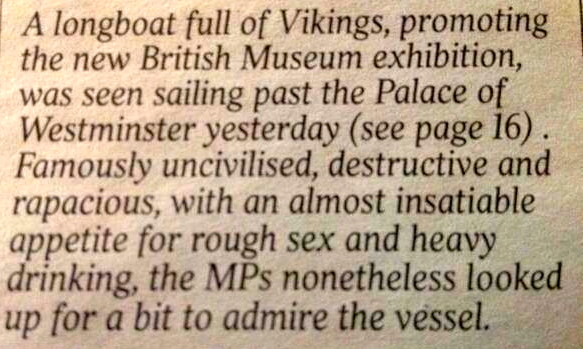
The problem begins with the subject, a longboat full of Vikings. The (syntactic) head of this phrase is certainly longboat (and that’s what determines agreement on the verb), but it’s functioning here semantically / pragmatically as as an expression of measure, much like a collective noun. So the question is whether the subject is “about” a longboat or “about” Vikings. (Animate beings, especially humans, are especially favored as topics, ceteris paribus, so we should probably look to the Vikings.)
At the same time, the first sentence introduces the British Museum and the Palace of Westminster, implicitly (but quite subtly) introducing the Members of Parliament as entities in the discourse, though probably not as the topic.
Then we get the second sentence, which is clearly about Vikings (uncivilized, destructive, and rapacious), not boats (or the Members of Partliament, for that matter).
Elizabeth Daingerfield Zwicky’s flower photos — piles and piles of them, since so many flowers, some with brief blossoming times, are in bloom now — include a number with spiders in them. Well, actually, not spiders, but harvestmen, a similar-looking but quite distinct creature. Here’s one on its own:

Background by P. L. Brayfield to accompany a YouTube video:
Sacred Harp singers are among the most enthusiastic and energetic vocalists anywhere! Here they express their joy in singing a favorite shape note song for the Eastern season: William Billings’s 1787 composition [Easter Anthem] also known as ‘The Lord is Risen Indeed.’ Recorded at the Kalamazoo all-day singing, July 20, 2009. NOTE: on the video, the number for Eastern Anthem is mistakenly given as 238. If you start to sing from that page, you will still be singing Eastern Anthem, but you will be two pages ahead of everyone else 😉 The correct page, of course, is 236, as several viewers have reminded me!
The music, spread over four pages: