Two cartoons this morning that hark back to familiar topics on this blog — A Zippy with barbats and a Mother Goose and Grimm with sporks:
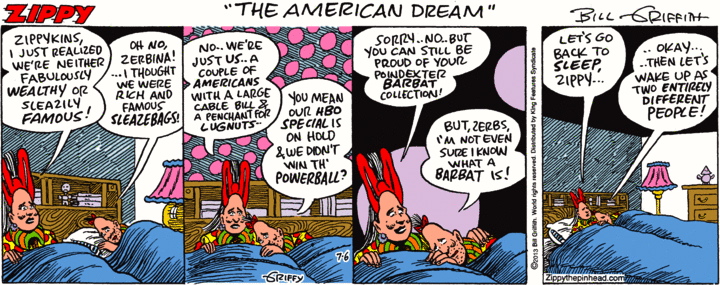 (#1)
(#1)
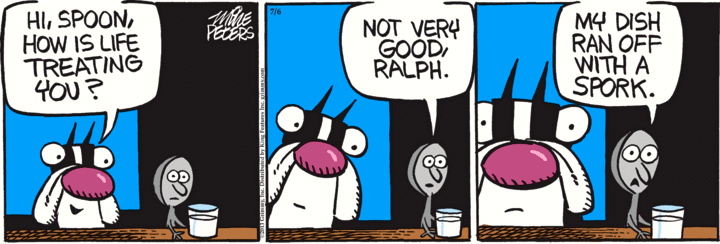 (#2)
(#2)
Two cartoons this morning that hark back to familiar topics on this blog — A Zippy with barbats and a Mother Goose and Grimm with sporks:
(#1)
(#2)
Today’s Pearls Before Swine:
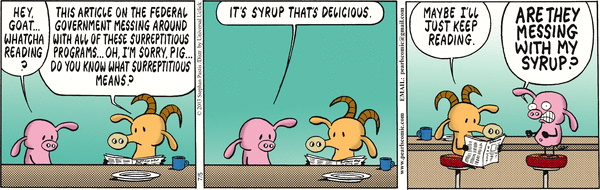
Pig’s grasp of English vocabulary is somewhat unsteady. Faced with the unfamiliar surreptitious ‘kept secret, esp. because it would not be approved of’ (NOAD2), he guesses that it’s a portmanteau — of syrup and delicious. That means he’s treating a word that is clearly an adjective in context — in these surreptitious programs — as a noun, meaning ‘syrup that’s delicious’. But people are frequently uncertain about parts of speech, and cartoon animals can’t be expected to do better.
The story starts with this cartoon, sent to me by Don Steiny for pretty obvious reasons:
 (#1)
(#1)
The cartoon is one of several offering, as an explanation for why unicorns went extinct, that Noah took two male unicorns onto the ark, so of course they couldn’t re-populate the species after the Flood. (In another version, the unicorns are explaining Noah’s mistake to him.) In another vein of cartoons, the extinction of unicorns is explained by their having missed the sailing of the ark, through a misunderstanding about the day or the time of day of the ark’s departure.
Side matters: one, the source of #1, which is obviously a professionally drawn cartoon; and two, the rise of a rainbow – butterfly – unicorn association in popular culture (a modern wrinkle in unicornology).
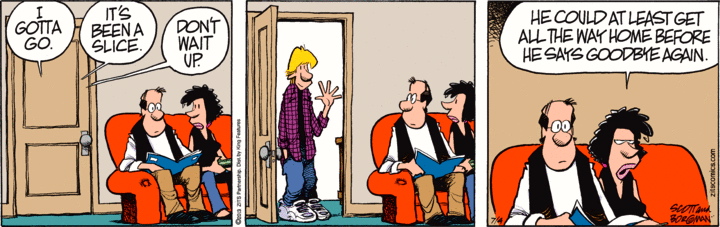
Today’s Zits:
 (#1)
(#1)
It’s been a slice, as a way of saying ‘it’s been good; goodbye’, was new to me. It’s in a few recent dictionaries of American slang / idioms, but not in Green’s Dictionary of Slang or (unsurprisingly) the OED; I have a citation from the late 1990s, but not (yet) anything earlier than that. And its origins are murky.
That’s the first half of the main title of a piece in The Week (3/22/13) by Neal Whitman (who gets mentioned on this blog with some regularity). The rest of the title: “26 backformed compound verbs”. The subtitle: “An alphabetical tour of modern verbs that entered the language backwards”. Neal writes:
To get an idea of how productive this compounding-reanalysis-backformation process is, here’s a list of 26 such verbs, one for each letter in the alphabet. Some are older; some are newer; some are here to stay; others probably aren’t. However, in these actual examples from the past two years, they’ve all been used to talk about current topics in business, politics, entertainment, or culture in general.
As I’ve said many times on this blog, I don’t aim to collect all the two-part back-formed verbs in English — that would be a foolish and never-ending task — but I do keep an inventory of examples that come past me (especially when people complain about them), and Neal’s alphabet of examples has 16 that weren’t already on my list.
Some notes from some time ago about professional musicians who attend to language, notably the pianist Jeremy Denk and the composer Nico Muhly. Since I’ve posted recently on Taylor Lautner — the relevance of this will become clear — I’ll start with Denk, then go on to Muhly and further to comments on other musicians connected to one or another of these two.
(Not about language.)
Having gotten off onto shirtless abs-displaying hunks in acting and modeling (Kellan Lutz, Josh Duhamel, Taylor Lautner), I pulled up shirtless tennis hunks, including two recent favorites and perennial rivals, with different body types: the very muscular Rafael Nadal and the very lean Novak Djokovic. Both wonderful to watch in play, each in his own way. Paired shirtless shots of Rafa and Djoker:
 (#1 Rafa)
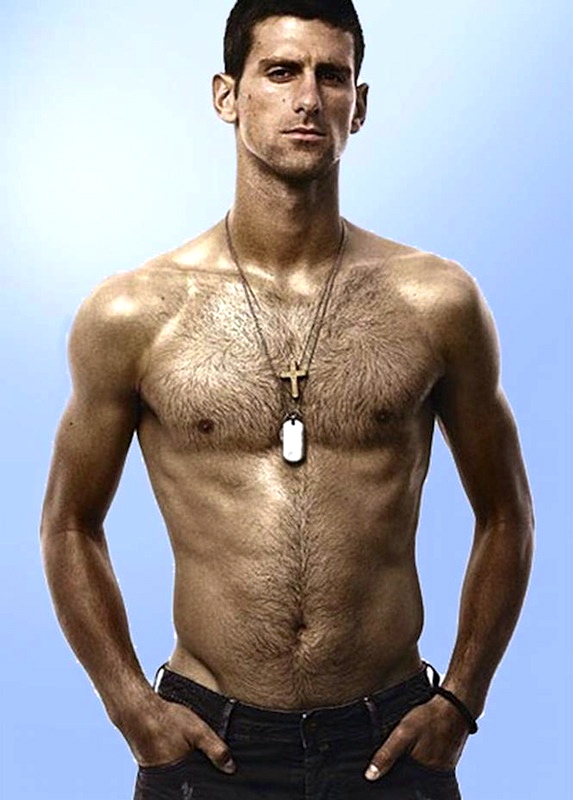 (#2 Djoker)
In the NYT Book Review on Sunday, a review by David W. Blight of Allen C. Guelzo’s Gettysburg: The Last Invasion — from which:
Spread over 15 square miles around a small Pennsylvania town on the first three days of July 1863, involving more than 160,000 soldiers and huge numbers of camp laborers, including between 10,000 and 30,000 slaves forced to serve the invading Southern army, the conflagration caused a degree of slaughter like no other in American history.
That is, 150 years ago this week.
The most recent Scenes From a Multiverse:
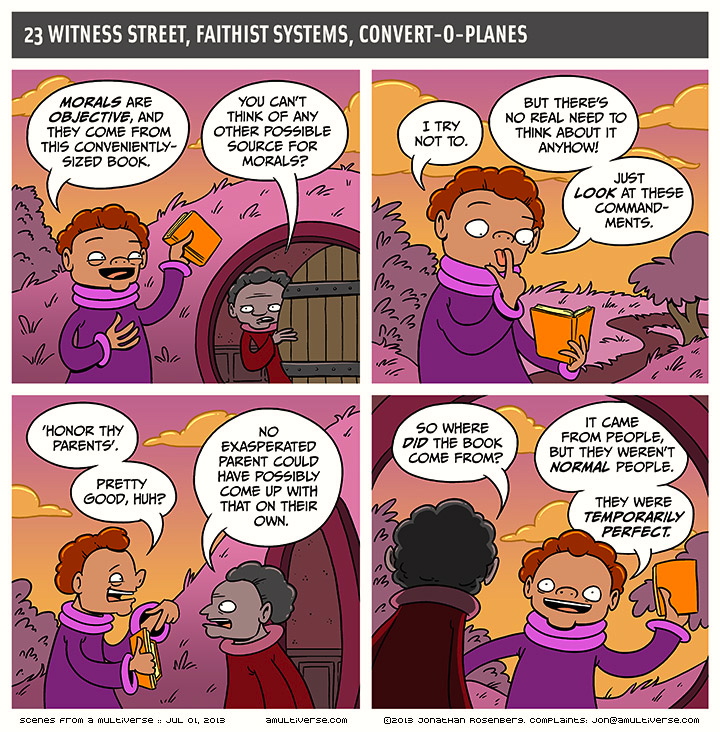
This is an astonishingly common idea: that morality comes from the pronouncements of religion (which are assumed to be divinely inspired, so that ultimately, morality comes from God), and only from those, so that non-believers cannot, by definition, have morals. But reasonable people will challenge the assumption.
Today’s Zippy:

The onomatopoetic lexical items murmur, yodel, belch, and gargle give Bill Griffith an excuse for the phrasal overlap portmanteau Yoko Onomatopoeia.