Archive for July, 2013

In quotation marks

July 18, 2013

Today’s Dilbert, with Dogbert weaseling words to the boss:

The strip has Dogbert speaking in quotation marks, indicating a prosody that sets off the word storage, suggesting that the word is not to be taken literally: it’s in what we’ll call storage, but nothing is actually stored there (a message that is close to ironic or sarcastic).

Seize the day

July 18, 2013

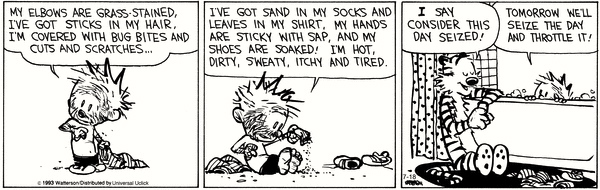
Today’s Calvin and Hobbes, with a classical allusion:

Seize the day!

(more…)

namesake

July 18, 2013

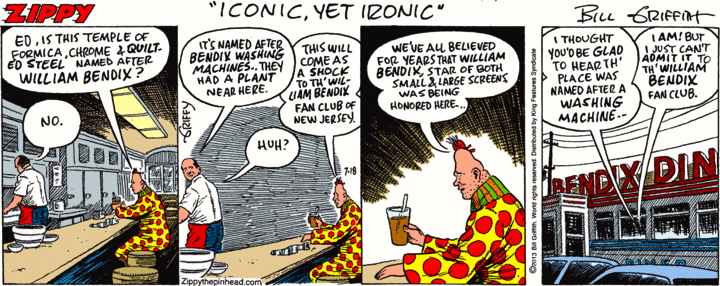
Today’s Zippy:

(#1)

The strip uses the V P idiom name(d) after, but that made me think about the noun namesake.

(more…)

Gay cookbooks

July 17, 2013

Yesterday’s venture into the book The Gay Kitchen (which has nothing to do with sexuality) led me to wonder about gay cookbooks. To start with, there are significant associations between gay men, food, and cooking (briefly explored in my “gay greens” postings, here and here); while the concentration of gay men among chefs and food writers seems to be less than for, say, hairdressers and organists, it looks substantial. So we were bound to get cookbooks aimed at gay men.

The first monument in the field came in, astonishingly, 1965: Chef Lou Rand Hogan’s The Gay Cookbook.

(more…)

Brief notice: urinary similes

July 17, 2013

In “Sexual lexical semantics”, I took up (among other things) similes like Maggie fucks like a mink, attributing enthusiasm in intercourse to Maggie. And now a comment from Robert G with a simile that was new to me:

“I have to piss like a mink”. One of the old-man’s odd turns of phrase. Surely he was an odd phrase-maker, but I cannot see as this fits into the general drift re: intransitives.

I don’t see intransitivity as the point of interest here (most uses of piss are intransitive). Instead, it’s the choice of comparison animal that intrigues me; where does the mink come from?

(more…)

Surprising etymologies

July 17, 2013

On the one hand, people are happy to invent (and believe) all sorts of stories about the history of words and phrases (acronymic etymologies, which are hardly ever correct, are enormously popular). On the other hand, some real histories are quite remarkable, and once you’ve seen the details of some well-documented histories — bedlam, nice, silly, O.K. — you might be willing to swallow anything.

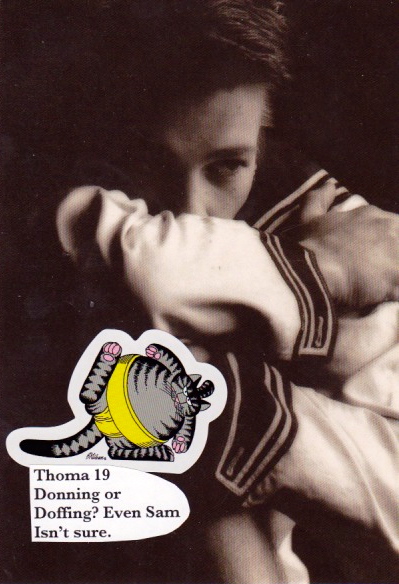
Here’s a small-scale example of surprising but true history: the verbs don and doff, as in this cattioned photo (photo by Benno Thoma, caption by me, cat by B. Kliban), from AZBlogX (where several sets of these have been posted; many are not X-rated, but few have linguistic interest, so they end up on my other blog):

The history in brief: from the late Middle English V + Prt verbs do on and do off.

(more…)

Brief notice: judg(e)ment

July 17, 2013

Comment from strangeguitars on my “Internet enlightenment” posting, about the difficult road to the Zen state of Internet enlightenment (no longer caring when someone is wrong on the Internet):

A difficult road, indeed; I wouldn’t have made it past “judgment” (it hurts to type that!).

(more…)

Captioned croppings

July 16, 2013

(Warning: Very high (homo)sexual content. Not for everyone.)

On AZBlogX, I’ve done a series of postings on facial expressions during gay sex (recently, Wagner Vittoria on Tiziano Fuentes in Lovers in Paradise, illustrating a technically non-X photo whose sexual content is absolutely clear). One image I’m especially fond of: Tommy Defendi on Jimmy Fanz, both wonderfully ecstatic, in Hole 1; the original image has no Officially Naughty Bits, but still I’ve cropped it to be absolutely clearly non-X (while also being clearly a fuck shot). And then I’ve added a caption (from the musical Gypsy):

(#1)

Sing out, Louise!

(more…)

Internet enlightenment

July 16, 2013

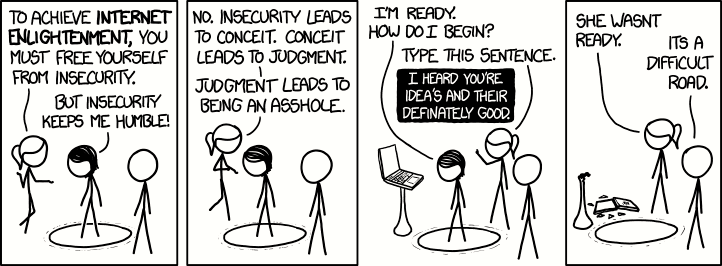
From several friends, this xkcd:

You must free yourself from judgment and come to the Internet with a Zen mind, no longer caring that Someone Is Wrong On the Internet. In particular, cast away your concerns about spelling.

(I would have had the text go I HERD YOU’RE …But that’s just me.)


Turn-ons

July 16, 2013

Today’s Zits:

The strip embodies the popular idea that males are easily aroused, by almost anything, while females require very specific triggers. And it plays on the ambiguity of the V + Prt idioms turn on and turn off.  From NOAD2:

turn someone on   informal   excite or stimulate the interest of someone, esp. sexually.

turn something on   start the flow or operation of something by means of a valve, switch, or button: she turned on the TV.

turn someone off    informal   induce a feeling of boredom or disgust in someone.

turn something off    stop the operation or flow of something by means of a valve, switch, or button: remember to turn off the gas.