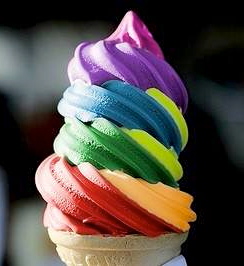
Via the Princeton LGBT Center on Facebook, this cone for Pride Month:
Most recent rainbow food posting: “More rainbow fruit” of 11/27/12, with links to four earlier postings with rainbow food.
Via the Princeton LGBT Center on Facebook, this cone for Pride Month:
Most recent rainbow food posting: “More rainbow fruit” of 11/27/12, with links to four earlier postings with rainbow food.
Yesterday my friend Don Steiny talked up the benefits of the herb bacopa as an aid to memory. I’m cautious about herbal remedies, but I found the name familiar — and eventually realized I knew it as a very pretty (but not showy) plant related to the medicinal herb.
A report on research at the University of California, on “The visual linguistics of a comic book page”:
Inside Science recently wrote about the study by UCSD’s Neil Cohn, Navigating Comics, which looks at the underlying structure of the comics language:
People who read the English written word scan text from left to right. Once our eyes hit the end of the page, we stop. Then ding!, like an old-time typewriter, our eyes shift downward and snap back to the left to start reading the next line. This is known as a “Z-path,” as our eyes whip about like the end of Zorro’s sword.
But that linear track gets derailed in comics with complex layouts and Cohn wanted to know if experienced readers had strategies to follow along.
The short answer is yes, but matters are complex:
Cohn asked participants to number each panel in the sequence they would read them.
There were no correct answers. But he found that more experienced comics readers were more likely to abandon the Z-path reading approach when faced with layouts more complicated than a neat grid.
Certain design techniques led to similar reading strategies. For example, if a panel ran down the entire length of the right side of the page, experienced readers were more likely to read each panel on the left side before moving to the one panel on the right. In this case, the readers were reading vertically instead of across the page.
However, some other design techniques did not provoke such predictable responses, perhaps suggesting that the context is also necessary for readers to navigate the story.
(Hat tip to Norma Mendoza-Denton.)
A Steve Macone cartoon from the New Yorker, in “The Questions Academics Ask: Conference Edition” on Allan Johnson’s blog The Art of Academic Practice:
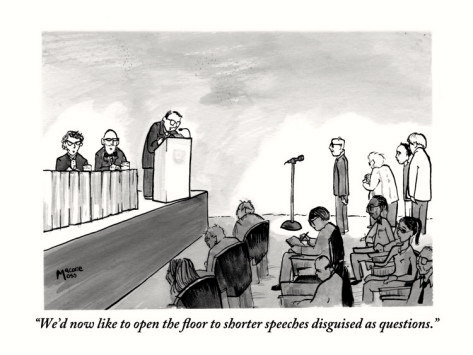
Johnson: “Macone’s cartoon perfectly captures one of the several strange things that can happen during a conference Q&A.”
(Hat tip to Lauren Hall-Lew.)
A recurring topic on this blog: the semantic relationship between N2 (the head N) and N1 in a N1 + N2 compound. If the compound is subsective — an N1 + N2 is an N2 — then the semantics of the compound is ‘an N2 related to N1’, but there are a great many types of relationship: a few common types, plus many very specific and context-bound examples. As in ice nations (boldfaced) in this NYT editorial (“Reaching an Arctic Accord”) of 4/20/13:
The waters of the central Arctic, an area the size of the Mediterranean, hold the last untouched fishing stocks on this planet. At present, they also lie beyond the boundaries of settled international law — more than a million square miles outside the reach of the exclusive economic zones that protect the national waters of the five countries with coastlines on the Arctic: the United States, Russia, Canada, Denmark [in Greenland] and Norway.
What ice once protected, it is now up to humans to protect. Beginning later this month, the ice nations will discuss an international accord that would impose a moratorium on commercial fishing until scientists have had a chance to study the fish populations and underwater environment.
So ice nation refers to a nation that is related to ice in a very specific way, which couldn’t be predicted from the form of the compound. Iceland isn’t an ice nation. Nor are Finland and Sweden, despite the fact that significant portions of these countries lie north of the Arctic Circle. Nor is China, which has some decidedly cold northern regions. Nor are countries with Antarctic islands but no Arctic coastline: Australia, the UK, France. Nor are countries that merely have icy and snowy mountain ranges (in the Alps, Andes, and Himalayas, for example).
(Bonus: There is a firm named Ice Nation, which advertises itself as “Your #1 Source for Hip Hop Jewelry and Watches” — with the slang item ice ‘diamonds, jewels, bling’.)
June 16th (today’s date) is a triple occasion: Bloomsday, the anniversary of the Zwicky – Daingerfield wedding, and my stepson Kit’s birthday. This Sunday is also Commencement Day at Stanford and Father’s Day.
A Funny Times cartoon (passed on by Rebecca Wheeler on Facebook):
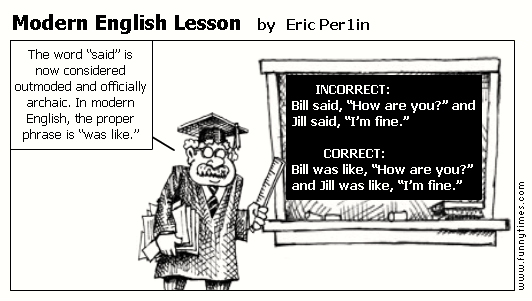
In the world of innovative quotatives (which includes go, (be) like, (be) all, and be), (be) like has definitely been on the upswing. See the items in Isa Buchstaller’s 2004 bibliography on quotatives: social and linguistic factors and grammaticalization and the Stanford papers on quotative (be) all:
John R. Rickford, Isabelle Buchstaller, Thomas Wasow, & Arnold M. Zwicky. Intensive and quotative all: Something old, something new. American Speech 82.1.3-31 (2007).
Isabelle Buchstaller, John R. Rickford, Elizabeth Closs Traugott, Thomas Wasow, & Arnold M. Zwicky. The sociolinguistics of a short-lived innovation: Tracing the development of quotative all across spoken and internet newsgroup data. Language Variation and Change 22.2.191-219 (2010).
From the abstract for the second of these:
This paper examines a short-lived innovation, quotative all, in real and apparent time. We used a two-pronged method to trace the trajectory of all over the past two decades: (i) Quantitative analyses of the quotative system of young Californians from different decades; this reveals a startling cross-over pattern: in 1990/4 all predominates, but by 2005 it has given way to like; (ii) Searches of internet newsgroups; these confirm that after rising briskly in the 1990s, all is declining. Tracing the changing usage of quotative options provides year-to-year evidence that all has recently given way to like.
Recent postings on AZBlogX on gay porn; not much on language, and not for the kiddies or the sexually modest (lots of full-frontal nudity and man-man sex acts plainly depicted):
6/4/13 Kent Larson (and Barrett Long) (link): beefy pornstar Kent Larson, seen paired with Barrett Long)
6/9/13 Big Dick Sale (link): another sale on porn flicks featuring big dicks (and vocabulary for talking about them)
6/13/13 Scruf: Dario Beck and Rogan Richards (link): on the flick Scruf and two of its stars; featuring facial scruff
6/14/13 Face Fuckers (link): on the all-oral flick Face Fuckers (bluntly but alliteratively named) and ten of its stars
In my collection of linguistic errors (from both speech and writing) there are some of the telescoping, or “jump ahead” variety. Recently, in writing about young men judged to be twinkalicious / twinkilicious / etc., I was especially afflicted by this sort of error, in typing and in handwritten text. The sequence LI CI kept tempting me towards jumping ahead from the L to the I following the C, thus telescoping the sequence to LI and giving twinkalious etc. Very annoying.
Then there’s telescoping as an inadvertent error in speech — for instance, in two instances of Barack Obama inadvertently telescoped to Barama (and then corrected), as reported in this posting.
(Telescoped portmanteaus are also frequently committed intentionally, as in verminfestation ‘vermin infestation’ and teenius ‘teen genius’, reported in this posting.)
My friend (and former student) Tyler Schnoebelen now blogs regularly on the site of the company he works for, idibon (in San Francisco), where he’s Senior Data Scientist. These postings look at matters with a NLP (natural language processing) angle to them, but always with an engaging take on the material and often with an unexpected choice of topic. Four recent postings of this sort: