Archive for September, 2012

Goat accents

September 10, 2012

In yesterday’s NYT Magazine, in the “one-page magazine” feature, this story about goat accents (“What a Well-Born Goat” by Hope Reeves):

It’s not just Eton alumni who distinguish themselves with their posh accents. According to a new University of London study, English pygmy goats (those farm-bred in Nottinghamshire, anyway) also display recognizable vocalization styles that morph as their social groups change. “It is not really a measure of animal intelligence,” says Alan McElligott, a co-author. “Nevertheless, the study does show a surprising additional cognitive capacity in a domestic animal that we are all very familiar with.”
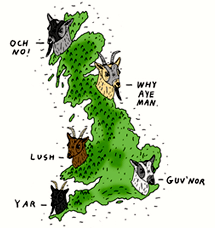
In contrast to the great “cow dialect” story of August 2006, there’s real research here — McElligott leads a research group at Queen Mary University of London, “focussed on communication and cognition research, using goats, cattle and fallow deer” — but the little piece in the Times (with its fanciful dialect map of British goat bleats) frames the story in terms of large-scale dialect differences (by geographical region and social class) that will be familiar to its readers, though that’s not what McElligott’s research was about.


(more…)

Dangler rage

September 9, 2012

It’s been a while since I posted about the absolutist (vs. the contextualist) position on subjectless predicational adjuncts requiring a referent for the missing subject (SPARs, for short), namely that they must obey the Subject Rule (that the missing subject of the adjunct must be supplied by subject of the clause it’s adjoined to); if a SPAR doesn’t obey the Subject Rule, it’s labeled a “dangler” and is judged, by absolutists, to be always ungrammatical, regardless of context, discourse organization, or real-life plausibility. So examples like

After writing a book, it seems that Harry is at loose ends.

are rejected as irredeemably ungrammatical by some writers. For them, the Subject Rule is a matter of God’s Truth, not a preference in referent-finding.

What I said on the matter last year:

How do people get to the absolutist [vs. the contextualist] position? The full journey is twisted and complicated, but the crucial midpoint is where the Subject Rule comes to be seen not as a rule of thumb but as a rule of grammar (for standard English). Once you buy that, then there’s no point in looking at context; context can’t ameliorate ungrammaticality. Kisses pleases me (with kisses understood as the plural of the common noun kiss ‘act of kissing’) is not standard English, and no amount of preceding or following linguistic context or scene-setting story-telling can change that …

So almost everyone writing about “danglers” cites examples isolated from context of any kind and bereft of background knowledge about the substance of the text. The internal content of the examples is almost entirely irrelevant, in this view …

Now two recent instances of absolutist criticism.

(more…)

Overlapping

September 9, 2012

Yesterday’s “TV mystery theme song” on local radio station KFJC — identify the show and win movie tickets to the Stanford Theatre in Palo Alto — was Al Jarreau’s recording of the theme to “Moonlighting”, which I recognized immediately. I didn’t call in, because I was working on a posting, but I did recall the show (with pleasure) and one of its salient linguistic features, its

fast-paced, overlapping dialogue between the two leads, harkening back to classic screwball comedy films such as those of director Howard Hawks (link)

— what Deborah Tannen calls the “machine gun style”of speech.

(more…)

Snoopy on editing

September 9, 2012

A Peanuts cartoon from 1972, in which Snoopy struggles with his writing:

Novice writers often get fixed on one turn of phrase and, unable to move on to a fresh idea, repeat that material in several versions. Sometimes they simply don’t have a lot to say.

(more…)

Nighthawks

September 9, 2012

Passed on by Barbara Need, from the Geeks of Doom site on Facebook, this Trekkie parody of Edward Hopper’s famous painting Nighthawks:

Nighthawks at the Starbase. In a long line of Nighthawks parodies.

(more…)

Take my wife

September 8, 2012

I recently came across a reference to the Henny Youngman “take my wife” joke, which turns on the ambiguity of that phrase, with two very different uses of take, one of them very restricted in its syntax and discourse function, the other free in both respects.

(more…)

boxercide

September 8, 2012

Yesterday’s Rachel Maddow Show looked at the Mitt Romney campaign as illuminated by the movie Rocky IV (“Rocky Balboa, secret Romney campaign advisor?”), and a couple of minutes into the show we get the innovation boxercide.

(more…)

Dinosaur puns

September 7, 2012

From Chris Waigl, this Sticky Comics as a birthday gift:

Punning phrasal overlap portmanteaus (well, the second is a bit more complicated).

(more…)

More perils of advice

September 7, 2012

From the Daily News (of the central San Francisco peninsula) yesterday, in “Man faces federal drug distribution charges: Perry Mosdromos, 46, allegedly sold medications to pay mother’s medical bills” by Jason Green:

Mosdromos, who remains in custody, hinted that the enterprise involves more than one person, according to the affidavit.

“Mosdromos stated the operation is much bigger than he,” [FBI Special Agent Matthew] Beaupain wrote, “however, Mosdromos did not disclose any co-conspirators or elaborate as to how the operation works.” (p. A4)

I’ve boldfaced the relevant clause, which has a nominative pronoun, he, in construction with than — in a context where the nominative strikes me as simply unacceptable; the operation is much bigger than him would have been the way to go.

(more…)

Brief mention: an inadvertent blend

September 7, 2012

From a discussion yesterday with Elizabeth Traugott and Melissa Carvell (about linguistics in the comics), Elizabeth saying:

It’s a cycular process

and then pausing in confusion, and correcting cycular to cyclical. (And I of course took notes on the event.)

Cycular is an inadvertent blend, a combination of cyclical and circular, which were in competition with one another as Elizabeth was framing her sentence. The competition was especially acute because the alternatives are so similar to one another phonologically.

A couple more word blends in conversation from the past few years:

Jackstone Merlot (Jackson + Blackstone) (AMZ, 1/30/08)

It’s ledged in there. (lodged + wedged) (Ned Deily, 9/3/09)

In both, the phonological similarity of the competitors facilitates the error.