Archive for September, 2011

actually

September 8, 2011

Today’s Zits, with a semantic/pragmatic puzzle about the adverb actually:
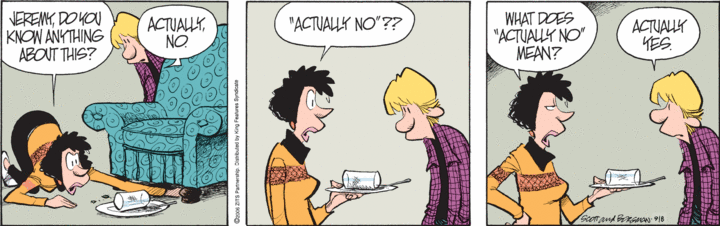
I’m not sure where in the second (sentence-adverbial) part of this NOAD2 entry for actually this usage comes, but ‘contrary to expectation’ is wrapped up somewhere in there:

1 as the truth or facts of a situation; really : we must pay attention to what young people are actually doing | the time actually worked on a job.

2 [as sentence adverb ] used to emphasize that something someone has said or done is surprising : he actually expected me to be pleased about it!

• used when expressing an opinion, typically one that is not expected : “Actually,” she said icily, “I don’t care who you go out with.”

• used when expressing a contradictory opinion or correcting someone : “Tom seems to be happy.” “He isn’t, actually, not any more.”

• used to introduce a new topic or to add information to a previous statement : he had a thick Brooklyn accent—he sounded like my grandfather actually.

Maybe Jeremy supposes that his mother is expecting the answer “Yes” — her question is rhetorical; she assumes that Jeremy does know something about the situation — so that he provides the contrary answer, signalling the contrast with apparently. But that’s just a stab.

Maternal qudgments

September 8, 2011

Today’s Rhymes With Orange takes up indirect speech acts, in particular the complex case of interrogatives in the form of declaratives (with interrogative intonation), but in fact serving the function of exclamations (with imperative force):

It starts with the declarative You’re really going out dressed like that, with really signalling emphasis, surprise, or disbelief, and rising final intonation signalling a question. So, roughly, ‘Is it really true that you’re going out dressed like that?’

Then this question — like yes-no questions in general — can function as a “rhetorical question”, conveying an assertion with the opposite polarity (‘You’re not going out dressed like that’), having judgmental or directive force (‘You shouldn’t go out dressed like that; don’t go out dressed like that’).

All these steps are conventionalized in English, so that the recipient of the original can move seamlessly from question to judgment. Compare the title of Deborah Tannen’s 2006 book You’re Wearing that?: Understanding Mothers and Daughters in Conversation.

Then of course there’s the portmanteau qudgment (question + judgment). The literature on indirect speech acts includes discussions of the whimperative (wh-question + imperative –Why don’t you kiss me? ‘Kiss me!’) and queclarative (question + declarative — Is that necessary? ‘That isn’t necessary’), from Jerry Sadock in 1970 and 1971, respectively.

What are pockets for?

September 8, 2011

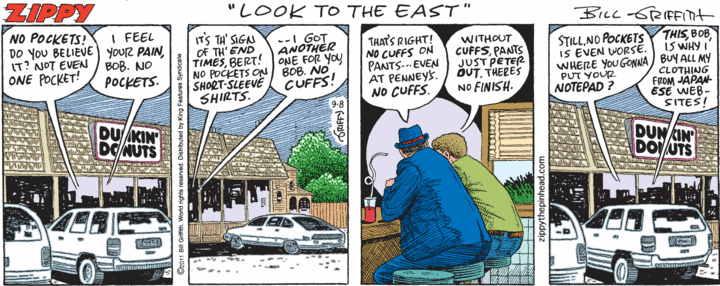
Today’s Zippy, on pockets:

Yes, yes, where would you put your notebook if you didn’t have pockets? They’re crucial for me, as you can see in this academic collage of mine:

(Apologies to Edward Gorey.)

getting your money worth

September 7, 2011

From an NPR Morning Edition story about Hulu this morning:

He better be, or you’re not getting your money worth.

Getting your money’s worth is the standard idiom, but here the possessive inflection has been truncated — by a speaker who gave no indication of being a speaker of AAVE (in which unmarked possessives are reasonably frequent).

And it’s most unlikely to be a slip, an inadvertent error.

(more…)

Today’s portmanteau

September 7, 2011

This morning, a message from a friend about events sponsored by the Bay Area CSMA (Community School of Music and Arts), including:

Anonymous 4 – Stanford Lively Arts Informance [November 19]

“Informance?”, my friend wrote.

(more…)

Penis-to-penis

September 6, 2011

Probably not everyone knows that one way two men can interact with one another is through their penises — actually two ways, in mock play (referred to metaphorically as swordplay or a swordfight, with the figure of penis as sword) or amiably (in what I’ll call cockversation).

(more…)

Today’s anagram and initialism

September 6, 2011

My mailbox overflows with birthday wishes today. On Facebook, this anagram from Betsy Herrington:

Pithy Bad Harpy, Cranky Old Wiz

which has an anagram for Happy Birthday followed by one for Arnold Zwicky.

And then from several friends in e-mail, this initialism:

hbba

which stands for “happy birthday, biiig arnold” — the latter part uses one of my pseudonyms, #4 of 37 on the list here — and can be turned into an acronym by pronouncing it like hubba, as in hubba hubba!, an exclamation, now somewhat out of date, glossed by Green’s Dictionary of Slang as

(orig. US teen/campus) a term of approval, esp. when directed at a passing girl or woman.

(Green quotes a complex origin story, which I’m not sure whether to credit, taking the expression back to military use in World War II.)


Tennis and double anapests

September 4, 2011

A fortuitous coincidence: the U.S. Open tennis tournament, which I’ve seen bits of on television (amazing to see Novak Djokovich in action; he’s a lean tennis machine), and the appearance of Flanders and Swann’s “Tried by the Centre Court” (a song about a tennis umpire: “The umpire, on whom the sun never sets”) on my random iTunes play.

Earlier postings have looked at double dactyls and double trochees. The F&S song goes in double anapests, notably in the line:

Thĕy ăre báshĭng ă báll wĭth thĕ gút ŏf ă cát

Two half-lines, each a double anapest, WWS WWS. (There’s some nice consonantal stuff going on in each half-line as well.)

(more…)

lobster?

September 4, 2011

The Upper West Side lobster fuss continues in New York City — over the “lobster salad” at Zabar’s (the grocery store/high-end deli), which contained no lobster.

(more…)

Telescoped portmanteaus

September 4, 2011

Two recent additions to my portmanteau file: verminfestation ‘vermin infestation’ (found while looking for more -festation words like fleafestation — see here) and teenius ‘teen genius’ (found by Victor Steinbok). Both are deliberately playful, both are telescopings of N+N compounds, both have the contributing words spliced together (rather than merely having the first word substitute for the initial part of the second word, as happens in fleafestation), and both have some material (phonological and/or orthographic) shared by the two contributors (/ɪn/ for verminfestation, /in/ for teenius).

(more…)