Archive for August, 2011

More on pepperoni

August 19, 2011

This is in effect a guest posting, reproducing (with minor editing) a long posting from Victor Steinbok on ADS-L following up on my pepperoni etc. posting a while back. The formatting of his ADS-L posting made it hard to read, and, although it’s not tightly structured, it has a number of valuable points, which I’m happy to pass on here.

From here on it’s Victor speaking, not me.

(more…)

SOS

August 19, 2011

Another contribution to the X happens file (previous postings here and here), from the Mental Floss people:

Like Sit happens, Ship happens is very close phonologically to Shit happens ‘bad things happen’And the image has the extra virtue of depicting a disaster.


From Edward Gorey

August 19, 2011

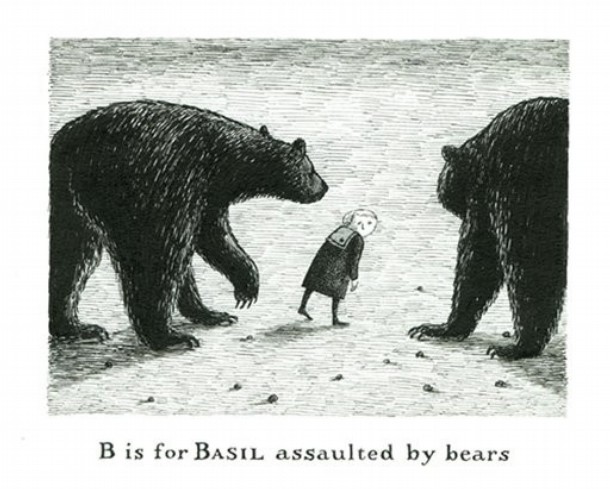
I’ve been sending out postcards of Edward Gorey drawings recently. Hard to choose favorites, but here are two that tickle me: the title of his story The Epiplectic Bicycle, and the second line in the deathly abecedarian book The Gashleycrumb Tinies:

(more…)

More notional-subject NomConjObs

August 18, 2011

Recently collected instances of NomConjObjs (nominative conjoined objects — see the brief summary of the topic, bibliography, and list of blog postings here):

(1) Seer: Don’t be naive. I told you of my vision. Of you and I doing great things together. [episode of the tv show Charmed] (link)

(2) “I think it raises, at a very bottom line, real serious questions about government interfering with the ability of you and I to talk to each other,” Policinski [Gene Policinski, executive director of the First Amendment Center] says. “How far does that go? How far will the courts permit it?” [about Twitter blocking on BART in San Francisco] (link)

Add to these:

(3) You’re getting everything that you’ve heard Norm and I talk about…  (Greg Sherwood, in KQED begathon, 5/22/06)

(4) Michele Obama: “I think it was important for Jill and I to come now because we’re at the point where the relief efforts are underway but the attention of the world starts to wane a bit. And as we enter the rainy season and the hurricane season, you know, the issues are just going to become more compounded. And I think it was important for us to come and shed a light.” (link) [e-mail from Ben Zimmer 4/14/10 under header “FLOTUS NomConjObj”)

(5) “My poor friend,” she [Sonia Sotomayor] recalled years later in a speech honoring Mr. Cabranes, “he spent all that time listening to José and I dissect the Puerto Rican colonial spirit.” [David D. Kirkpatrick, “Judge’s Mentor: Part Guide, Part Foil”, NYT 6/22/09, p. 1]

All of these involve (coordinate) objects functioning as the notional subject of a following VP — a likely context for nominative case, since the cooordinate NP “feels” subject-like to many speakers, even more likely in a coordinate object, where nominative case is now widespread. (See brief discussion in connection with (5) here.)

(more…)

Creations and control

August 18, 2011

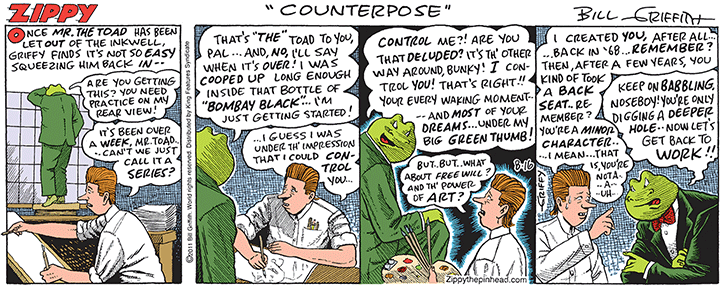
A Zippy in which The Toad (formerly Mr. Toad) takes control:

Writers regularly say that once they embark on a story, their characters “take over” and direct the flow of fictional events. Bill Griffith takes things one step further, as he becomes The Toad’s creature rather than vice versa — in the strip.

Highway whateverism

August 17, 2011

A recent Bizarro with an instance of “stand-alone whatever“, a.k.a. “free-standing whatever“, “discourse marker whatever“, and “dismissive whatever“:

This usage is relatively recent, and is stereotypically (but not entirely accurately) associated with young people — airheaded girls and slacker boys (earlier discussion on this blog in “Dudetalk in the Arctic”, with another Bizarro cartoon, here).

(more…)

Ilse Lehiste Memorial Symposium

August 16, 2011

From the Linguistics Department site at the Ohio State University, an announcement of the Ilse Lehiste Memorial Symposium: The Melody and Rhythms of Language, November 11-12. Invited speakers: Jaan Ross, Estonian Academy of Music and Theatre; Janet Fletcher, University of Melbourne; and Linda Shockey, University of Reading.

Opening remarks by Keith Johnson, UC Berkeley; closing remarks by me. Submitted abstracts are invited; see the website.

(more…)

Another transitive depend

August 13, 2011

In the last posting: depends + WH-clause. Now another transitive use of depend (discussed in this posting). This one I first noticed in a CSI: Crime Scene Investigation episode, “Ending Happy”, first aired 4/26/07:

They depended me on that ‘They depended on/upon me for that’

(more…)

depends + WH-clause

August 13, 2011

From Michael Palmer on Facebook this morning:

Terry, it depends where you work.

(where I’d usually have depends on, or maybe upon). Historically, this is transitivizing P-drop; the transitive argument structure isn’t in OED2 (1959), and at the time MWDEU (p. 329) remarked:

Many commentators point out that in speech this construction can be followed by a clause with no on or upon intervening, as in “It all depends how many times you’ve seen it” or “It all depend whether it rains.” We have no evidence of these conversational patterns in ordinary prose.

That was then, this is now, and examples of depends + WH-clause are all over the place in “ordinary prose”, in fact in educated prose, like Palmer’s above (trust me on Palmer’s erudition and writing experience).

(more…)

Anna Siewierska

August 13, 2011

From the Association for Linguistic Typology on August 11:

We received the devastating news that Anna Siewierska, ALT’s president, died in a car accident while on holiday.

She has quite a substantial webpage at the University of Lancaster, reporting that:

My major research interests are language typology, the comparison of different theoretical frameworks, diachronic change, discourse pragmatics and the morpho-syntax of English dialects. Recently I have also become interested in the [effects] of long standing wide-spread literacy on grammar.

A long list of publications on typology, Functional Grammar, and dialects, among other things — including several very substantial typological surveys in morpho-syntax, for instance, The Passive: A Comparative Linguistic Analysis (Croom Helm, 1984), Word Order Rules (Croom Helm, 1988), and Person (Cambridge, 2004). And then:

Over the last fifteen years I have developed in cooperation with Dik Bakker from the University of Amsterdam an extensive computerized database on pronominal systems, person agreement, case marking and word order. Information on person agreement and personal pronouns for well over 450 languages is now available here .

Condolences to Dik Bakker — her husband as well as collaborator — and to their family and her colleagues and (many) students at Lancaster.