Archive for August, 2011

Reversed blame

August 27, 2011

It started on the 18th with Barara Partee’s doing a double-take (in Facebook) on this headline she read in Yahoo! News:

Obama blames Congress Republicans on bus tour

She read it (as did I) as involving blame (A):

(A) blame RESULT on SOURCE

Eventually I came to see another possible argument structure for the headline (in addition to (A) and the intended reading).

(more…)

Bromantic lexicography

August 26, 2011

A little note on lexicography in the media. As each new edition of a well-known dictionary comes out, there’s a little media blitz; it’s always news that new words are welcomed to “the dictionary” (or that some are retired). So for Merriam-Webster’s Collegiate Dictionary, now covered in many places. Here’s the beginning of the Reuters story:

US Merriam-Webster dictionary adds “tweet,” “bromance”
By Molly O’Toole
Aug 25 (Reuters) – Crowdsourcing tweeters bonding in bromance and tracking cougars earned an official place in the English lexicon on Thursday when Merriam-Webster announced the addition of 150 words to its 2011 Merriam-Webster’s Collegiate Dictionary. (link)

(this following on the bromantic cartoon I posted recently).

The article is clear that dictionaries record established usages, not admit them to to some sort of inner circle of wordhood — “Gosh, bromance is a word now; it’s in the dictionary!” — but, still, the attraction of these stories lies in the perceived authority of dictionaries to govern usage. No doubt there are people out there bewailing the degradation of the English vocabulary by the inclusion of bromance, tweet, and the other newcomers in the new Webster’s Collegiate.


bottoming

August 26, 2011

Passed on by Steven Levine on Facebook a little while back, a headline from the business news:

Bottoming is a messy process (link)

The MarketWatch story, by Mark Hulbert, begins:

Bottoming is a process, not an event.

Some readers will see an entertaining ambiguity here.

(more…)

catastrophic planning

August 26, 2011

Heard on the radio this morning, in reports on the advance of Hurricane Irene: references to catastrophic planning ‘catastrophe planning, planning for catastrophes, planning for catastrophic events’ — using the adjective catastrophic rather than the noun catastrophe. Very much a non-predicating adjective (recent examples on this blog: active bottoms here, nude beach here); one hopes that the planning is not itself catastrophic.

(more…)

The martyrdom of St. Jeremy

August 26, 2011

The trials of adolescence, as depicted in Zits:

Another playful allusion to Saint Sebastian in art (examples both serious and playful here), minus the homoerotic tones.

few and far in between

August 25, 2011

… caught on the radio as I was going to sleep several days ago. Didn’t record the source, but you can google up large numbers of this expanded version of the predicative idiom few and far between — and also a respectable number of the truncated version few and far ‘few and far between/apart/away’. The expanded version looks like it originated, eggcornishly, as an attempt to make more sense of the standard idiom (by incorporating the idiom in between in it), and the truncated version looks like a nonce truncation that might be spreading on its own.

(more…)

More egotism

August 24, 2011

When you’re confronted with a variant that’s unfamiliar to you, especially if it puzzles you, you’re likely to reason that if you said it or wrote it, it would be an inadvertent error of some kind, so that when other people say or write it, it’s just a slip of the tongue or pen. This is what I’ve called grammatical egotism, and it’s entirely natural — but the reasoning is perniciously invalid. You might be looking at an inadvertent error, but you might just be looking at a variety of the language (possibly a non-standard variety) different from your own.

(Read about the phenomenon here, in a posting I’m not likely to improve on, with a follow-up here.)

(more…)

Marisol

August 24, 2011

(Not really about language, but mostly about art.)

Drifting through recollections of time past, I came up with the artist Marisol, with whom I had a distant connection when I lived in Cambridge MA. A pleasure to get reacquainted with her work after many years.

(more…)

Cartoon POP

August 24, 2011

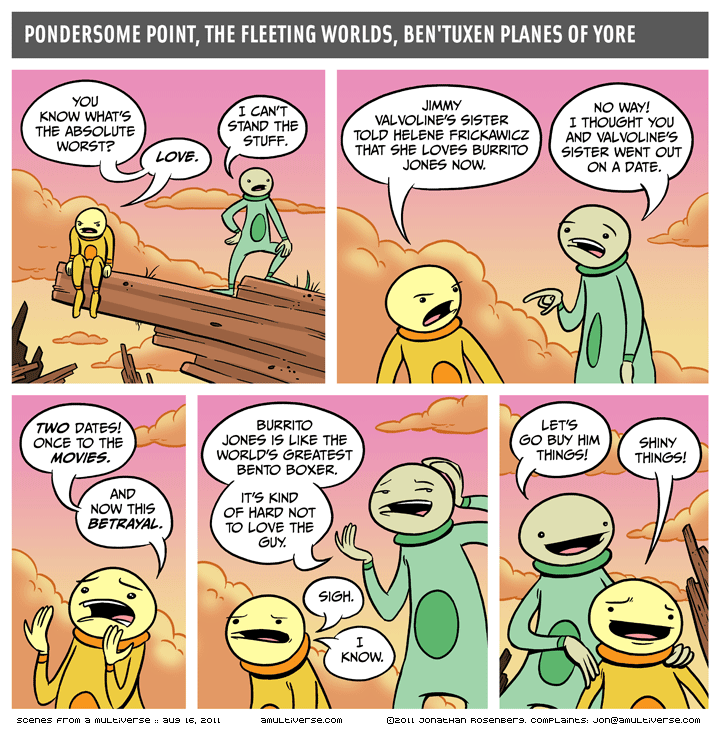
From a recent Scenes from a Multiverse:

The linguistic point is the cute POP (phrasal overlap portmanteau) bento boxer: bento box + boxer.

On bento box, from the Wikipedia page:

Bento (弁当 bentō) is a single-portion takeout or home-packed meal common in Japanese cuisine. A traditional bento consists of rice, fish or meat, and one or more pickled or cooked vegetables, usually in a box-shaped container. Containers range from disposable mass produced to hand crafted lacquerware. Although bento are readily available in many places throughout Japan, including convenience stores, bento shops (弁当屋 bentō-ya), train stations, and department stores, it is still common for Japanese homemakers to spend time and energy for their spouse, child, or themselves producing a carefully prepared lunch box.

Bento boxes are widely available as lunch specials in Japanese restaurants outside Japan (for instance, in several restaurants within a mile or two of my house in Palo Alto).

I’m still trying to imagine the sport of bento boxing.

Think of the children

August 24, 2011

It’s hard to talk about taboo vocabulary without someone explaining that children need to be protected from “adult” language, because it’s intrinsically damaging to them. So with “adult” imagery — at least (in the United States) if it’s sexual in character, but not (in the United States) if it’s violent. Ruben Bolling’s Tom the Dancing Bug on the subject:

For those of you outside the Americas, Cheez E. Chainsaw’s is a play on Chuck E. Cheese’s (Wikipedia page here). (Local note: The first Chuck E. Cheese’s was located right here in Santa Clara County, in San Jose, in 1977.)