A special type of POP (phrasal overlap portmanteau), the “name chain”, in a Bizarro:

From an earlier posting on danglerology, a promissory note:
[this example] illustrates that the acceptability of such sentences depends not merely on their internal syntactic structure, but also on their place in a larger discourse. (For a later posting: why so many people have thought otherwise.)
Consider:
(1) After writing a book, it seems that Harry is at loose ends.
(1) has no overt subject for the predicate writing a book, and such sentence adjuncts require that the referent of this subject be supplied (they are SPARs, in my terminology); a general principle, the Subject Rule, says that this referent is supplied by the subject of the main clause (the clause the adjunct modifies). But what’s the status of the Subject Rule?
[At the end of this posting, there’s a request for your opinions. But first, a buildup.]
In what is, I very much hope, an accident, when the label on my Stanford appointment was recently changed from Visiting Professor to Consulting Professor (on the grounds that the labels should be rationalized, with Visiting reserved for people from some other institution who were teaching at Stanford on some temporary basis — unlike me, with my 25 years of Visiting status), I was demoted from Professor (i.e., full professor) to Associate Professor, which I did not take well.
The departmental staff are laboring to fix this. But the event did make me think about what I would have to do to justify a full professorship.
[At the end of this posting, there will be an invitation to nominate further examples. Wait for it.]
Three portmanteau words that I came across recently that struck me as unsatisfactory: Innovatrium, womance, twunk.
Caught on tv recently, an ad for Oreo Fudge Cremes, viewable here, in which four exclamations (about the marvels of the cookies) go past very fast:
Whoa! … Get out! … Shut the front door! … Franklin Delano!
The last two are euphemized exclamations, neither of them clearly tied to specific taboo exclamations. But that didn’t stop a commenter from being outraged on behalf of the kiddies.
A Zippy with the surprising verb inexplicate (in the past tense):

We start with the adjectives perplexing and inexplicable. Perplexing is based on the verb perplex. What, then, is the verb that inexplicable is based on? Obviously, inexplicate, the meaning of which is hard to, um, explicate.
(The semantics of perplexing and inexplicable are, of course, quite different, and the in- of inexplicable is a negative prefix associated with the adjective explicable rather than with the verb explicate. But Bill Griffith understood that.)
On a postcard I got recently, a reproduction of this drawing by Saul Steinberg (used as a New Yorker cover in 1971):
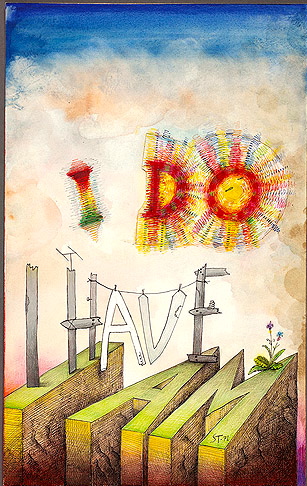
The prototypical activity verb do (with agentive subjects) and two stative verbs (with non-agentive subjects), relational have and predicating be, with their (usual) semantics represented in visual images.
I’ll say a bit more about activity and stativity. But first, some words about Saul Steinberg.
As the weekend and a spate of same-sex marriages in New York approach, a photo of a male couple, with a caption lifted from a New Yorker cartoon:

But you knew I was addicted to bad men when you married me.
