Archive for March, 2011

Losing the author’s “voice”

March 8, 2011

In the “Lives” feature of the NYT Magazine on March 6, an affecting piece by Justin Horner, “The Tire Iron and the Tamale”, about three roadside breakdowns and the people who stopped to help Horner (Mexican immigrants who didn’t speak English, every time, including the occasion he recounts in this column). In the story, Horner not only gets help with his flat tire, the daughter of the family gives him a tamale to slake his hunger, and her father refuses to accept payment for his services, telling Horner, in effect, to pass it on. (I’ve had experiences like this myself, several times.)

Then comes the information at the bottom of the page:

Justin Horner is a graphic designer living in Portland, Ore. This essay was adapted from a message-board posting on reddit.com.

Considerably adapted, as it turns out, with some alterations that are predictable for the NYT (prudishly replacing or omitting shit and fuck), others that alter the tone of the piece (eliminating dude and other vernacular expressions), and some more subtle.

(more…)

Rough Boy

March 7, 2011

In the NYT New York section today, a delightful story about public art and gender politics (“For Unloved Queens Statue, Brooklyn Cemetery May Be the Last Stop” by Jay Maeder), with some entertaining writing as a bonus.

(more…)

Punk-ass fag in the news

March 7, 2011

From Ben Zimmer, a link to this St. Louis Post-Dispatch column (“Why we printed some normally unprintable language” by Ronald Wade, posted March 6), in which the paper defends its decision to print punk-ass fag in a news story:

(more…)

Eggcorn cartoon

March 7, 2011

From Charlie Doyle on ADS-L, this F Minus cartoon (by Tony Carrillo):

Doggy-dog made it into the Eggcorn Database back in 2005, here.

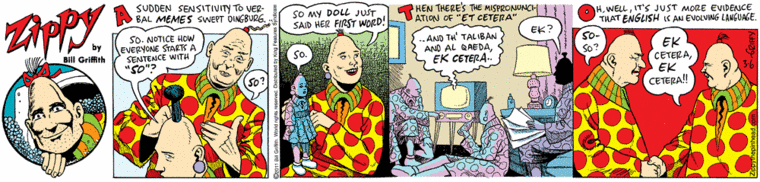
Two Dingburg memes

March 7, 2011

Well, spreading usages:

The discourse marker so in sentence-initial position has been around for a long time and seems to have been frequent for about a hundred years (discussion by Mark Liberman here).

The pronunciation ek cetera has also been around for some time. Webster’s New World Guide to Pronunciation complained about it in 1984 (and many have complained about it since then), but the pronunciation surely goes back long before then; I have recollections of hearing it from friends in the early 1960s, but unfortunately such memories are unreliable. (MWDEU in 1989 provides an explanation for it.)

Here’s a Zippy about it from 11/23/06:

Nucular comes up in Zippy cartoons every so often.


Obscenity and literary merit

March 6, 2011

Yesterday’s viewing: the 2010 movie Howl, an evocation of an era and a celebration of Allen Ginsberg, with stunning performances, notably by James Franco as Ginsberg. The film interleaves three stories: a dramatization of the 1957 U.S. trial of Lawrence Ferlinghetti (of City Lights Books) for publishing obscenity; the story of Ginsberg’s life up to that point (especially the episodes that are transformed in the poem); and an animation of the poem.

(more…)

Inflection rage

March 6, 2011

Letter in the March 2011 Instinct magazine expressing inflection rage:

WE’RE SUNK

As a retired professor of English, I must call attention to the grammatical error in the latest issue: The past tense of the verb sink is sank, not sunk (that’s the past participle, as in, “The Nazis had sunk many war vessels” [“Editor’s Letter,” Dec. 2010/Jan. 2011]. In the future, I would be happy to copy-edit any editorials, since whoever does your copy editing has obviously fallen down on the job. A concerned but very avid reader…

Ben A. in Los Angeles, CA

A snappy, jokey reply from the editors accepts the criticism, but attributes the error to the editor Mike Wood, rather than the proofreaders:

Mike’s just rambling on and on in those “Editor’s Letters” moments before we have to pry the copy from his clammy hands to deliver the magazine to the presses!

All the parties in this exchange seem to believe that there is One Right Way to form the past tense of a verb, and for SINK this way is sank.

Both beliefs are flawed, the second dramatically so, though I have a speculation about the source of the professor’s rage.

(more…)

Data points: portmanteaus 3/5/11

March 5, 2011

From Instinct magazine (young, trendy, and gay), March 2011, p. 24, review of singer Ellie Goulding’s album Lights:

Goulding packs Lights with consistently sharp melodies and lyrics. She’s a rare breed in 2011: a popstrel with actual integrity.

That’s popstrel: pop minstrel, a telescoping-type portmanteau. (It took me a little while to work that out.) Most popstrels seem to be female, but I’ve found references to Justin Bieber as a popstrel, as here:

PUBESCENT popstrel Justin Bieber caused a tweenage riot in Sydney [Australia] yesterday when police cancelled his scheduled three-song live performance on Channel Seven’s Sunrise after several fans among the 5000-strong crowd were injured. (link)

Pubescent popstrel is nicely alliterative. Tweenage is a bonus. The story also refers, half-rhymingly, to Bieber fever.


Another day to remember

March 5, 2011

We have National Grammar Day (March 4), and, more venerably, Hangul Day (October 9). And now, OK Day (March 23). From Allan Metcalf on ADS-L:

Half a century ago, Allen Walker Read proved beyond a doubt that OK was born on Saturday, March 23, 1839, on the second page of the Boston Morning Post. We all know (or should know) of his magnificent series of articles on the subject in American Speech in the 1960s, reprinted in 2002 in volume No. 86 of PADS, edited by Richard W. Bailey.

Relying on his copious material, as well as on subsequent documentation and items dredged from the Internet, I did a book on OK myself, published last fall by Oxford UP. And that gets me to this request —

Let’s celebrate the 172nd birthday of OK this year, on March 23.

How celebrate? Well, any way you want. After all, it’s OK.

If you are on Facebook, I’d appreciate it if you’d go to the page I’ve set up (link)

(where there is now a copy (very hard to read) of the Morning Post piece).

And for some discussion of the meaning/use of OK, see David Beaver’s Language Log posting here.


Two danglers

March 5, 2011

Two examples of non-canonical SPARs (commonly called “dangling modifiers”), both of which point to the importance of discourse context in understanding these expressions: one from 2007 that doesn’t work at all well, one from this week that works much better.

(more…)